
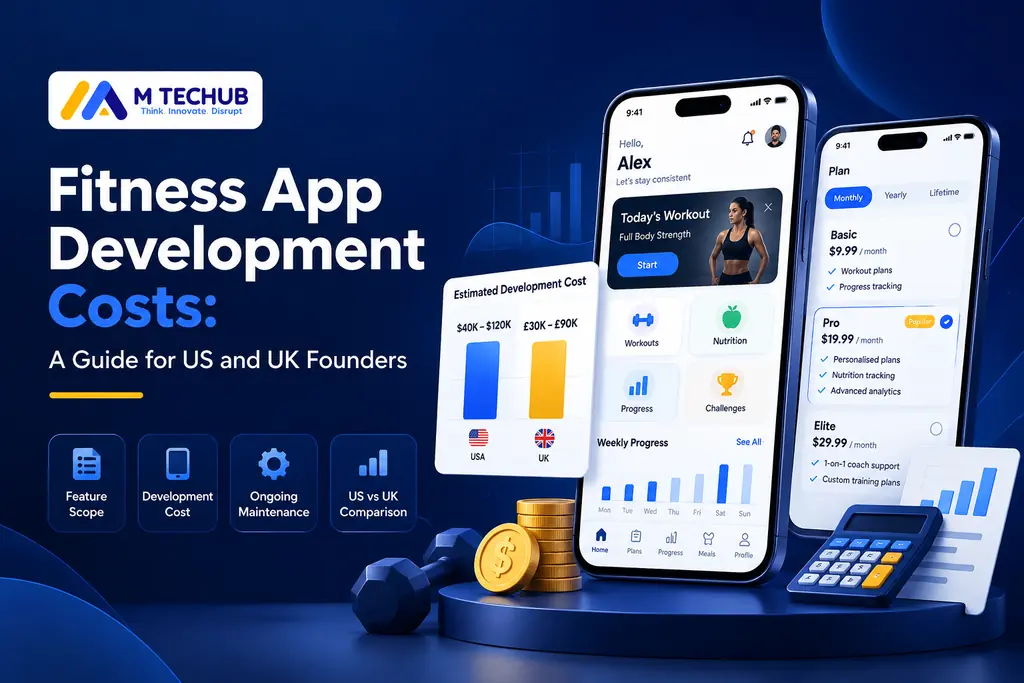
The fitness app development cost depends on what your product needs to do, how much custom engineering it requires, and who builds it.
For founders in the United States and United Kingdom, the challenge is not simply finding the lowest development quote. It is understanding what that quote includes, which expenses continue after launch, and how those costs affect the app’s long-term financial viability.
For founders building subscription-based fitness products, the development budget should also align with the monetization strategy. A B2C freemium application and a B2B fitness SaaS platform may require different features, billing systems, customer acquisition strategies, and revenue expectations.
A basic workout-planning application may need user accounts, exercise libraries, and progress tracking. A more sophisticated product might require GPS activity recording, wearable integrations, subscriptions, artificial intelligence (AI), and a backend capable of supporting thousands of users.
Each requirement changes the development scope.
For initial budgeting, founders can use these illustrative estimates.
| Fitness app type | US development budget | UK development budget |
|---|---|---|
| Basic fitness MVP | $30,000–$108,000 | £25,000–£90,000 |
| Intermediate fitness app | $54,000–$192,000 | £45,000–£160,000 |
| Advanced fitness app | $96,000–$360,000 | £80,000–£300,000 |
These are planning estimates, not verified market averages or fixed agency quotes. They use illustrative blended rates of $60–$120 per hour for US projects and £50–£100 per hour for UK projects, alongside estimated development effort.
The figures assume a contracted delivery team and exclude taxes, major marketing expenditure, and long-term operating expenses.
Understanding these estimates can help founders compare development proposals, prioritize features, and plan for sustainable growth.
How Much Does Fitness App Development Cost?
Fitness app development costs are primarily influenced by three factors: project complexity, development hours, and the selected team’s pricing.
A straightforward way to estimate the initial budget is:
Estimated development cost = Total project hours × Blended hourly rate
A blended hourly rate combines the costs of relevant team members, which may include developers, UI/UX designers, testers, technical leads, and project managers.
For example, consider a startup building a workout-tracking MVP with:
- User registration and authentication
- Workout plans and exercise libraries
- Workout logging and progress history
- Basic reminders and notifications
- A simple administration dashboard
- iOS and Android support
If the project requires 800 hours, the estimated development costs would be:
| Budget component | US example | UK example |
|---|---|---|
| Estimated effort | 800 hours | 800 hours |
| Assumed blended rate | $90/hour | £75/hour |
| Estimated development cost | $72,000 | £60,000 |
These calculations are illustrative rather than actual supplier quotations.
Founders should request a detailed specification showing the included features, engineering responsibilities, testing scope, and excluded expenses before committing to development.
Cost to Build a Fitness App in the US vs the UK
The cost to build a fitness app in the US and the cost to make a fitness app in the UK cannot be compared accurately using location alone.
Both markets include freelancers, specialist mobile development agencies, large technology consultancies, and companies operating distributed engineering teams.
Development rates vary with technical expertise, staffing arrangements, project complexity, and the services included in a proposal.
Clutch’s dedicated health and wellness app development listings provide useful provider-level information, including advertised hourly rates, minimum project sizes, specializations, and locations.
Relevant directories include US Health and Wellness App Developers and UK Health and Wellness App Developers. These listings demonstrate provider pricing variation but do not establish a single average fitness app development cost.
Fitness App Development Costs in the US
US development costs depend on the selected team’s experience, location, technical specialization, and delivery model.
A specialist US agency providing discovery, product design, development, testing, and ongoing support may quote differently from a team focused primarily on implementation.
Founders should confirm whether their development proposal includes:
- Product discovery and technical planning
- iOS and Android development
- Backend infrastructure and database design
- Third-party integrations
- Security and quality assurance testing
- App deployment and initial support
A lower development quotation does not necessarily mean lower total project costs if essential services must be purchased separately.
Fitness App Development Costs in the UK
UK businesses face similar technical requirements, but should evaluate development quotations in GBP, with applicable VAT stated separately.
For example, a UK gym-management application may prioritize member bookings, scheduling, recurring payments, and administrative reporting.
A consumer fitness startup may instead require subscriptions, workout engagement features, progress tracking, and wearable integration.
These differences in functionality have a greater impact on the development scope than geographic location alone.
When comparing US and UK proposals, founders should use identical feature specifications, delivery requirements, and testing expectations.
Fitness App Development Cost Breakdown
A fitness app development cost breakdown helps founders understand how their initial investment is distributed across product planning, design, engineering, integrations, and testing.
The following example uses an 800-hour MVP project with an assumed US blended rate of $90 per hour and a UK blended rate of £75 per hour.
| Development stage | Hours | US cost | UK cost |
|---|---|---|---|
| Discovery and planning | 80 | $7,200 | £6,000 |
| UI/UX design | 100 | $9,000 | £7,500 |
| Mobile frontend development | 230 | $20,700 | £17,250 |
| Backend development | 170 | $15,300 | £12,750 |
| APIs and integrations | 80 | $7,200 | £6,000 |
| Testing and deployment | 140 | $12,600 | £10,500 |
| Total | 800 | $72,000 | £60,000 |
This is an illustrative workstream allocation, not a measured industry average. Project coordination is assumed to be distributed across the workstreams.
UI/UX Design
UI/UX design determines how users interact with workout plans, monitor progress, manage subscriptions, and navigate fitness information.
Design costs increase when applications require sophisticated activity dashboards, detailed exercise visualizations, custom onboarding journeys, or extensive accessibility testing.
Early wireframes and interactive prototypes can help identify usability problems before full development begins.
Frontend and Backend Development
Frontend development creates the mobile interface users interact with.
Backend development handles authentication, user information, data storage, business logic, subscriptions, and third-party connections.
A basic workout planner requires less infrastructure than an application processing GPS activity, multiple wearable integrations, personalized recommendations, and social interactions.
Cross-platform frameworks such as React Native and Flutter may reduce duplicated engineering work for iOS and Android applications.
However, platform-specific integrations, device compatibility testing, and ongoing maintenance remain necessary.
APIs and Third-Party Integrations
Application programming interfaces (APIs) allow fitness applications to exchange information with external services.
Common integrations include:
- Apple HealthKit and Android Health Connect
- GPS tracking and mapping services
- Payment and subscription platforms
- Push notifications
- Nutrition databases
- AI model services
Integration costs involve more than connecting an API. Teams must account for permissions, synchronization, error handling, data consistency, and future updates.
For example, Google Maps Platform uses service-specific pricing, meaning route tracking or location-based functionality can create additional usage expenses.
Founders should review the Google Maps Platform pricing documentation when estimating location-service costs.
Testing and Deployment
Testing should cover application functionality, security, usability, performance, and compatibility across supported devices.
Fitness apps require particular attention to interrupted workout sessions, duplicate activity records, sensor inaccuracies, and synchronization failures.
Deployment also includes production configuration, app store submissions, release testing, and monitoring setup.
Reducing essential testing to lower the initial quotation may increase the risk of expensive post-launch fixes.
How App Complexity Affects Development Costs
The complexity of a fitness application depends on more than its number of screens.
Data processing, background activity tracking, personalized recommendations, and integration requirements can significantly increase development effort.
Basic Fitness MVP
A minimum viable product (MVP) is a usable version of an application containing the core features necessary to validate a specific product idea.
Typical features include:
- User registration
- Workout libraries
- Exercise instructions
- Basic activity tracking
- Progress summaries
- Simple notifications
An illustrative development effort of 500–900 hours produces a budget of approximately $30,000–$108,000 in the US or £25,000–£90,000 in the UK under the stated rate assumptions.
Intermediate Workout or Fitness Tracking App
An intermediate application may introduce GPS recording, richer progress analytics, subscriptions, workout scheduling, and wearable integration.
These features increase development time because they require additional data processing, third-party connections, billing logic, and testing.
An illustrative development effort of 900–1,600 hours produces budget estimates of $54,000–$192,000 in the US or £45,000–£160,000 in the UK.
Advanced AI-Powered Fitness App
An advanced fitness application might combine AI-powered coaching, extensive wearable support, adaptive workout planning, personalized nutrition recommendations, and community functionality.
These features require more sophisticated engineering, testing, data governance, and ongoing monitoring.
An illustrative development effort of 1,600–3,000 hours produces estimates of $96,000–$360,000 in the US or £80,000–£300,000 in the UK.
These ranges are not fixed thresholds. A smaller application with technically demanding integrations may cost more than a larger app with relatively straightforward functionality.
How Much Does It Cost to Build a Fitness App Like Strava?
A Strava-like fitness application combines multiple engineering requirements, particularly GPS activity recording and location-based data processing.
Typical functionality includes:
- GPS workout recording
- Route maps and activity history
- Distance, pace, and elevation calculations
- User profiles
- Social activity feeds
- Achievements and challenges
- Location privacy controls
A focused GPS tracking MVP may fit within an intermediate development budget if extensive social and discovery functionality is excluded.
A more comprehensive Strava-like product could require 2,000–4,000 development hours or more, depending on technical architecture and project scope.
Using the illustrative blended rates introduced earlier, this produces approximate budgets of $120,000–$480,000+ in the US or £100,000–£400,000+ in the UK.
These figures are scenario calculations, not Strava’s actual development expenditure.
Building a basic route recorder is very different from reproducing the features, reliability, and operational scale of an established fitness platform.
Founders should determine whether activity tracking, training analytics, or social engagement is the product’s main differentiator before committing to extensive development.
How Much Does It Cost to Build an AI Fitness App?
AI fitness app development costs depend on the type of personalization and intelligence required.
A rules-based application that recommends workouts using predefined conditions is generally less complex than a product that trains machine-learning models using extensive activity histories.
| AI approach | Development requirement | Ongoing cost consideration |
|---|---|---|
| Rules-based personalization | Recommendation logic and user profiles | Maintaining rules |
| Third-party AI API | Model integration, evaluation, safeguards | API usage and monitoring |
| Custom machine-learning model | Data engineering, model training, validation | Model infrastructure and updates |
AI-Powered Workout Recommendations
A rules-based recommendation system can adapt suggested workouts using information such as user goals, available equipment, and training experience.
This approach does not necessarily require advanced machine learning.
It may be suitable for an MVP when personalized workout suggestions are needed without the complexity of a custom model.
AI Coaching and Third-Party Models
A fitness application can use an existing AI model to provide conversational assistance, workout explanations, or structured training suggestions.
Although such functionality may be relatively quick to prototype, production deployment requires input validation, output evaluation, error handling, and safeguards.
Usage-based API charges should also be included in ongoing operating budgets.
Custom Machine-Learning Features
Custom machine-learning functionality may require data collection, model training, validation, deployment infrastructure, and ongoing performance monitoring.
Founders should establish whether the resulting personalization offers meaningful value beyond simpler alternatives.
AI-generated workout advice should not be presented as medically validated guidance without appropriate evidence and review.
Fitness App Development Costs for Startups
For fitness startups, the best budget is not necessarily the one supporting the largest initial feature set.
It is the budget that helps validate a business idea while leaving enough capital to improve the product after launch.
An early-stage fitness startup should divide its budget into three categories:
- Product development: Research, design, engineering, testing, and launch.
- Operating expenses: Hosting, API usage, monitoring, technical support, and maintenance.
- Customer acquisition: Marketing, onboarding, content, partnerships, and retention activities.
For a subscription-based fitness application, these expenses should be evaluated alongside the expected revenue model.
How Monetization Affects a Fitness Startup’s Budget
A B2C fitness application may use a freemium model, paid subscriptions, or premium coaching features.
A B2B fitness SaaS platform might charge gyms, personal trainers, or fitness businesses monthly or annual subscription fees.
Each business model creates different technical requirements and operating expenses.
Founders should consider three important financial metrics:
- Customer Acquisition Cost (CAC): The average cost of acquiring a new paying customer.
- Customer Lifetime Value (LTV): The estimated economic value generated by a customer throughout their relationship with the business.
- Churn Rate: The proportion of customers who cancel or stop renewing subscriptions over a defined period.
Consider a fitness app charging $15 per month.
The subscription price alone does not establish profitability. Platform fees, hosting, support, customer acquisition costs, and churn all affect the amount a business retains.
Founders should estimate customer lifetime value using contribution margin rather than assuming every dollar of subscription revenue is available to recover development expenses.
Start With a Focused Fitness MVP
A personal training startup could initially launch with trainer-created workout plans, session tracking, and progress summaries.
Automated coaching, advanced analytics, and extensive wearable support could follow once user demand is demonstrated.
Founders should also consider retaining a contingency allowance.
A 10–20% planning reserve is one possible budgeting assumption, not an industry rule.
For a $72,000 development estimate, a 15% contingency would add $10,800, giving a provisional development allocation of $82,800 before ongoing operating and marketing expenses.
How Much Does Fitness App Maintenance Cost Per Year?
Fitness app maintenance is an ongoing expense that founders should include in their financial planning before development begins.
Maintenance typically covers operating system compatibility, security updates, bug fixes, performance monitoring, and third-party integration changes.
For preliminary budgeting, founders can consider an annual maintenance allowance of 15–25% of the original development budget.
This is an illustrative planning assumption, not a verified industry average. Major enhancements, infrastructure consumption, and extensive customer support may require separate funding.
| Original development cost | Estimated annual maintenance |
|---|---|
| $50,000 US project | $7,500–$12,500 |
| $100,000 US project | $15,000–$25,000 |
| £50,000 UK project | £7,500–£12,500 |
| £100,000 UK project | £15,000–£25,000 |
What Increases Fitness App Maintenance Costs?
Maintenance requirements vary depending on how the app operates.
A basic workout planner may require occasional security updates, bug fixes, and device compatibility improvements.
A more advanced platform may need continuous monitoring of wearable integrations, AI services, GPS functionality, subscription billing, and backend infrastructure.
As an application gains users, it may also require database optimization, additional server capacity, and more comprehensive technical support.
Founders should request an annual maintenance proposal explaining which services are included and how additional work will be charged.
Hidden Costs Fitness App Founders Should Consider
Initial development quotations do not always include the full cost of launching and operating a fitness application.
Some expenses depend on app distribution, subscription billing, third-party services, content production, and data protection responsibilities.
App Store and Google Play Fees
Publishing a fitness application on major app stores involves registration and potentially transaction-related expenses.
Apple lists its Developer Program membership at $99 annually, while Google Play lists a $25 one-time developer registration fee. These are separate from commissions on eligible purchases.
Apple Developer
+1
For subscription-based applications, platform fees can influence the amount of revenue retained from each paying customer.
Apple App Store
Under Apple’s standard auto-renewable subscription terms, developers generally receive 70% of the subscription price during a subscriber’s first year of paid service, after applicable taxes.
After a subscriber accumulates one year of paid service, developer proceeds generally increase to 85%.
Eligible developers enrolled in the App Store Small Business Program receive 85% from the beginning, subject to the program’s qualification requirements.
Google Play
Google Play introduced an updated fee structure for the US and UK on June 30, 2026.
For applicable auto-renewing subscription transactions, Google lists a 10% service fee, with an additional 5% billing fee when Google Play Billing applies.
Other transactions, alternative billing arrangements, and different markets may have distinct requirements.
How App Store Fees Affect Fitness SaaS Revenue
Consider an illustrative fitness subscription priced at $15 per month before taxes.
| Subscription arrangement | Illustrative platform fee | Remaining revenue |
|---|---|---|
| Apple standard first-year subscription | 30% | $10.50 |
| Apple eligible Small Business Program | 15% | $12.75 |
| Google Play US/UK, applicable subscription with Play Billing | 10% + 5% | $12.75 |
These simplified calculations exclude taxes, refunds, infrastructure expenses, and other business costs. Actual payment arrangements and platform terms must be evaluated individually.
For a fitness SaaS business, the revenue remaining after platform fees is not necessarily profit.
Hosting, customer support, software maintenance, content production, and customer acquisition must also be considered when setting subscription prices.
Content Production and Fitness Expertise
Exercise instructions, workout demonstrations, training plans, and nutrition content may require additional investment.
Applications featuring hundreds of exercises can involve considerable filming, editing, content management, and professional review.
Founders should determine who will create, own, update, and maintain this content.
Wearable Integration and Data Accuracy
Wearable integration involves more than retrieving step counts or heart-rate measurements.
Developers must account for user permissions, missing information, delayed synchronization, duplicate activity records, and device disconnections.
Platform-specific requirements also influence development effort.
For example, Android Health Connect requires applications to request appropriate permissions before accessing relevant health and fitness information.
Its technical requirements are documented in the Android Health Connect development guide.
Privacy, Security, and Regulatory Requirements
Fitness applications may process personal information, location histories, and health-related measurements.
In the UK, information revealing a person’s health status can qualify as special category data under the UK GDPR. Such processing requires an appropriate lawful basis and a relevant special-category processing condition.
ICO
+1
In the United States, HIPAA does not automatically apply to every consumer fitness app. Applicability depends on the business, its relationships, and the information it handles.
Other privacy and consumer protection requirements may still apply, including the Federal Trade Commission’s Health Breach Notification Rule for covered businesses.
Federal Trade Commission
These obligations may affect consent management, data storage, access controls, security testing, and incident response planning.
Founders should assess applicable privacy and security requirements early in development and obtain qualified legal advice when necessary.
How to Reduce Fitness App Development Costs Without Sacrificing Quality
Reducing development costs works best when unnecessary complexity is removed without eliminating essential testing, security, or product functionality.
Prioritize Essential MVP Features
Identify the primary action that demonstrates the application’s value to its intended users.
For a workout tracker, this could be completing a session and reviewing progress.
For a gym-management application, it might be assigning training programs and monitoring client participation.
Additional features can be scheduled for later releases.
Consider Cross-Platform Development
Frameworks such as React Native and Flutter allow teams to share substantial portions of their codebase across iOS and Android.
This may reduce duplicated work when both platforms require similar functionality.
However, developers must still evaluate native integrations, device compatibility, performance, and maintenance requirements.
Use Existing Third-Party Services
Authentication, notifications, payments, analytics, and cloud hosting can often be implemented using established services.
This may reduce the amount of custom software required.
Founders should still evaluate recurring charges, usage limits, security responsibilities, and vendor dependencies.
Validate Expensive Features Before Development
Advanced AI coaching, comprehensive nutrition databases, and extensive wearable integrations can create significant engineering requirements.
Founders can use prototypes, user interviews, or limited pilot releases to determine whether these features provide meaningful value.
Testing assumptions before development reduces the risk of investing heavily in functionality users do not need.
Compare Development Proposals Carefully
Provide potential development partners with the same written feature specification.
Ask each provider to explain deliverables, assumptions, testing responsibilities, code ownership, deployment support, and maintenance terms.
The most useful proposal is not necessarily the cheapest. It is one that delivers the required functionality with transparent costs and manageable technical risk.
Conclusion
Fitness app development costs vary because fitness products serve different audiences and require different levels of engineering.
For founders in the US and UK, a realistic budget should account for product discovery, mobile development, backend infrastructure, integrations, quality assurance, deployment, and ongoing maintenance.
Subscription-based businesses must also consider the relationship between development expenditure, monetization strategy, customer acquisition costs, and long-term retention.
A focused MVP supported by transparent delivery assumptions allows founders to validate their product before committing to advanced functionality.
The goal is not simply to build a fitness application at the lowest possible cost. It is to invest in a product that solves a meaningful user problem and has a financially sustainable path forward.