
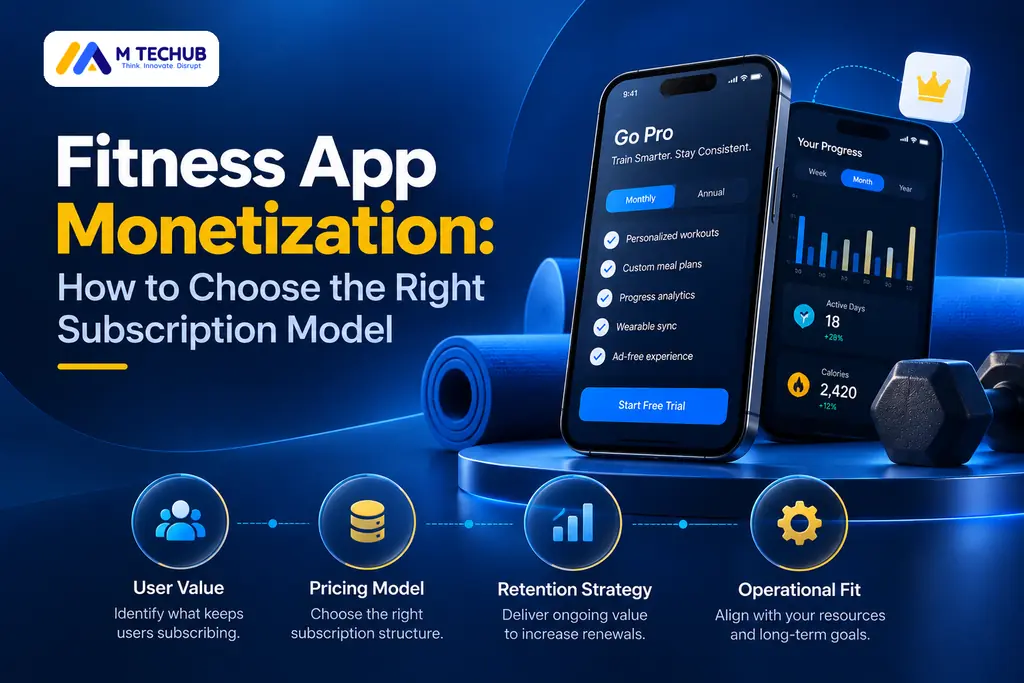
Learning how to monetize a fitness app starts with three decisions: who pays, what they receive, and why they would pay again.
Fitness apps can generate revenue through subscriptions, with coaching, one-time purchases, and B2B licensing added where they fit the product.
Subscriptions can fund ongoing training programs. One-time purchases can suit a fixed workout plan. Coaching fees pay for a trainer’s time, while B2B licensing lets gyms and studios pay for software their members use.
The right model connects customer value with delivery costs. More subscribers do not automatically mean a healthier business if coaching, infrastructure, and acquisition expenses consume the revenue.
This guide explains how to compare monetization models, establish a pricing floor, calculate recurring revenue, and measure whether customers stay long enough to support sustainable growth.
Fitness App Monetization Models Compared
A subscription is a recurring payment arrangement. Freemium provides an ongoing free version alongside paid capabilities. A free trial offers temporary access to a paid product.
These approaches can work together. A freemium fitness app might sell monthly subscriptions and offer a trial of its premium plan.
The table below compares the main fitness app subscription models and related revenue options side by side.
| Model | Revenue source | Suitable app types | Main advantage | Main limitation | Key metrics |
|---|---|---|---|---|---|
| Monthly or annual subscriptions | Recurring payments | Progressive training, workout libraries, tracking tools | Funds ongoing delivery | Requires continuing value | MRR, renewals, churn |
| Freemium with paid upgrades | Free users purchase premium access | Workout planners, trackers, habit apps | Demonstrates value before payment | Free users create operating costs | Free-to-paid conversion, cost per active user |
| Paid download | Payment before installation | Focused, standalone fitness tools | Simple purchase proposition | Support continues after the initial payment | Purchase conversion, refunds |
| One-time in-app purchases | Program, feature, or content purchases | Fixed challenges and specialist programs | Matches a defined deliverable | Revenue depends on further purchases | Purchase rate, contribution per sale |
| Coaching subscriptions | Recurring fees for human support | Trainer-led programs | Provides personal guidance | Trainer capacity limits delivery | Contribution per client, retention |
| B2B licensing | Gyms, studios, or trainers pay for software | Branded apps and business platforms | Revenue comes from business accounts | Sales and onboarding require resources | Revenue per account, account churn |
| Marketplace commissions | A share of eligible transactions | Platforms connecting trainers and clients | Revenue grows with completed transactions | Requires sufficient buyer and provider activity | Transaction value, take rate, repeat bookings |
| Employer contracts | Organizations pay for employee access | Corporate fitness programs | One contract can cover multiple users | Procurement and reporting can be demanding | Contract renewals, utilization, account contribution |
A hybrid model combines selected approaches. For example, a self-guided subscription might include an optional coaching add-on. Each offering needs clear pricing, access rules, and service limits.
Advertising and Affiliate Revenue
Advertising and affiliate partnerships can supplement revenue, but assess their effect on workout completion and customer trust.
Disclose commercial relationships clearly. The FTC’s endorsement guidance addresses affiliate disclosures in the US, while ASA guidance explains the need to identify advertising in the UK.
Choose partners whose products suit the audience. Commercial incentives should not determine unsuitable workout, equipment, or nutrition recommendations.
B2C Subscriptions vs B2B Licensing
With B2C subscriptions, individual users purchase workouts, tracking, or coaching.
With B2B licensing, a gym might pay for member onboarding, bookings, trainer workflows, and branded access. Members may receive the app through their existing membership.
A branded B2B2C arrangement connects both: the software provider sells to a fitness business, which delivers the experience to its customers.
Identify the buyer before building checkout. Charging trainers for software and charging their clients for coaching involve different purchasing decisions and support obligations.
Freemium vs Subscription: Which Model Fits Your Fitness App?
Freemium and subscription describe different things. Freemium describes access; subscription describes billing. A freemium app can earn revenue through paid subscription tiers.
The practical choice is whether users receive ongoing free access or need to pay after a preview or trial.
Freemium can suit an app whose basic experience is inexpensive to deliver and whose premium features solve a meaningful additional problem.
For example:
- Free: Record workouts and review recent activity.
- Premium subscription: Follow progressive programs and access deeper analysis.
- Coaching add-on: Receive scheduled trainer feedback.
Paid access after a trial may suit a complete guided program, provided users have a realistic opportunity to understand its value.
Before choosing, ask:
- Can users evaluate the benefit before paying?
- Can the business afford ongoing free usage?
- Does premium access improve a customer outcome?
- Can onboarding demonstrate that improvement?
Freemium becomes difficult when video, AI, storage, or support expenses grow without enough upgrades. A paywall becomes difficult when customers cannot understand what they are buying.
How to Price a Fitness App Subscription
A useful fitness app development pricing strategy combines customer research, delivery economics, and evidence from actual purchases.
Define the Customer and Paid Outcome
“People interested in fitness” is too broad.
A beginner seeking three manageable workouts each week has different needs from a trainer managing 60 clients.
Describe the paid outcome in one sentence:
A progressive strength program that adapts to completed sessions and available equipment.
Then identify the alternatives customers already use, what those alternatives cost, and where they fall short.
Separate Delivery, Fixed, and Acquisition Costs
Organize expenses before setting prices.
| Cost category | Examples |
|---|---|
| Variable delivery costs | Video usage, AI requests, usage-linked infrastructure, client-specific coaching |
| Transaction costs | Applicable store commissions and payment processing |
| Fixed operating costs | Salaried staff, baseline infrastructure, maintenance, planned content production |
| Acquisition costs | Advertising, sales activity, attributable marketing expenses |
| Revenue adjustments | Discounts, refunds, credits |
Build costs are separate from running costs; see our guide to fitness app development cost for the upfront side.
Some expenses span categories. Support staffing, for example, may remain fixed until customer numbers require another hire.
This distinction prevents an apparently profitable subscription from hiding substantial acquisition or staffing costs.
Calculate a Delivery-Cost Floor
Suppose variable delivery costs are $4 per subscriber per month, and percentage-based deductions are assumed to be 15%.
The price needed to cover those items is:
$4 ÷ (1 − 0.15) = $4.71
To generate $8 in contribution per subscriber:
($4 + $8) ÷ 0.85 = $14.12
These figures are illustrative. They exclude fixed costs, acquisition, refunds, taxes, and any separate fixed transaction charge.
Platform fees change the floor. Using Apple’s standard first-year subscription commission of 30%, the same $4 delivery cost requires:
$4 ÷ 0.70 = $5.71
That compares with $4.71 at a 15% deduction, assuming the same simplified, tax-exclusive calculation. Apple’s Small Business Program and other applicable arrangements can change the rate.
This floor identifies prices that would fail to cover the modeled costs. Customer research and purchase tests help establish what customers will pay.
Research Alternatives and Test a Clear Offer
Compare products serving the same customer and outcome. Record the purchase channel, billing interval, included services, and introductory conditions.
Start with a small number of distinct offers, such as self-guided access and coaching-supported access.
For a practical price test:
- Choose one audience and one clearly defined package.
- Set two candidate prices above the modeled floor.
- Keep the product and acquisition message consistent.
- Use an appropriate controlled test where supported.
- Compare conversion, refunds, contribution, and subsequent renewals.
Avoid drawing conclusions from a handful of purchases. If tests run sequentially, account for changes in traffic sources and seasonality.
Price Separately for US and UK Customers
Test local willingness to pay rather than relying only on currency conversion.
For example, 200 subscribers paying £12 monthly produce £2,400 in monthly subscription billings, before separating any included taxes and other adjustments.
UK consumer pricing must account for applicable mandatory charges and taxes. The CMA’s price transparency guidance explains how unavoidable charges should appear in the total price. US tax treatment varies by jurisdiction and transaction.
Best Subscription Pricing for Personal Trainer and Gym Apps
There is no universal best subscription price for personal trainer apps. Establish whether you are selling software, human coaching, or both.
Planning fitness app development for gyms and personal trainers starts with identifying the paying customer, the member experience, and the service responsibilities behind each plan.
| Customer | Possible charging structure | What should drive the decision |
|---|---|---|
| Independent trainer | Flat subscription or active-client allowance | Administrative time saved and client capacity |
| Online coaching business | Client subscription with defined support | Trainer time required per client |
| Gym or studio | Per-location or member-band license | Member workflows, onboarding, integrations |
| Multi-trainer business | Base fee plus seats or client capacity | Staff permissions, reporting, administration |
| Branded app customer | Setup fee plus recurring service fee | Branding, maintenance, hosting, support scope |
Keep setup revenue separate from recurring licensing revenue.
For coaching, define response times, check-in frequency, and contact limits. Unlimited messaging can create an open-ended service obligation.
For business software, explain what happens when the customer adds trainers, clients, or locations.
App Store Billing Rules and Subscription Fees
Classify the purchase before selecting a payment flow. Recorded workouts, live personal training, and physical gym access can receive different treatment.
Apple: Digital Content, Coaching, and Physical Services
The Apple App Review Guidelines distinguish:
- Section 3.1.1: In-app digital features and content.
- Section 3.1.3(d): Real-time services between two individuals, including fitness training.
- Section 3.1.3(e): Physical goods or services consumed outside the app.
Apple permits other payment methods for qualifying person-to-person services. Its guidance treats one-to-few and one-to-many live services differently. Storefront-specific provisions also affect external purchase links, including in the US.
Under Apple’s standard subscription terms, developers receive 70% during a subscriber’s first year and 85% after one year of paid service, minus applicable taxes. These correspond to commissions of 30% and 15%.
Eligible developers enrolled in the App Store Small Business Program receive the reduced 15% commission rate from the beginning. These terms should be distinguished from alternative regional arrangements.
Google Play: Service Fees and Billing Fees
Google distinguishes digital purchases from physical services such as gym memberships.
Its payments guidance also provides a qualifying exception for paid online services between two individuals when the session is not recorded or available for replay in a Play-distributed app. Personal trainer sessions are among its examples.
For US and UK transactions, Google’s current service fee schedule lists 10% for auto-renewing subscriptions, plus a 5% billing fee when Google Play Billing is used. The subscription column covers both new and existing installs under the listed regional schedule.
Alternative arrangements have their own conditions and may involve separate processing expenses. External checkout does not automatically eliminate platform charges.
Model each payment channel using the terms applicable to your product, region, and developer account.
How to Calculate App Recurring Revenue
Monthly recurring revenue, or MRR, expresses recurring subscription value on a monthly basis.
Define your reporting rules consistently. For example, Stripe’s subscription analytics documentation includes active and past-due subscriptions in MRR, excludes taxes, and provides configuration options for discount treatment. MRR therefore differs from successfully collected cash.
Consider these illustrative subscriptions:
| Subscription group | Calculation | MRR |
|---|---|---|
| Monthly plans | 500 × $15 | $7,500 |
| Annual plans | 100 × $120 ÷ 12 | $1,000 |
| Combined | $7,500 + $1,000 | $8,500 |
Assume no discounts or taxes and that all subscriptions qualify under the reporting definition.
If the 100 annual subscribers pay upfront together, they generate $12,000 in cash receipts. Their normalized MRR contribution remains $1,000.
Annualized recurring revenue = $8,500 × 12 = $102,000
That is a snapshot of recurring value, not guaranteed future revenue or recognized accounting revenue.
Calculate Contribution After Delivery Costs
Suppose the $15 monthly plan has:
- $4 in variable delivery costs.
- An illustrative 15% deduction, equal to $2.25.
Then:
$15 − $4 − $2.25 = $8.75 contribution per subscriber
For 500 subscribers:
500 × $8.75 = $4,375 monthly contribution
The 15% is a modeling assumption, not a universal fee quote. This contribution still needs to cover fixed costs and acquisition. Refunds and other adjustments can reduce it.
If acquiring a customer costs an illustrative $35:
CAC payback = $35 ÷ $8.75 = 4 months
That assumes the customer remains subscribed at the same price and contribution level. A customer who leaves earlier may not repay their acquisition cost.
Fitness App Monetization Strategies for 2026
Help Users Experience Value Early
Use onboarding information to improve the first session: available equipment, schedule, experience, and preferences.
Measure completion of a suitable workout, not simply completion of a questionnaire.
Make Trials Useful and Transparent
Design the trial around the experience customers need to evaluate. State the trial duration, subsequent charge, billing interval, and cancellation process clearly.
Track trial cohorts through renewal. Higher initial conversion accompanied by more refunds or early cancellations may weaken the business.
Explain Annual Savings Accurately
For an illustrative plan priced at $15 monthly or $120 annually:
Twelve monthly payments = $180
Annual saving = ($180 − $120) ÷ $180 × 100 = 33.3%
Display the $120 annual charge alongside the $10 monthly equivalent.
Annual payment improves upfront cash collection, but does not prove long-term engagement or eventual renewal.
Match Retention Work to Cancellation Reasons
Separate technical problems, unsuitable plans, low usage, price concerns, and changing circumstances.
Improve the underlying experience before relying on win-back discounts. Measure whether returning subscribers remain after the promotion ends.
Protect Billing Transparency and Health Data
US Subscription Disclosures and Cancellation
For covered online negative-option transactions, ROSCA requires clear disclosure of material terms, express informed consent before charging, and a simple mechanism to stop recurring charges. State requirements may add further obligations, as explained in the FTC’s guidance on negative-option sales.
Build clear consent and subscription management into checkout and account settings. Do not rely on terms and conditions alone to communicate recurring charges.
UK Subscription Rules and Upcoming Changes
Existing UK distance-selling guidance covers relevant pre-contract information and cancellation requirements. The treatment of digital content and services depends on the offer and purchase flow.
As of October 20, 2026, the government’s newly published subscription contracts guidance includes a draft document stating that the new subscription regime is not yet in force and that the draft regulations require parliamentary approval.
The draft addresses clearer pre-contract information, reminder notices, easier exit arrangements, and cooling-off rights. Prepare the product for these requirements while checking the final regulations and commencement provisions before implementation
Health Data and Advertising
Monetization planning should include the data sent to advertising, affiliate, and analytics partners.
Under UK Fitness App HIPAA Compliance and GDPR processing special category health data requires an Article 6 lawful basis and an applicable Article 9 condition. The ICO’s special category data guidance explains these requirements. Consent is not blanket permission for every subsequent use.
In the US, being outside HIPAA and gdpr does not remove all health-data obligations. The FTC’s Health Breach Notification Rule guidance explains how the rule can apply to qualifying health apps and related businesses.
Review sensitive data flows and applicable platform restrictions before enabling advertising or attribution tools.
Metrics to Track After Launch
| Metric | Definition |
|---|---|
| Free-to-paid conversion | Eligible free users who pay within a stated window ÷ eligible users in that cohort |
| Trial-to-paid conversion | Trial starters who become paying customers within a stated window ÷ trial starters in that cohort |
| Subscriber churn | Subscribers active at the start of a period who churn during it ÷ starting subscribers |
| Renewal rate | Successful renewals ÷ subscriptions due to renew during the period |
| Average recurring revenue per subscriber | Period-end MRR ÷ subscribers included in that MRR |
| Customer acquisition cost | Attributable acquisition spending ÷ new paying customers acquired |
| Customer lifetime value | Estimated contribution over the customer relationship, using explicit retention and cost assumptions |
| Refund rate | Refunded transactions ÷ eligible paid transactions in a defined period or cohort |
| Failed-payment rate | Failed payment attempts ÷ total payment attempts during the period |
Segment results by plan, purchase channel, market, and customer cohort. Separate voluntary cancellation from payment failure.
For a young app, observed cohort contribution can be more informative than a lifetime-value forecast based on limited retention history.
Common Monetization Mistakes
- Too many tiers: Give each package a distinct customer purpose.
- Weak paid value: Charge for outcomes customers recognize and use.
- Uncontrolled coaching costs: Define service limits before selling access.
- Downloads treated as success: Connect acquisition to payment and renewal.
- Permanent discount dependence: Compare contribution after promotional pricing ends.
- Confusing cancellation: Make subscription management accessible.
- Mixed revenue reporting: Separate setup fees, subscriptions, transactions, and cash receipts.
References: