
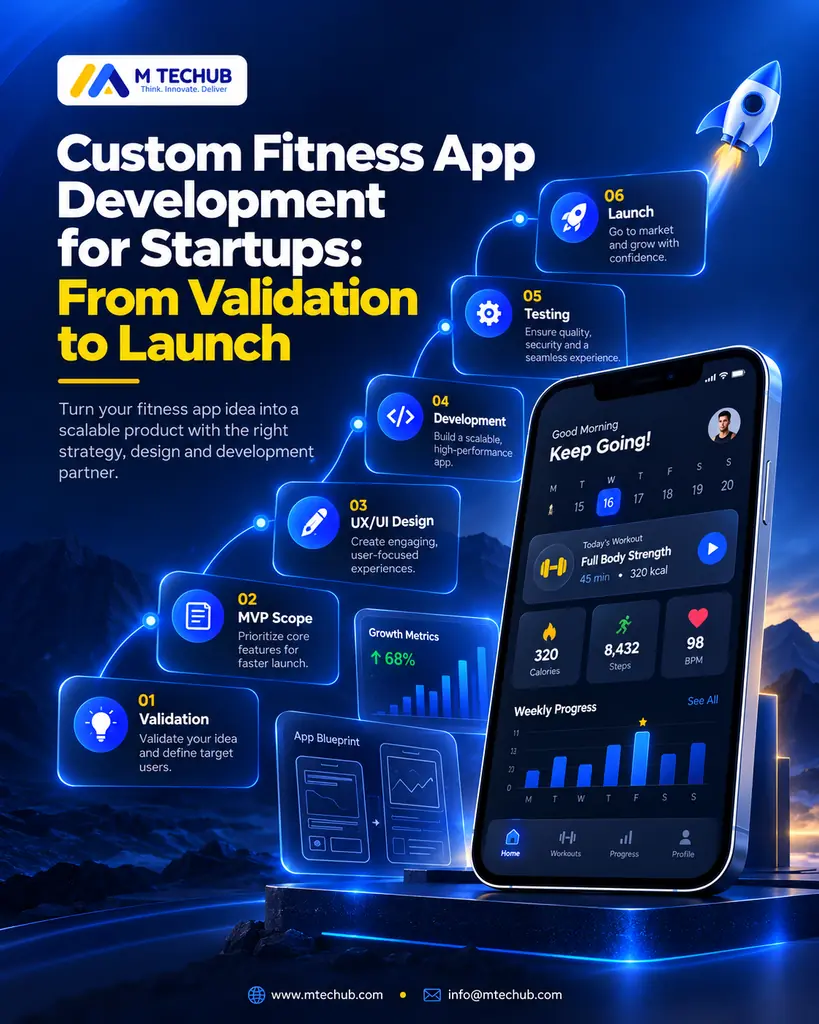
Fitness App Development for Startups
Fitness app development for startups begins with a clear decision: which user problem is worth solving, and what evidence justifies investing in software?
A workout library, activity dashboard, and subscription screen can form a working application. They do not establish whether people need the product, can use it comfortably, or will return after their first session.
Start by validating a specific problem. Then define a useful first release, estimate its delivery and operating costs, and choose how you will measure success.
Some startups can test demand through a manually delivered fitness program before commissioning software. Others need a functioning application because device integration or automation is central to their idea.
This guide explains how to make those decisions, from early research and product scope to hiring, launch, and improvement.
Phase 1 — Validate Your Fitness App Idea Before Launching
Start with a clearly defined user and an observable problem.
“People who want to get fit” is too broad to guide development. “New gym members who struggle to follow a strength-training routine without regular trainer support” gives the team something specific to investigate.
Research Existing Behavior
Interview potential users about what they currently do:
- What happened the last time they tried to solve this problem?
- Which apps, spreadsheets, trainers, or classes did they use?
- Where did the process become difficult?
- What have they already paid for?
- What would make them switch from their current approach?
Questions about recent behavior provide more useful evidence than asking whether someone likes an app idea.
Include alternatives beyond competing applications. A personal trainer’s messages, a familiar spreadsheet, or a paper workout plan may already solve enough of the problem.
Your product needs a credible reason for users to change their behavior.
Test the Riskiest Assumption
Choose a validation method that matches the uncertainty.
| Uncertainty | Practical test | Evidence to examine |
|---|---|---|
| Does the problem matter? | Customer interviews | Repeated problems supported by recent examples |
| Can users understand the solution? | Clickable prototype | Completion of the main task without coaching |
| Will people participate? | Small pilot program | Attendance and completion of planned activities |
| Will people pay? | Clearly described paid pilot | Purchases, cancellations, and reasons |
| Can the technology deliver? | Technical proof of concept | Required behavior on the intended devices |
Define the decision rule before running the test.
For example, a founder might require pilot participants to complete an initial workout and voluntarily return during the following week before funding further development. That is a product-specific criterion, not a universal retention benchmark.
Record what would justify proceeding, changing the idea, or stopping. Email sign-ups and positive comments can support research, but they should not carry the entire investment decision.
Phase 2 — Choose an MVP or a Broader First Release
A minimum viable product is a usable first release that tests an important business assumption with real users.
An MVP for a fitness app should deliver a complete, focused outcome. For a guided-workout product, that might mean helping someone choose an appropriate session, follow it, record completion, and find their next workout.
The decision is how much software is necessary to test the service credibly.
When a Focused MVP Makes Sense
A narrow release is useful when:
- Demand remains uncertain.
- The team needs evidence about one important workflow.
- Funding requires careful prioritization.
- Trainers or support staff can temporarily perform some tasks manually.
For example, a trainer could assign plans through a simple administration panel before the startup invests in automated recommendations.
Manual work should have a clear owner, an acceptable capacity limit, and appropriate handling of personal information.
When More Scope May Be Necessary
A broader first release can be justified when connected workflows are necessary to deliver the promised service.
A coaching platform may require scheduling, trainer access, client communication, and payments together. An activity-sync product may need a functioning integration immediately because manual recording would not test its central promise.
Decide the scope from the service requirements and evidence. Avoid copying every capability of an established competitor.
For a detailed breakdown of first-release features, budgeting, and delivery planning, see our fitness app MVP development guide.
Phase 3 — Select Features Around the First Useful Outcome
Choose features according to the product’s purpose. Guided workouts, personal coaching, gym services, and activity tracking require different workflows.
Each proposed feature should support a user outcome, an operating requirement, or a specific learning objective.
| Feature | Include early when… | Consider postponing when… |
|---|---|---|
| Onboarding and profiles | Information meaningfully changes the experience | Questions collect information without a clear use |
| Workout plans and exercise library | Guided exercise is the core service | The product mainly supports bookings or tracking |
| Progress tracking | Users need a record to continue or review progress | Complex dashboards do not support useful decisions |
| Trainer communication | Human coaching forms part of the service | Users can receive the promised value without messaging |
| Notifications | Timely reminders support activities users have chosen | There is no clear purpose or preference control |
| Wearable integration | Connected data is necessary to the product promise | Manual recording can test the same assumption |
| Payments and subscriptions | The release needs to test paid access | A separate pilot can test willingness to pay first |
| Analytics and feedback | The team needs evidence about product use | Data collection exceeds what the decision requires |
A custom health and fitness app development strategy should explain why each feature exists, what it costs to operate, and which evidence would justify expanding it.
Include Privacy, Security, and Accessibility in the Scope
Collect only the information needed for a defined purpose. Avoid asking for detailed health histories simply because similar applications do.
Plan safeguards such as restricted staff access, secure authentication, protected data transmission, backup recovery, and appropriate retention and deletion processes.
Include accessibility in design and testing. Consider readable text, sufficient contrast, screen-reader labels, understandable errors, and captions where workout instruction depends on spoken audio.
These requirements belong in the scope and acceptance criteria.
Understand US and UK Privacy Requirements
In the United States, HIPAA applicability depends on the organization’s role and relationships. A fitness app does not become subject to HIPAA merely because it collects health-related information. Review the official guidance for mobile health app developers to assess the relevant scenarios. Other obligations can apply even when HIPAA does not.
The Health Breach Notification Rule, updated in 2024 to clarify its coverage of health apps, can apply to qualifying personal health record vendors and related organizations outside HIPAA. A consumer fitness product should assess its applicability rather than assume that wellness data falls outside privacy regulation.
In the United Kingdom, information concerning health can be special category data. Processing it requires an Article 6 lawful basis and an applicable Article 9 condition under the UK GDPR, together with an associated Data Protection Act 2018 condition where required. Review the special category processing requirements against the actual processing purpose.
Determine the requirements for the product’s data flows, users, business relationships, and jurisdictions. Encryption and a privacy policy alone do not establish legal compliance.
If the app makes diagnostic or treatment claims, medical-device rules may apply depending on its intended purpose and functionality. Seek specialist regulatory and legal advice before making those claims or launching the relevant features; consult the US medical-app guidance and UK software-app guidance.
Phase 4 — Plan Your Startup Fitness App Budget
Startup fitness app cost depends on the work required to deliver and support the first useful outcome.
A simple workout product and a live-coaching platform may both be called fitness apps, but their engineering, content, support, and integration requirements differ substantially.
Before comparing prices, give suppliers the same product brief and ask them to identify their assumptions.
Request an Estimate by Workstream
| Workstream | What the estimate should include |
|---|---|
| Discovery | Requirements, assumptions, user journeys, and acceptance criteria |
| Product design | Wireframes, interface design, prototypes, and accessibility considerations |
| Mobile development | Screens, navigation, device behavior, and local storage |
| Backend and administration | Accounts, content management, access controls, and APIs |
| Integrations | Payments, notifications, analytics, and connected services |
| Quality assurance | Functional, device, security, accessibility, and recovery checks |
| Release preparation | Store materials, production configuration, and submission support |
| Handover | Documentation, account access, and deployment instructions |
Ask suppliers to identify uncertain items separately. An unfamiliar wearable integration may require a technical investigation before a dependable fixed price is possible.
When comparing the cost to build an MVP fitness app, examine what each proposal includes. A lower total may exclude administration tools, payment recovery, device testing, or handover.
For a fuller discussion of initial delivery and ongoing expenses, see our fitness app development cost guide.
Compare USA and UK Proposals Consistently
Request pricing in USD or GBP as appropriate to your budget, and clarify:
- Whether the quote includes taxes (such as US sales tax or UK VAT), where applicable.
- Where the delivery team is based.
- Whether design, testing, and project management are included.
- Which third-party charges the startup pays directly.
- How changes and additional work are priced.
- Whether support hours overlap with your working day.
- Which currency and payment terms apply to future work.
A customer’s country does not establish the supplier’s delivery rate. Compare equivalent deliverables, responsibilities, and commercial terms.
Budget for Operating the Service
The initial build is one part of the investment.
Allow for hosting, video delivery, messaging, monitoring, customer support, content updates, security work, and operating-system changes.
Subscriptions also create operational requirements, including failed payments, restored access, refunds, and cancellations.
Check payment implementation against the official App Review Guidelines and Google Play Payments policy. Applicable requirements depend on what is sold, the storefront, and any relevant exceptions or regional provisions.
Keep the development budget and operating forecast separate so both remain visible.
Phase 5 — Follow a Clear Fitness App Development Process
The fitness app development process should produce reviewable decisions and working software at each stage.
| Stage | Key deliverable | Decision before moving forward |
|---|---|---|
| Discovery | Product brief and requirements | Is the problem specific enough to investigate? |
| Validation | Findings and revised assumptions | Is there sufficient evidence to fund development? |
| User experience and design | Tested prototype | Can users complete the main journey? |
| Architecture | Data flows, technical plan, and integration assessment | Can the solution deliver the required behavior? |
| Development | Working product increments | Do completed features meet acceptance criteria? |
| Testing | Results, fixes, and release assessment | Are critical journeys ready for release? |
| Launch preparation | Production setup and store submission materials | Are support and operational responsibilities assigned? |
| Improvement | Usage findings and prioritized backlog | Which change addresses the strongest observed problem? |
Validation may return the team to discovery. Testing may expose a design assumption that needs revision.
Keep the process responsive to evidence while maintaining clear scope and change decisions.
Choose Technology Through Product Requirements
Assess technology against the experience users need.
Cross-platform development may suit products with similar workflows on iOS and Android. Separate native applications deserve consideration when specialized device behavior or platform capabilities dominate the experience.
Before choosing, examine:
- Required device and wearable connections.
- Offline behavior.
- Video or real-time communication requirements.
- Performance expectations.
- Third-party SDK compatibility.
- Team experience and maintenance ownership.
Test the most uncertain integration before committing the entire architecture.
Agree a Scope-Based Timeline
Ask for a delivery schedule tied to the actual release scope and staffing plan.
The proposal should identify:
- When discovery and design decisions are due.
- Which activities can run concurrently.
- When content and integration access must be supplied.
- How much time is allocated to testing and fixes.
- What release preparation includes.
- Which external dependencies could affect launch.
A short delivery window may be achievable for a tightly limited product with ready content. A release involving several roles, subscriptions, integrations, and extensive testing requires a different plan.
Agree milestones around observable outputs, such as a functioning workout journey or tested subscription access. Treat app-store review as an external dependency.
Phase 6 — Choose Custom Fitness App Development Services
When comparing custom fitness app development services, request evidence relevant to your product.
A portfolio helps establish experience, but the team should also explain how it handles incomplete data, failed payments, permission denial, content updates, and account access.
Ask potential partners to demonstrate:
- A relevant workflow they have delivered.
- How requirements become acceptance criteria.
- How progress and risks are communicated.
- How changes affect scope and price.
- How testing and release readiness are assessed.
- What documentation and support are included.
For a focused first release, explore MVP development services. For broader industry requirements, review M TECHUB’s healthcare and fitness software development services.
When to Hire Fitness App Developers
Hire fitness app developers when you have a defined problem to investigate and a clear development outcome to commission.
That outcome may be a prototype, technical investigation, focused MVP, or broader application.
You do not need a complete specification before speaking to a team, but you should be able to explain:
- Who the product serves.
- What users need to accomplish.
- What evidence already exists.
- Which assumptions remain uncertain.
- What budget and timing constraints apply.
External developers can provide engineering capacity and delivery expertise. Founders should retain responsibility for customer understanding, commercial priorities, content decisions, and acceptance of the delivered product.
If the largest uncertainty is whether anyone wants the service, commission validation work before a substantial software build.
Clarify Ownership and Handover Before Signing
The contract should address source code ownership, third-party licensing, repository access, infrastructure accounts, documentation, and exit arrangements.
Where practical, keep production cloud and app-store accounts under the startup’s control.
Establish who can deploy changes, rotate credentials, recover backups, and respond to incidents.
Ask what happens if another team takes over. The agreed documentation and access arrangements should make that transition manageable.
Phase 7 — Launch, Measure, and Scale With Evidence
A launch should establish whether users can receive the promised value reliably.
Before release, test onboarding, the first meaningful activity, saved progress, paid access where applicable, and support.
Include interruption scenarios such as lost connectivity, expired sessions, denied permissions, and unsuccessful payments.
Measure Meaningful Product Behavior
Choose metrics that reflect the service.
| Metric | Example definition | What it helps investigate |
|---|---|---|
| Activation | Eligible new users completing a first suitable workout within a defined period | Whether onboarding leads to value |
| Retention | A defined signup cohort returning for a meaningful activity in a later period | Whether the experience remains useful |
| Core engagement | Planned workouts completed per active participant | Whether users follow the intended routine |
| Paid conversion | Eligible trial users starting a paid plan | Whether the offer matches perceived value |
| Renewal | Subscriptions renewed among those due for renewal | Whether value continues beyond the first payment |
| Reliability | Failed saves, playback errors, and crash incidents | Whether technical problems interrupt use |
| Support demand | Repeated issue categories and resolution times | Where users need help or product changes |
Record each metric’s denominator and time window.
“Retention improved” means little unless the team knows which users, activities, and periods were measured.
Avoid sending detailed health information to analytics systems when a less sensitive event can answer the same product question.
Expand the Proven Workflow
If users struggle to start their first workout, investigate onboarding, suitability, and technical reliability.
If users complete sessions but stop paying, examine the continuing service, expectations, and subscription experience.
Combine usage data with interviews and support findings. A low completion rate can have several causes, each requiring a different response.
Expand features when evidence identifies a useful next capability. Increase infrastructure capacity when observed demand and reliability requirements justify it.
Common Fitness App Development Mistakes Startups Should Avoid
- Copying an established app’s entire feature set. Mature products reflect different customers, resources, and business constraints. Prioritize the workflow your users need first.
- Using sign-ups as the only validation signal. Examine participation, repeated use, and payment behavior where relevant.
- Treating content as something to add later. Workout production, review, organization, and updates affect both delivery and the user experience.
- Underestimating integration failures. Plan for unavailable services, delayed data, expired authorization, and permission changes.
- Leaving privacy decisions until release. Data collection choices influence architecture, analytics, contracts, and support procedures.
- Accepting a quote without clear deliverables. Compare scope, assumptions, exclusions, responsibilities, and acceptance criteria.
- Ignoring maintenance and handover. Establish operational ownership and access arrangements before launch.
References: