
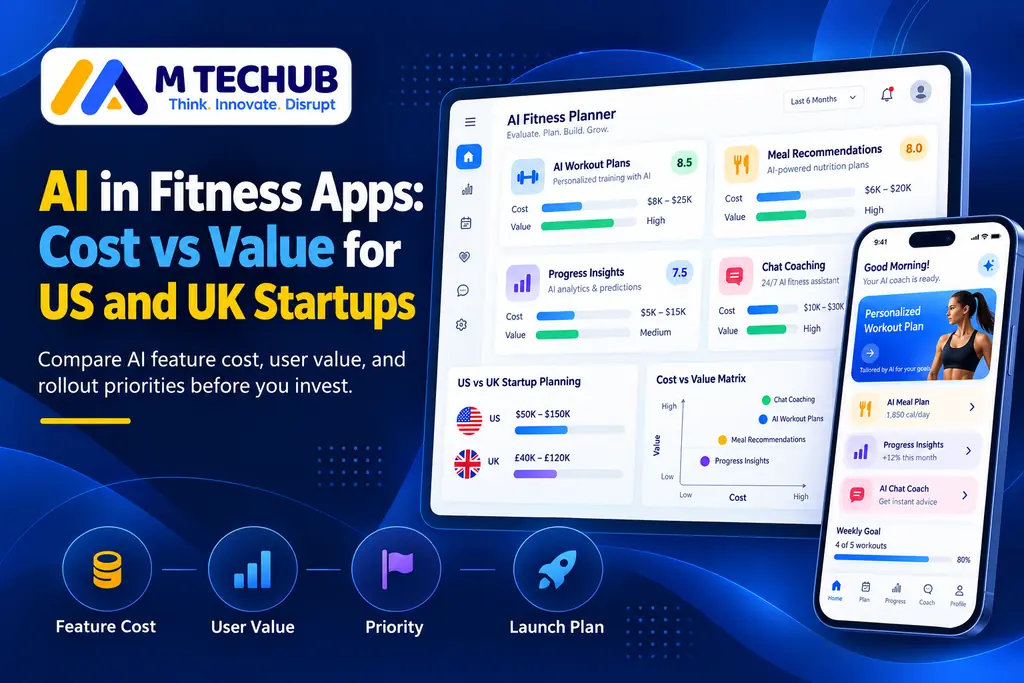
AI fitness app development cost typically requires an initial planning budget of $25,000–$60,000 for a focused MVP or $120,000–$300,000+ for an advanced platform involving computer vision, custom AI models, or complex wearable integrations.
For US and UK startups, development cost is only one part of the investment. AI infrastructure, subscriptions, maintenance, data protection, and customer acquisition affect long-term profitability.
This guide covers AI fitness app development prices, regional hiring costs, development timelines, technology choices, operating expenses, and return on investment (ROI).
AI Fitness App Development Cost at a Glance
| App type | Estimated development cost (USD) | Timeline |
|---|---|---|
| Basic AI fitness MVP | $25,000–$60,000 | 3–4 months |
| AI personal trainer app | $40,000–$90,000 | 4–6 months |
| Adaptive workout platform | $60,000–$120,000 | 5–7 months |
| AI fitness app with wearables | $70,000–$150,000 | 5–8 months |
| Advanced computer vision app | $120,000–$300,000+ | 7–12+ months |
Cost assumptions: These ranges are scope-based planning estimates, rather than verified market averages or historical M Techub project data. Final costs depend on engineering hours, hourly rates, functionality, regulatory requirements, and integrations.
What Affects AI Fitness App Development Costs?
Five factors determine the overall development investment:
- AI architecture: Rules-based logic, third-party AI APIs, or custom machine learning.
- Feature complexity: Workout recommendations, LLM coaching, computer vision, or real-time exercise feedback.
- Platform coverage: iOS, Android, web applications, or multiple platforms.
- Development team: In-house hiring, local agencies, offshore outsourcing, or hybrid delivery.
- Infrastructure: Cloud hosting, model inference, data storage, monitoring, and maintenance.
Defining these requirements before development reduces scope uncertainty and supports more accurate supplier quotations.
AI Fitness App Development Price Breakdown
An AI fitness app requires both core application infrastructure and AI-specific engineering.
The following example covers an MVP with user accounts, workout logging, subscriptions, basic personalization, and an LLM-powered training assistant.
| Development workstream | Hours | Cost at $60/hour |
|---|---|---|
| Product discovery and UI/UX | 100 | $6,000 |
| Mobile app development | 240 | $14,400 |
| Backend and subscriptions | 170 | $10,200 |
| AI integration and evaluation | 120 | $7,200 |
| Testing, security, and deployment | 130 | $7,800 |
| Project coordination | 40 | $2,400 |
| Development subtotal | 800 | $48,000 |
| Contingency (15%) | — | $7,200 |
| Total estimated investment | — | $55,200 |
The $55,200 budget excludes substantial custom AI training, extensive video production, customer acquisition, and recurring operating costs.
AI Personal Trainer App Development Cost
An AI personal trainer app combines workout planning, progress monitoring, and automated coaching.
Its engineering requirements depend on the level of personalization.
Basic implementations may include:
- Personalized exercise suggestions
- Workout schedule generation
- Progress summaries
- Conversational workout explanations
- Equipment-based exercise substitutions
Advanced implementations may require adaptive training intensity, recovery-related recommendations, wearable-data analysis, and contextual coaching.
These functions introduce additional decision logic, AI evaluation, data-processing requirements, and safety testing.
Fitness professionals may also need to review exercise recommendations and define appropriate coaching boundaries.
How Much Does AI Computer Vision Cost for Fitness Apps?
Computer vision uses camera input to analyze exercise movements and provide feedback.
Typical capabilities include:
- Human pose estimation
- Repetition counting
- Joint-position analysis
- Exercise classification
- Movement consistency checks
- Real-time exercise form feedback
Basic repetition counting may run directly on supported mobile devices. Advanced form correction requires exercise-specific validation, camera-angle testing, device optimization, and reliable feedback logic.
The implementation choice also affects recurring costs.
On-device processing reduces reliance on cloud inference but requires mobile performance optimization. Cloud processing may increase compute, network, and storage expenditure.
Advanced computer vision platforms can require six-figure development budgets when they support multiple exercises, real-time analysis, and extensive testing.
AI Fitness App Development Cost: US vs UK vs Offshore
Startups can build AI fitness applications using local development teams, international agencies, or hybrid delivery models.
The supplier’s location affects labor costs, but technical expertise, project management, and delivery efficiency also influence total expenditure.
Regional AI Development Hourly Rates
Clutch’s July 2025 research identified the following AI development provider rate bands:
| Development region | Reported hourly rates |
|---|---|
| United States | $50–$99 |
| India | $25–$49 |
| Ukraine | $25–$49 |
| United Kingdom | Requires current supplier-specific quotations |
Source: Clutch – Offshoring AI Development
These figures reflect reported provider pricing rather than guaranteed rates for AI fitness app development.
For an 800-hour project:
- At $35/hour, estimated labor expenditure is $28,000.
- At $80/hour, estimated labor expenditure is $64,000.
The lower hourly rate may offer savings, but founders should also assess communication, quality assurance, rework, and project-management costs.
US and UK Budgeting Differences
US startups generally plan domestic spending in USD, while UK businesses benefit from GBP-based development and operating budgets.
United States considerations:
- State-specific privacy obligations
- State and local sales-tax treatment where applicable
- Subscription demand and acquisition costs
- Domestic versus international development expenditure
United Kingdom considerations:
- GBP-denominated project and operating costs
- VAT treatment of services and purchases
- UK GDPR compliance
- Potential eligibility for qualifying R&D tax relief
- Cross-border supplier arrangements
The standard UK VAT rate is 20%, although the VAT treatment of individual transactions depends on their circumstances.
UK businesses conducting qualifying technological R&D may investigate HMRC relief schemes. Routine software development does not automatically qualify.
AI Fitness App Development Timeline
A focused AI fitness MVP typically requires 12–16 weeks of planned development, assuming clear requirements, available engineering resources, and existing AI services.
| Phase | Schedule | Deliverable |
|---|---|---|
| Discovery and planning | Weeks 1–2 | Product scope and architecture |
| UI/UX design | Weeks 3–4 | Approved interfaces and user flows |
| App and backend development | Weeks 5–10 | Functional mobile application |
| AI integration | Weeks 9–12 | Integrated AI functionality |
| Testing and security | Weeks 13–15 | Tested release candidate |
| Launch preparation | Week 16 | App-store submission and monitoring |
Some phases overlap to reduce delivery time.
Advanced wearable integrations, custom machine learning, computer vision, regulatory assessments, and app-store reviews can extend the schedule.
AI Fitness App Development Team
A typical MVP requires:
- Product manager: Requirements, priorities, and delivery coordination.
- UI/UX designer: User experience, onboarding, and interface design.
- Mobile developer: iOS and Android application development.
- Backend developer: APIs, accounts, subscriptions, and data services.
- AI engineer: Model integration, evaluation, and AI-related functionality.
- QA engineer: Functional, device, performance, and regression testing.
Security, privacy, and exercise-science specialists may contribute based on product requirements.
Small development teams can combine roles, provided responsibility for each deliverable is clearly defined.
AI Fitness App Technology Stack
Technology selection directly affects development complexity, integration requirements, and long-term maintenance.
| Component | Technology options | Application |
|---|---|---|
| Mobile development | React Native, Flutter, Swift, Kotlin | Mobile interfaces |
| Backend | Node.js, Python, PostgreSQL | APIs, accounts, subscriptions |
| LLM coaching | OpenAI API, Google Gemini API | Conversational coaching |
| Recommendations | Rules engines, Python ML services | Workout personalization |
| Computer vision | MediaPipe, on-device ML | Exercise movement analysis |
| Apple health integration | HealthKit | Permission-based health data access |
| Android health integration | Health Connect | Health and fitness data exchange |
| Cloud infrastructure | AWS, Google Cloud, Azure | Hosting, storage, monitoring |
Native vs Cross-Platform Development Cost
Cross-platform development with React Native or Flutter can reduce duplicated engineering effort for applications serving both iOS and Android.
Native development using Swift and Kotlin provides direct access to platform-specific features and may be preferable for specialized camera processing or health-data integration.
Cross-platform development still requires native modules, device testing, and platform-specific engineering where necessary.
Founders should choose a framework based on the app’s technical requirements, not solely on expected initial savings.
AI API Costs: OpenAI vs Google Gemini
AI model usage creates recurring expenses that depend on requests, token consumption, and the selected model.
Providers commonly price text processing using input and output tokens, often at different rates.
Google’s published standard paid-tier pricing for Gemini 2.5 Flash includes:
- Input: $0.30 per million tokens
- Output: $2.50 per million tokens
Actual billed usage can include additional token categories and provider-specific processing charges.
Example: Monthly AI Coaching Token Costs
Assume an application has:
| Usage metric | Monthly assumption |
|---|---|
| Active AI coaching users | 2,000 |
| Conversations per user | 20 |
| Total conversations | 40,000 |
| Input tokens per conversation | 1,500 |
| Output tokens per conversation | 500 |
Total monthly consumption:
- Input tokens: 60 million
- Output tokens: 20 million
At the stated Gemini rates:
| Usage | Estimated monthly cost |
|---|---|
| 60M input tokens at $0.30/M | $18 |
| 20M output tokens at $2.50/M | $50 |
| Total text token cost | $68 |
This represents a defined text-token calculation, not the complete operating cost of an AI coaching feature.
Longer conversations, additional processing tokens, voice services, retrieval systems, monitoring, cloud hosting, and storage can increase expenditure.
OpenAI publishes separate prices for model input, cached input, and output processing.
Startups should compare providers using cost per completed coaching interaction, response quality, latency, operational reliability, and privacy requirements.
Hidden Costs and Annual AI Fitness App Maintenance
Development expenditure does not end when the application launches.
Recurring costs include:
- Cloud hosting, storage, and bandwidth
- LLM API usage and inference
- Security updates and compatibility testing
- Wearable API maintenance
- Monitoring and analytics
- Customer support
- Privacy and regulatory assessments
- Exercise content production and video licensing
- Subscription processing fees
Annual Maintenance Cost Example
A planning allowance of 15%–25% of initial development expenditure annually can help estimate routine maintenance needs. This percentage is a budgeting scenario, not a verified industry average.
For the $55,200 MVP:
| Maintenance assumption | Annual budget |
|---|---|
| 15% of development cost | $8,280 |
| 20% of development cost | $11,040 |
| 25% of development cost | $13,800 |
The allowance may cover bug fixes, compatibility updates, security patches, and routine support.
It should not automatically be expected to fund new major features, substantial AI inference, marketing, or ongoing content production.
Exercise Video and Content Licensing
Workout videos and instructional content can create significant additional expenditure.
Founders may need to:
- Produce original exercise demonstrations
- License commercial workout content
- Commission professional instruction
- Maintain exercise libraries
- Review usage and distribution rights
Content ownership and licensing terms should be established before integrating third-party material into the application.
AI Fitness App ROI: How to Calculate Business Value
AI fitness app ROI measures whether additional financial value exceeds the cost of developing and operating AI capabilities.
Key metrics include:
- Activation rate: Users who complete their first meaningful fitness activity.
- Retention: Users who return over a defined period.
- Churn: Subscribers who cancel within a given period.
- CAC: Customer acquisition cost.
- LTV: Estimated customer lifetime contribution.
- Contribution margin: Revenue remaining after relevant variable costs.
- Payback period: Time required to recover the initial investment.
ROI Example: A $55,200 AI Fitness MVP
Assume a subscription-based fitness app has 1,000 paying users.
| Financial metric | Monthly value |
|---|---|
| Paying subscribers | 1,000 |
| Subscription price | $15 |
| Gross subscription revenue | $15,000 |
| Assumed platform/payment fees | $2,250 |
| AI and other variable costs | $2,000 |
| Fixed operating expenses | $7,000 |
| Operating surplus | $3,750 |
Simple payback calculation:
$55,200 ÷ $3,750 = 14.72 months
This assumes stable subscribers, revenue, and costs, with no further capital expenditure, taxes, or financing costs included.
A subscription business should also model churn, user acquisition expenditure, and changes in operating costs.
How Much Additional Value Must AI Generate?
Suppose introducing AI adds $1,500 in monthly operating expenses.
If each additional retained subscriber contributes $10 per month after variable costs:
$1,500 ÷ $10 = 150 additional subscriber-months
The AI feature must therefore generate at least 150 additional subscriber-months each month to cover that incremental operating expenditure.
This does not include recovery of the initial AI development investment, which would require additional contribution.
Founders should compare AI-powered experiences against a suitable non-AI baseline before assuming improved retention or profitability.
AI Fitness App Subscription Pricing: $5 vs $15–$30
Subscription pricing influences revenue, customer acquisition, and long-term unit economics.
For competitive context, Fitbod has published US pricing of $15.99 monthly and $95.99 annually, with the annual plan equivalent to approximately $8 per month when billed yearly.
These figures describe a particular product and offer rather than the average subscription price across AI fitness applications.Subscription pricing influences revenue, customer acquisition, and long-term unit economics.
For competitive context, Fitbod has published US pricing of $15.99 monthly and $95.99 annually, with the annual plan equivalent to approximately $8 per month when billed yearly.
These figures describe a particular product and offer rather than the average subscription price across AI fitness applications.
Subscription Revenue Comparison
| Monthly price | Potential positioning | Revenue at 1,000 subscribers |
|---|---|---|
| $5 | Basic workout planning | $5,000 |
| $15 | Personalized training and progress analytics | $15,000 |
| $30 | Premium coaching and advanced features | $30,000 |
These are pricing scenarios, not verified willingness-to-pay benchmarks.
A premium subscription needs to deliver clear additional customer value. Lower-priced plans require careful management of acquisition, support, and AI operating expenses.
US and UK startups should test demand at locally appropriate price points before finalizing revenue projections.
When Is AI Worth It for Fitness App Startups?
AI is most valuable when it improves a meaningful user outcome that a simpler approach cannot achieve efficiently.
Different personalization technologies offer different capabilities and costs.
| Technology | Best use case | Key consideration |
|---|---|---|
| Rules-based systems | Workout schedules and exercise substitutions | Predictable, easier to test |
| Machine learning | Complex recommendation patterns | Requires suitable data |
| LLM coaching | Natural-language fitness guidance | Accuracy, safety, and usage costs |
| Computer vision | Movement tracking and exercise feedback | Device performance and validation |
When Rules-Based Personalization Is Enough
A rules-based system can manage:
- Workout progression
- Exercise substitution
- Equipment preferences
- Training schedules
- Goal-based workout selection
- Basic nutrition calculations
These features may satisfy early-stage customer needs without custom machine learning.
When Advanced AI Makes Sense
Advanced AI may be justified when an application needs complex personalization, conversational interaction, large-scale activity analysis, or validated computer vision.
The investment decision should follow user research, feature adoption data, and financial analysis.
What Should Founders Measure Before Scaling AI?
Monitor five outcomes:
- AI feature activation and usage.
- Recommendation quality and reliability.
- Retention compared with an appropriate baseline.
- Incremental revenue and contribution margin.
- AI operating cost per active user.
Expanding AI features without measurable demand can increase expenditure without improving the product’s commercial position.
AI Fitness App Privacy and Regulatory Requirements
AI fitness applications may process exercise activity, body measurements, health information, and behavioral data.
Privacy and regulatory obligations depend on the product’s intended use, data practices, business relationships, and jurisdictions.
United States: HIPAA, State Privacy, and FDA
HIPAA does not automatically apply to every consumer fitness app. Its applicability depends on the involvement of covered entities or business associates and the relevant processing activities.
Additional obligations may arise under state privacy laws.
Examples include:
- Washington My Health My Data Act: Protects qualifying consumer health data.
- California CCPA/CPRA: Establishes privacy requirements for covered businesses.
- FTC Health Breach Notification Rule: May apply to certain health applications and related services.
Relevant official guidance:
- Washington My Health My Data Act
- FTC Health Breach Notification Rule
The FDA’s January 2026 general wellness guidance also helps distinguish certain low-risk wellness products from software that may require medical-device regulatory consideration.
Reference: FDA General Wellness Guidance.
United Kingdom: UK GDPR and Health Data
Health information can qualify as special category personal data under UK GDPR.
Where applicable, organizations need an Article 6 lawful basis and a relevant Article 9 condition.
Core safeguards include data minimization, access restrictions, appropriate security, transparent privacy notices, and suitable retention policies.
Reference: ICO – Special Category Data.
Apple App Store and Google Play Requirements
App distribution platforms impose additional requirements on applications handling health and fitness data.
Apple’s guidelines address health-data privacy, permissions, and restrictions on certain data uses.
Google Play requires relevant developers to complete the Health apps declaration and meet applicable health and privacy policies.
Official references:
- Apple App Review Guidelines
- Google Play Health Apps Policy
Founders should assess their intended claims and processing activities before launch and seek qualified legal advice where required.
Final Thoughts: AI Fitness App Cost vs Business Value
AI fitness app development costs vary according to technical complexity, delivery model, infrastructure, and compliance requirements.
A focused MVP allows US and UK startups to validate demand before investing in custom AI models, extensive wearable integrations, or real-time exercise analysis.
The commercial decision should consider development investment, operating expenses, subscription economics, customer retention, and measurable contribution margin.
Prioritizing validated customer needs gives startups a stronger foundation for long-term development decisions.