
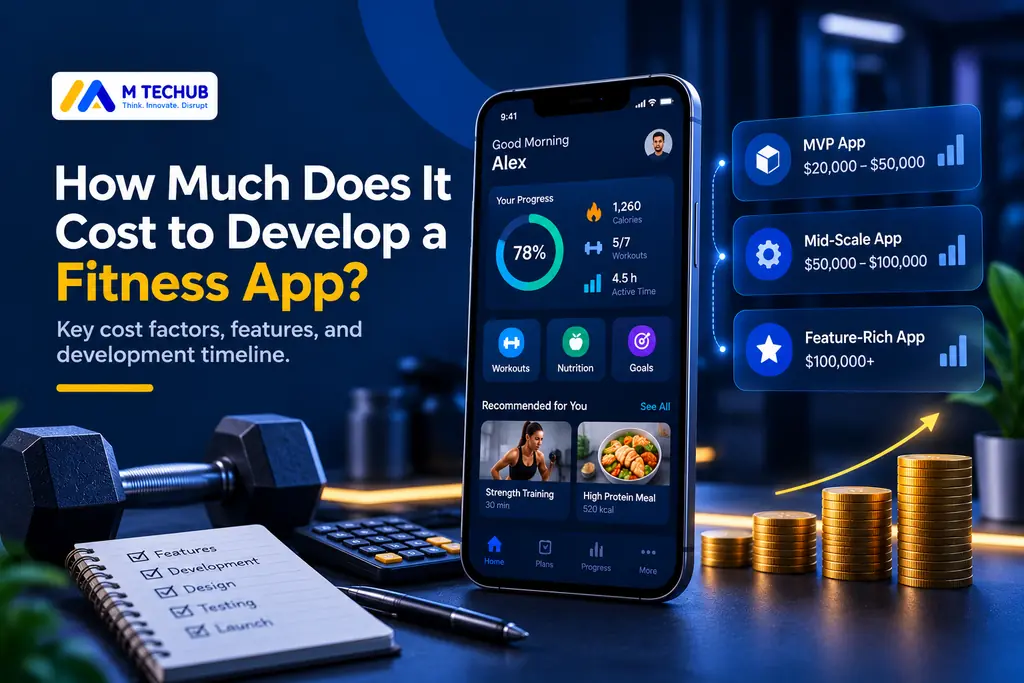
How much does it cost to make a fitness app in 2026? For US businesses, a custom fitness app MVP may cost approximately $35,000–$80,000, while a more feature-rich application may require $80,000–$150,000. Advanced fitness platforms can cost $150,000–$250,000 or more, particularly when they include complex integrations, advanced analytics, or AI-powered features.
These are illustrative planning estimates, not verified US market averages or actual vendor quotations. They assume a professionally managed project with defined requirements, cross-platform development where appropriate, backend infrastructure, quality assurance, and initial deployment.
For broader market context, Clutch’s Mobile App Pricing Guide 2026, updated September 21, 2026, reports that many mobile application projects reviewed on its platform fall between $10,000 and $49,999, with commonly listed agency rates of $25–$49 per hour. However, these findings cover mobile development generally, not fitness app projects specifically. Clutch
The final investment depends on what the application needs to accomplish.
A workout app offering exercise routines and basic progress tracking requires far less engineering than a platform combining AI coaching, nutrition analysis, wearable synchronization, and subscription management.
For fitness startups, gym owners, personal trainers, and wellness businesses, understanding these differences is essential before hiring developers or approving a project budget.
This guide explains fitness app development costs in the United States, including feature estimates, development hours, timelines, AI integration, wearable connectivity, maintenance expenses, and practical budgeting strategies.
Fitness App Development Cost in 2026: Quick Breakdown
Fitness applications generally fall into three broad project categories.
| Fitness App Type | Estimated Cost | Development Timeline |
|---|---|---|
| Basic fitness app or MVP | $35,000–$80,000 | 3–4 months |
| Mid-complexity fitness app | $80,000–$150,000 | 4–7 months |
| Advanced fitness platform | $150,000–$250,000+ | 6–12+ months |
These estimates are hypothetical project-planning ranges, not established industry pricing standards.
What do these estimates include?
The estimates assume a defined application scope, a shared mobile codebase for iOS and Android where practical, standard authentication, a suitable backend, an administrative interface, UX/UI design, testing, and launch preparation.
They also assume a blended team that may include US-based and international developers. They do not represent exclusively US-based agency prices.
The lower end of each range generally assumes fewer integrations, simpler workflows, and greater reuse of existing infrastructure.
The upper end allows for more custom functionality, complicated user roles, additional integrations, and greater testing requirements.
Marketing, extensive content production, major post-launch development, and ongoing operating costs are not automatically included.
Basic fitness app or MVP: $35,000–$80,000
A basic fitness app focuses on one core experience.
For example, a personal trainer might want clients to access workout programs, follow exercise instructions, and track progress.
Typical features include registration, fitness goals, a workout library, exercise scheduling, activity logging, and basic reporting.
This type of application generally avoids sophisticated AI systems, complex wearable integrations, and extensive administrative workflows.
Mid-complexity fitness app: $80,000–$150,000
A mid-complexity application supports a wider range of user and business requirements.
It may include subscription plans, video workouts, nutrition logging, trainer dashboards, notifications, and more personalized training experiences.
For example, a fitness startup could use this approach to deliver paid training programs and manage multiple coaches.
The additional cost comes from business logic, content management, payment handling, and more comprehensive testing.
Advanced fitness platform: $150,000–$250,000+
Advanced platforms may combine multiple user roles, wearable integration, GPS tracking, sophisticated analytics, adaptive recommendations, and complex administrative systems.
A fitness company might use such a platform to support personalized training across multiple locations while integrating with existing business software.
Projects involving proprietary machine-learning models, specialized connected equipment, or extensive real-time processing may exceed this budget.
AI is not automatically an advanced-tier requirement. A relatively simple AI feature could be included in a smaller application, while a sophisticated custom AI system could substantially increase the price of any project.
How Are Fitness App Development Costs Calculated?
One useful way to estimate fitness mobile app development costs is to calculate the expected engineering effort.
The basic formula is:
\[ \text{Project Budget}=\text{Development Hours}\times\text{Blended Hourly Rate} \]
A blended hourly rate represents the combined cost of the specialists involved, rather than the rate of a single developer.
Example project budgets
| Project Type | Estimated Hours | Assumed Rate | Calculated Cost |
|---|---|---|---|
| Fitness app MVP | 1,000 | $45/hour | $45,000 |
| Mid-complexity app | 1,800 | $60/hour | $108,000 |
| Advanced platform | 2,800 | $75/hour | $210,000 |
These calculations are illustrative assumptions. They are not measured project averages, confirmed US labor rates, or quotations from MTechub.
Actual rates depend on team location, seniority, responsibilities, engagement model, and project complexity.
Example: Where does a 1,000-hour MVP budget go?
Consider a hypothetical startup building a cross-platform workout application.
The product includes user registration, a workout library, training schedules, basic progress tracking, a small admin dashboard, and initial deployment.
A sample effort allocation could be:
| Development Activity | Estimated Hours | Budget at $45/hour |
|---|---|---|
| Product discovery and planning | 100 | $4,500 |
| UI/UX design | 130 | $5,850 |
| Mobile application development | 350 | $15,750 |
| Backend and database development | 230 | $10,350 |
| Testing and quality assurance | 130 | $5,850 |
| Deployment and project coordination | 60 | $2,700 |
| Total | 1,000 | $45,000 |
This is a constructed example showing how effort may be distributed across a project.
It assumes a shared cross-platform architecture and a limited number of integrations. It excludes major content licensing, marketing, substantial infrastructure costs, and post-launch enhancements.
The estimate would change if the business added subscriptions, custom nutrition tracking, real-time coaching, or extensive wearable functionality.
This illustrates an important budgeting principle: Two apps with a similar number of screens can have very different development costs because their underlying functionality differs.
What Factors Affect Fitness App Development Cost?
Several technical and business requirements influence the amount of development work needed.
1. App features and complexity
App complexity is one of the biggest cost drivers.
A simple workout calendar may allow users to schedule training sessions.
A more sophisticated calendar may need to manage trainer availability, membership eligibility, group classes, cancellations, and waiting lists.
Although both features might be described as scheduling, their technical requirements are substantially different.
Businesses should describe complete user workflows when requesting estimates instead of relying on feature names alone.
2. UI/UX design and accessibility
Fitness applications must provide understandable instructions and accessible navigation, often while users are physically active.
Custom dashboards, exercise animations, interactive charts, and advanced onboarding can increase design and development time.
Accessibility is also important. Screen-reader support, suitable contrast, readable typography, and appropriate touch-target sizes should be considered during initial design.
Addressing these requirements early can reduce expensive interface rework later.
3. iOS, Android, and cross-platform development
Businesses can choose native or cross-platform development.
Native applications typically use Swift for iOS and Kotlin for Android.
Cross-platform frameworks such as Flutter and React Native allow substantial portions of code to be shared between operating systems.
For a workout app offering nearly identical features on both platforms, shared development can reduce duplicated engineering effort.
However, advanced sensor integrations, Bluetooth functionality, background activity tracking, and operating-system-specific capabilities may still require native code.
Cross-platform development is therefore not automatically the cheapest option for every fitness application.
4. Backend architecture and integrations
The backend manages information that must remain consistent across devices and users.
Depending on the product, it may handle accounts, training plans, workout histories, subscriptions, trainer communication, reporting, and third-party integrations.
For example, an application may need to synchronize a completed workout recorded on a smartwatch with the user’s mobile dashboard.
If the same workout arrives from multiple sources, the system should avoid creating duplicate activity records.
This requires data modeling, synchronization rules, source tracking, and testing.
5. Workout and nutrition tracking
Workout tracking may include exercises, repetitions, weights, duration, personal records, and performance trends.
Nutrition tracking introduces different requirements, such as food databases, meal records, calorie calculations, portions, and barcode scanning.
A basic meal diary is considerably simpler than an application supporting custom recipes, branded-food databases, and complex nutrition analytics.
External database licensing and API usage may also create recurring expenses.
6. Subscription and payment management
Subscription systems involve more than processing an initial transaction.
Developers must handle renewals, cancellations, refunds, payment failures, access restoration, and premium feature entitlements.
Apple and Google also maintain platform-specific payment policies.
For Google Play, covered digital fitness subscriptions generally use Google Play Billing unless an applicable exception or program permits another method. Physical services, including gym memberships, are treated differently. Play Console Help
Apple’s App Review Guidelines also distinguish digital purchases from certain real-time person-to-person services, including fitness training, and contain provisions affecting US storefront applications. Apple Developer
The appropriate payment architecture depends on what customers are purchasing, where they are purchasing it, and the applicable platform rules.
Feature-Wise Fitness App Development Cost
The following estimates illustrate how common fitness app features affect engineering effort.
They use a hypothetical blended rate of $50 per hour.
| Fitness App Feature | Assumed Hours | Illustrative Cost |
|---|---|---|
| User registration and profiles | 40–120 | $2,000–$6,000 |
| Workout library and plans | 80–240 | $4,000–$12,000 |
| Workout logging and progress charts | 80–200 | $4,000–$10,000 |
| Nutrition and meal logging | 100–300 | $5,000–$15,000 |
| Subscription management | 80–240 | $4,000–$12,000 |
| Trainer dashboard | 160–500 | $8,000–$25,000 |
| Basic wearable integration | 100–300 | $5,000–$15,000 |
| GPS activity tracking | 120–400 | $6,000–$20,000 |
| AI-assisted workout recommendations | 160–600+ | $8,000–$30,000+ |
Estimation assumptions: These figures describe incremental feature development within an existing application architecture. They assume suitable shared infrastructure is already available and exclude major project-wide discovery, infrastructure, and additional operational expenses.
For example, the nutrition tracking allowance assumes an existing food-data provider rather than the creation of a proprietary nutrition database.
The AI estimate assumes existing AI services or constrained recommendation logic, not a custom foundation model.
Actual effort can vary substantially depending on feature scope, backend readiness, platforms, testing requirements, and third-party limitations.
These estimates are not independently verified market prices, and adding the individual figures together will not automatically produce an accurate total project quotation.
MVP vs. Full-Featured Fitness App: What Should You Build First?
A minimum viable product is the first usable version of an application that delivers its essential value.
For a startup, an MVP helps evaluate whether real users find the product valuable before the business invests in more extensive functionality.
Consider a company planning a workout application for busy professionals.
Its initial product could help users select training goals, follow structured workout programs, and track completed sessions.
| Essential MVP Features | Later-Stage Features |
|---|---|
| User registration | Community challenges |
| Fitness goal selection | AI coaching assistant |
| Workout programs | Adaptive training models |
| Exercise instructions | Live video coaching |
| Workout tracking | Extensive wearable integrations |
| Basic progress dashboard | Predictive performance analytics |
The startup can then evaluate onboarding completion, first-workout completion, weekly engagement, and user retention.
If users frequently abandon the onboarding process, improving that experience may be more valuable than adding advanced AI.
A useful MVP should still include reliable functionality, security controls, and appropriate testing. Its purpose is to reduce unnecessary scope, not compromise basic product quality.
How Much Does AI Workout App Development Cost?
AI workout app development costs vary according to the type of intelligence required.
A basic AI integration may involve an existing model that explains exercise routines or summarizes recorded activity.
A more advanced system may personalize recommendations based on fitness goals, workout history, user preferences, and wearable measurements.
Third-party AI APIs
Existing AI services can support features such as workout explanations, conversational assistance, and activity summaries.
This approach avoids training a large model from scratch.
However, developers still need to build secure integrations, control usage costs, validate outputs, and test the user experience.
Custom recommendation models
A custom recommendation system may use structured information about completed workouts, exercise preferences, available equipment, and user goals.
These systems require additional data engineering, recommendation logic, evaluation, and monitoring.
Custom models also introduce maintenance responsibilities as user behavior and available data change.
AI exercise analysis
Computer vision can be used to analyze movement from video.
These applications require specialized processing and testing across camera angles, lighting conditions, device capabilities, and different exercises.
They can be considerably more expensive than a text-based AI assistant.
Ongoing AI expenses
AI functionality can introduce recurring expenses through API usage, model inference, hosting, evaluation, and monitoring.
For example, generating one workout summary each week creates a different usage pattern from providing continuous conversational coaching.
Founders should estimate AI expenses based on expected active-user behavior rather than total account registrations.
AI recommendations should also have appropriate safeguards, particularly when users report injuries or other health-related concerns.
Fitness Tracking App Development and Wearable Integration
Wearable integration allows fitness applications to use selected activity information from supported health-data platforms.
Two important systems are Apple’s HealthKit and Android’s Health Connect.
Apple HealthKit
Apple HealthKit enables supported applications to request permission to read and share health and fitness data.
Its authorization model requires developers to request access to specific data types and respect user-controlled permissions. Apple Developer Documentation
For example, a workout application may request access to workout records without collecting unrelated personal information.
Official documentation: Apple HealthKit Authorization.
Android Health Connect
Health Connect provides APIs for working with supported health and fitness records on Android.
Developers need to declare relevant data permissions, request user authorization, and handle access changes. Android Developers
Official documentation: Android Health Connect Developer Guide.
Why wearable integrations increase development costs
Wearable functionality introduces challenges beyond connecting to an API.
Users may record the same activity through several applications, producing duplicate or inconsistent records.
Devices may also report different measurements, delay synchronization, or stop sharing information when permissions change.
A reliable integration may require data-source identification, duplicate detection, synchronization logic, and device-specific testing.
These requirements should be included in the project scope before obtaining a quotation.
How Long Does It Take to Develop a Fitness App?
A focused fitness app MVP may take approximately three to four months, depending on the team, feature scope, and technical dependencies.
A hypothetical 16-week development plan could follow this structure:
| Development Phase | Estimated Duration | Main Deliverables |
|---|---|---|
| Discovery and planning | 2 weeks | Requirements and technical scope |
| UI/UX design | 2 weeks | Wireframes and prototypes |
| Application development | 7 weeks | Mobile app, backend, integrations |
| Testing and stabilization | 3 weeks | Functional testing and fixes |
| Launch preparation | 2 weeks | Release validation and submissions |
This is an illustrative schedule, not a guaranteed delivery timeline.
Actual projects may overlap phases or require additional time for content preparation, integration problems, security reviews, and app-store approvals.
In-House Fitness App Developers vs. Development Agencies
US businesses can choose among internal engineering teams, external agencies, independent specialists, and hybrid arrangements.
| Development Approach | Main Advantage | Main Consideration |
|---|---|---|
| In-house team | Direct product control | Salaries, recruitment, benefits |
| Development agency | Coordinated specialist expertise | Scope and contract management |
| Freelancers | Flexible specialist access | Coordination and continuity |
| Hybrid team | Internal ownership with external capacity | Clear responsibilities |
In-house development
An internal team may be appropriate when a business expects continuous product development.
However, total employment costs include more than salaries. Recruitment, equipment, benefits, and management must also be considered.
External development agency
An agency may provide design, mobile engineering, backend development, testing, and launch support through a coordinated project.
This can be useful when a startup needs multiple technical disciplines but does not want to hire an entire permanent engineering team.
Hybrid development
A hybrid approach combines internal product management or technical leadership with external engineering resources.
This model can help established businesses maintain strategic control while obtaining additional implementation capacity.
The right development model depends on budget, existing expertise, delivery expectations, and long-term ownership requirements.
Additional and Ongoing Fitness App Costs
The initial development budget is only one part of the total cost of ownership.
After launch, a fitness application may require cloud services, monitoring, third-party APIs, maintenance, customer support, and additional feature development.
| Expense | Typical Cost Structure |
|---|---|
| Cloud hosting | Monthly infrastructure and usage |
| Third-party APIs | Subscription or usage-based |
| AI services | API calls or model hosting |
| Video delivery | Storage and bandwidth |
| Analytics and monitoring | Free tiers or paid subscriptions |
| Maintenance | Ongoing engineering |
| Product enhancements | Separate development budget |
Apple App Store and Google Play fees
Apple’s standard Developer Program membership costs $99 per year. Apple Developer
Google Play Console registration costs $25 as a one-time fee. Play Console Help
These are standard enrollment fees, not the total cost of distributing and monetizing an application.
Depending on the business model, other expenses may include applicable platform commissions, payment-processing fees, taxes, and third-party services.
How much should you budget for maintenance?
For financial planning, a business might initially reserve approximately 15% of its development expenditure annually for routine maintenance.
This is an illustrative budgeting allowance, not a verified universal benchmark.
Actual expenses depend on app complexity, infrastructure, platform changes, security requirements, and support expectations.
Major feature development should be separated from routine maintenance.
Example: First-year fitness app budget
Consider a hypothetical US startup developing a custom cross-platform workout application.
| Budget Item | Estimated Cost |
|---|---|
| Initial development, testing, and deployment | $70,000 |
| Cloud hosting and monitoring | $2,400 |
| Maintenance and security updates | $10,500 |
| Third-party API services | $2,000 |
| Apple and Google developer accounts | $124 |
| Contingency allowance | $7,000 |
| Total First-Year Budget | $92,024 |
This is a constructed budget example rather than an actual project quotation.
The $124 developer-account allowance combines Apple’s standard $99 annual membership and Google’s standard $25 one-time registration fee.
The example assumes that hosting, maintenance, and API expenses are not already included in the initial development contract.
It excludes taxes, marketing, customer support staffing, payment commissions, major content production, and substantial new features.
This demonstrates why businesses should estimate both initial development and first-year operating expenses.
How to Reduce Fitness App Development Costs
The goal of cost optimization should be to remove unnecessary engineering work while protecting the application’s essential functionality.
Define the core user workflow
A personal trainer application may focus on delivering workout plans and reviewing client progress.
A gym application may need membership access, booking functionality, and class management.
These products have different requirements, even though both fall within fitness app development.
Select integrations carefully
External systems introduce development effort and operational dependencies.
Evaluate whether wearable connectivity, nutrition databases, gym management software, or AI features are necessary for the initial release.
Reuse suitable technologies
Established frameworks and managed services can reduce unnecessary custom implementation.
However, businesses should consider service limitations, recurring costs, security requirements, and data portability before selecting a provider.
Create measurable acceptance criteria
Clearly describe what each feature must do.
For example, workout tracking requirements should specify whether records work offline, how synchronization behaves, and what happens if a session is interrupted.
This helps development teams estimate effort and evaluate completed work.
Include project contingency
Technical dependencies can create unexpected work.
A separately identified contingency allowance helps distinguish planned development from unexpected changes.
It should not replace clear requirements or a properly defined contract.
What Can Unexpectedly Increase a Fitness App Development Budget?
Even a reasonable initial estimate can become inaccurate when important responsibilities are excluded.
The following issues deserve particular attention during vendor discussions.
| Potential Budget Risk | Why It Matters | What to Confirm |
|---|---|---|
| Backend excluded | Mobile screens still need data services | Backend scope and API ownership |
| Admin dashboard omitted | Staff may need to manage users and content | Included administrative workflows |
| Subscription edge cases omitted | Renewals, refunds, and cancellations need handling | Complete payment lifecycle |
| Wearable compatibility unclear | Device and OS differences require testing | Supported devices and data types |
| Content production excluded | Exercise videos and images require resources | Content ownership and production scope |
| QA insufficient | Bugs and synchronization issues may appear after launch | Testing responsibilities and acceptance criteria |
| Support undefined | Maintenance can create unexpected expenses | Warranty, response times, and support pricing |
For example, a quotation might include workout-plan screens but exclude the content management system needed to upload and organize exercises.
The app could technically display workout plans, but the business would lack a practical way to maintain its library.
Identifying these gaps early makes project estimates more meaningful.
Should You Build a Custom Fitness App or Use Existing Software?
Custom development is not the right choice for every fitness business.
Some gyms and personal trainers primarily need standard functionality already offered by existing software.
| Business Requirement | Option Worth Evaluating |
|---|---|
| Standard gym memberships and bookings | Existing gym management software |
| Basic branded training experience | Configurable white-label platform |
| Unique fitness product or business model | Custom fitness app |
| Specialized integrations and workflows | Custom development or hybrid integration |
| Rapid concept validation | Prototype or focused MVP |
Existing platforms can reduce initial implementation work but may introduce recurring licensing expenses and customization limits.
Custom development offers more control over product features, architecture, and long-term evolution, but requires a greater engineering investment.
A business should compare total ownership costs, feature requirements, data portability, and expected growth before deciding.
How to Choose Fitness App Developers in the USA
Choosing the right development partner involves evaluating technical expertise and commercial responsibilities.
Review relevant technical experience
Ask prospective developers how they approach subscription management, data synchronization, offline functionality, and external integrations.
For fitness tracking applications, questions about duplicate activity records and changing wearable permissions can reveal how deeply the team understands real implementation challenges.
Clarify intellectual property and handover
The contract should explain ownership of custom source code, design assets, documentation, and project deliverables.
It should also address repository access, infrastructure accounts, developer accounts, and the process for transferring work to another team.
Evaluate privacy and security
Fitness applications may collect workout histories, body measurements, and other personal data.
Important considerations include secure storage, access controls, data retention, account deletion, and third-party data sharing.
Not every consumer fitness app automatically falls under HIPAA. Applicability depends on the organizations involved, their legal relationships, and how protected health information is handled.
Apple also imposes specific rules for the use of health and fitness data, including restrictions on certain advertising and data-mining activities. Apple Developer
Where regulated health information is involved, businesses should seek appropriate legal and compliance advice.
Compare complete project proposals
A useful quotation should explain the scope, milestones, platforms, integrations, testing, documentation, ownership arrangements, and post-launch responsibilities.
A lower quoted price may not represent better value if essential deliverables are excluded.
Conclusion: What Should You Budget for a Fitness App in 2026?
Fitness app development costs vary because fitness businesses have different users, business models, and technical requirements.
A startup creating a focused workout-tracking MVP has different engineering needs from an organization building an AI-powered training platform with wearable integrations and sophisticated analytics.
For US businesses, the most effective budgeting approach is to define the required functionality, understand the engineering effort, and separate initial development expenses from ongoing operational costs.
A detailed scope and transparent project estimate can make development decisions more predictable and help businesses avoid paying for functionality they do not yet need.