
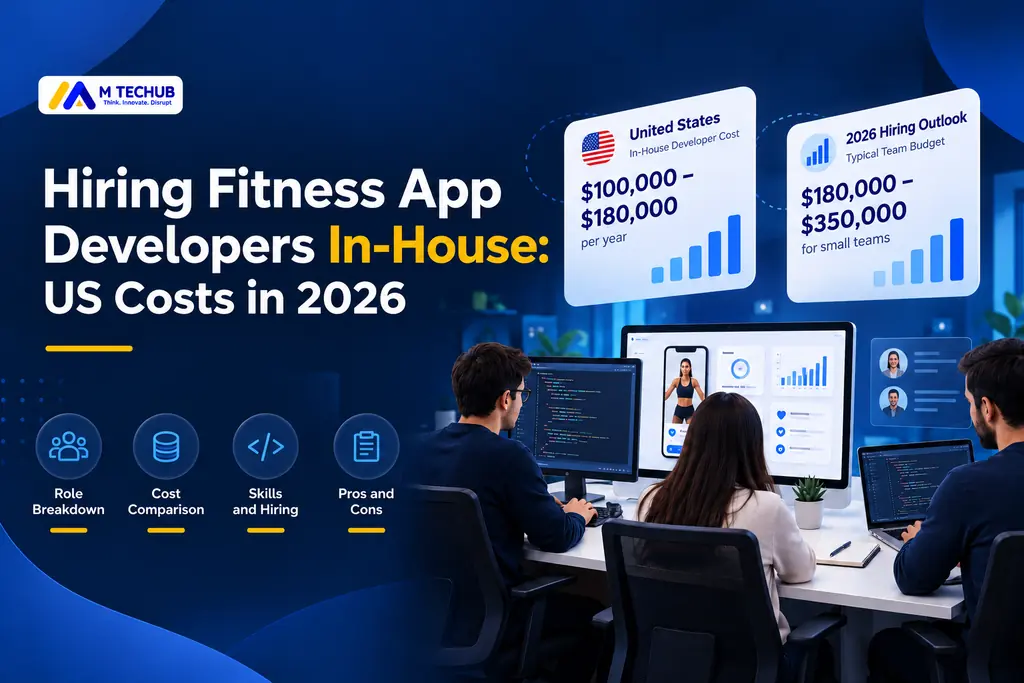
Hiring fitness app developers in-house can give your business greater control over its technology, product roadmap, and development priorities. But what does it actually cost to build an internal fitness app development team in the United States?
According to the US Bureau of Labor Statistics (BLS), the median annual salary for software developers was $135,980 in May 2025. Once employee benefits, recruitment, infrastructure, and other expenses are included, the cost of developing a fitness app internally can increase significantly.
Bureau of Labor Statistics
For US startups, gym chains, fitness brands, and health technology companies, understanding these costs is essential before committing to full-time hires.
This guide breaks down developer salaries, the true cost of an in-house team, MVP development budgets, and how internal hiring compares with outsourcing.
Key Takeaways
- US developer salary: The median annual software developer wage was $135,980 in May 2025, according to BLS.
- Fully loaded compensation: A 1.43× salary multiplier provides a useful preliminary budgeting benchmark based on June 2026 private-industry employer compensation data.
- Six-month MVP budget: A four-person US development team could cost approximately $431,694 under the staffing and operating assumptions detailed below.
- Agency alternatives: Clutch reports that mobile app projects in its international dataset commonly fall between $10,000 and $49,999, although complex projects can cost substantially more.
The salary and compensation figures come from official BLS data, while the MVP budget is a modeled scenario rather than an industry average.
How Much Does It Cost to Hire Fitness App Developers in the US?
The cost of hiring a fitness app developer in the United States depends on experience, technical expertise, geographic location, and the company’s compensation package.
Fitness app developers are not classified separately in federal occupational wage data. However, BLS software developer statistics provide a reliable national benchmark.
US Fitness App Developer Salary Benchmarks
| Role | Median annual US wage |
|---|---|
| Software developer | $135,980 |
| Software QA analyst/tester | $104,300 |
| Web and digital interface designer | $104,000 |
| Web developer | $92,650 |
These occupations reflect different responsibilities within a development team.
A mobile developer typically handles iOS or Android functionality, while a backend developer manages APIs, databases, authentication, and server-side operations. UI/UX designers create the product experience, and QA specialists test application performance and reliability.
A startup may combine these responsibilities within a smaller team, but doing so does not eliminate the underlying work.
What Is the Hourly Rate for a US Fitness App Developer?
Using the national median annual developer wage and a standard 2,080-hour work year:
$135,980 ÷ 2,080 = $65.38 per scheduled hour.
This is the equivalent hourly base salary, not a freelancer’s billing rate or an agency quote.
The BLS also reports that the highest-paid 10% of software developers earned more than $214,670 annually in May 2025. Specialized engineering positions may therefore require a substantially higher salary budget.
The True Cost of an In-House Fitness App Development Team
Salary is only one part of the cost of hiring developers.
Employers must also account for compensation expenses such as health insurance, retirement contributions, paid leave, and legally required benefits.
In its June 2026 Employer Costs for Employee Compensation report, released September 9, 2026, the BLS reported the following private-industry averages:
| Compensation component | Cost per hour worked |
|---|---|
| Wages and salaries | $32.82 |
| Employee benefits | $14.07 |
| Total employer compensation | $46.89 |
Dividing total compensation by wages produces a multiplier of approximately 1.43.
That means a business can use salary multiplied by 1.43 as an initial estimate of total employee compensation.
This is a broad private-industry benchmark rather than a technology-specific rate; actual expenses depend on the employer’s benefits structure and employment arrangements.
Example: Annual Cost of a Four-Person Development Team
Consider a fitness startup hiring two software developers, one UI/UX designer, and one QA engineer.
| Team member | Annual salary cost |
|---|---|
| Two software developers | $271,960 |
| One digital interface designer | $104,000 |
| One QA engineer | $104,300 |
| Total base salaries | $480,260 |
| Estimated employer compensation at 1.43× | $686,772 |
For this staffing arrangement, the annual compensation budget approaches $687,000 before separate recruitment, infrastructure, or business operating expenses.
The company would also need product management and technical leadership, either through existing employees or additional hires.
For startup founders, this raises an important question: does the business require a permanent engineering department, or would a smaller project-based development arrangement better suit its current needs?
How Much Does It Cost to Build a Fitness App MVP In-House?
A minimum viable product (MVP) is an initial version of an app containing the essential features needed to test demand and gather customer feedback.
For a fitness application, an MVP could include user registration, workout plans, exercise tracking, progress reports, and basic subscription management.
Advanced features such as live classes, AI-generated coaching, extensive wearable integrations, and complex gym administration can be introduced when they are commercially justified.
Six-Month Fitness App MVP Cost Breakdown
Assume a fitness startup employs the four-person team described above for six months.
This example uses national median salaries, an approximate 1.43× employer compensation multiplier, a $20,000 recruiting allowance, $12,000 for tools and infrastructure, and a 15% contingency. It assumes all four employees are on payroll throughout the six-month period.
Six-month in-house MVP budget
| Base salaries (six months) | $240,130 |
| Additional employer compensation | $103,256 |
| Recruitment | $20,000 |
| Tools and infrastructure | $12,000 |
| Contingency (15%) | $56,308 |
| Total six-month estimate | $431,694 |
Recruiting, tools, and contingency amounts are hypothetical planning allowances. Contingency is calculated on the $375,386 pre-contingency subtotal; totals are rounded to whole dollars.
The numbers demonstrate how quickly permanent staffing expenses accumulate during product development.
A smaller engineering team, existing technical employees, fractional specialists, or a simpler product scope could reduce the required upfront budget. Conversely, additional management, security, or integration requirements could increase it.
Hidden Costs of Hiring In-House Fitness App Developers
Beyond employee compensation, several expenses can influence the financial viability of internal development.
Recruitment and onboarding
Hiring experienced mobile engineers may involve recruitment services, technical interviews, candidate assessments, and management time.
New developers also need time to understand the product, codebase, architecture, and business requirements.
Delayed hiring can push back the launch even when the company has allocated enough money for salaries.
Cloud infrastructure and development tools
Fitness apps may require cloud hosting, databases, analytics, development software, automated testing tools, monitoring services, and backups.
These expenses can rise as the app gains users or introduces data-intensive capabilities such as workout video streaming.
Testing and maintenance
A fitness application must perform reliably across supported phones, operating systems, and connected devices.
Regression testing, bug fixes, compatibility updates, performance monitoring, and app-store maintenance continue after launch.
Employee turnover
Replacing a developer can create recruitment expenses, knowledge-transfer work, and delivery delays.
Clear documentation, shared technical ownership, and consistent development practices help reduce the operational impact.
Data security and regulatory requirements
Fitness applications may collect personal information, exercise history, heart-rate measurements, or other health-related data.
The legal requirements depend on how the app operates and which organizations are involved.
For example, HIPAA generally applies to covered entities and business associates. A consumer-facing fitness app does not automatically become HIPAA-regulated simply because it processes health information. The Federal Trade Commission’s Health Breach Notification Rule may separately apply to certain non-HIPAA health technology businesses.
HHS.gov
+1
Relevant security and legal obligations should be evaluated during product planning.
Which Fitness App Features Increase Development Costs?
Not all fitness applications require the same level of technical effort.
A basic workout tracker generally involves fewer complex integrations than a platform offering personalized training, real-time coaching, and wearable synchronization.
The table below compares the relative implementation effort of common fitness app features.
| Fitness app feature | Relative effort | Main technical challenge |
|---|---|---|
| User registration and profiles | Low | Account setup and authentication |
| Workout logging | Low–Medium | Exercise records and progress tracking |
| Progress dashboards | Medium | Calculations and data visualization |
| Subscription payments | Medium | Billing integration and access control |
| Nutrition tracking | Medium–High | Food data and calculation rules |
| Trainer booking and scheduling | Medium–High | Availability and calendar management |
| Wearable integrations | High | Permissions, APIs, and synchronization |
| Live workout streaming | High | Video delivery and real-time infrastructure |
| AI-assisted fitness coaching | High | Model integration, evaluation, and safeguards |
Relative effort is a qualitative comparison, not a monetary price range. The complexity of each feature depends on implementation scope and available third-party services.
Wearable Integration Costs
Fitness apps that connect with smartwatches or health platforms must handle user permissions, synchronization failures, and different data types.
For example, Apple HealthKit enables authorized access to supported health and fitness information.
Developers must account for permission changes, incomplete records, and ongoing compatibility requirements.
AI Fitness App Development Costs
AI features may include personalized workout suggestions, adaptive training plans, and nutrition recommendations.
Their cost depends on whether a company uses existing AI services, builds specialized recommendation logic, or operates custom models.
Businesses should prioritize AI features that solve a measurable user problem instead of expanding scope unnecessarily.
In-House vs Agency: Which Fitness App Development Model Costs Less?
One of the most important decisions for a fitness startup is whether to hire permanent developers or work with an external development agency.
The financial difference can be substantial, particularly during the first product launch.
According to Clutch’s September 2026 mobile app pricing guide, mobile app development projects reviewed on its platform commonly range from $10,000 to $49,999. The dataset’s average project cost is approximately $90,780, with company hourly rates generally reported at $25–$49.
clutch.co
These pricing benchmarks include international providers and a variety of application types. They should not be interpreted as US-only agency rates or guaranteed fitness app development prices.
Comparing In-House and Agency Costs
| Cost factor | In-house team | Development agency |
|---|---|---|
| Financial structure | Salaries and employment expenses | Project fees or retainers |
| Initial recruitment | Employer responsibility | Typically managed by agency |
| Staffing flexibility | Requires hiring or reassignment | Depends on contract and availability |
| Development oversight | Direct internal control | Shared through project management |
| Long-term support | Internal team | Contracted or transferred internally |
| Typical business fit | Continuous development | Defined projects and specialist needs |
Why Is the In-House Budget Much Higher Than Typical Agency Project Prices?
The $431,694 internal budget and Clutch’s $10,000–$49,999 common project range illustrate the difference between funding a permanent team for six months and purchasing a defined development engagement.
However, they do not represent identical deliverables.
The internal scenario assumes four US employees remain on payroll throughout the six-month period, including time spent designing, testing, coordinating, and handling noncoding responsibilities.
Clutch’s project data covers a variety of deliverables, durations, provider locations, and scopes. Some projects may involve relatively limited functionality, while complex applications can cost substantially more.
Agency pricing may also reflect distributed teams working in different labor markets.
For example, a startup developing an MVP with only workout logging, user profiles, and basic reporting may not need four full-time employees for six months.
An agency could potentially assign developers, designers, and testers only when their contributions are required.
That flexibility can reduce upfront employment commitments, but it does not guarantee that outsourcing will produce a lower total project cost.
For a reliable comparison, businesses should request agency proposals covering the same features, technical standards, testing, intellectual property ownership, deployment, and maintenance requirements.
When In-House Development Makes More Sense
Hiring internally may be appropriate for fitness businesses that expect continuous engineering work.
An established gym chain, for example, might require permanent technical staff to maintain membership systems, improve booking features, integrate payment platforms, and support multiple locations.
In that situation, building long-term institutional knowledge may justify the recurring employment expense.
When an Agency or Hybrid Team Makes More Sense
A startup validating its first fitness product may prefer a more flexible arrangement.
Working with an agency or maintaining a small internal product team supported by external engineers can help align staffing with actual project requirements.
At M Techub, our fitness and healthcare software development work includes the Savage Mushroom Fitness project, which our company identifies as an AI-powered fitness platform. The project illustrates how fitness software may combine mobile experiences with specialized recommendation and calculation features.
The development model should ultimately reflect the product’s commercial stage, technical complexity, and long-term roadmap.
How to Budget for Your Fitness App Development Team
A realistic development budget should begin with product requirements rather than a fixed headcount.
Start by identifying the essential activities users must complete in the first release. A personal training app, for example, may only need workout assignments, activity logging, coach communication, and basic progress tracking.
Next, determine the technical approach. Native iOS and Android development may be appropriate for products with extensive platform-specific requirements, while cross-platform development can be worth evaluating for applications sharing substantial functionality across devices.
The staffing plan should cover mobile development, backend services, interface design, QA, deployment, and ongoing support.
For each role, estimate the amount of work and expected duration. Not every specialist necessarily needs to be employed full-time.
The complete budget should then account for compensation, recruitment, infrastructure, external services, and contingency.
Finally, compare at least three scenarios: a lean MVP, a baseline product, and an expanded release with additional integrations.
This helps decision-makers understand which expenses are essential for launch and which can be deferred until the business has stronger evidence of customer demand.
Final Thoughts: Should You Hire Fitness App Developers In-House?
Hiring an internal fitness app development team gives businesses direct control over product decisions, technical resources, and ongoing development.
However, the financial commitment extends beyond developer salaries. Employers must consider benefits, recruitment, infrastructure, maintenance, and the cost of maintaining technical expertise over time.
For established fitness technology companies with continuous development needs, in-house hiring can be a valuable long-term investment.
For startups, entrepreneurs, and fitness brands testing a new product, an agency or hybrid development model may offer greater flexibility.
The right approach is the one that supports your product requirements, budget, and commercial goals without creating unnecessary financial commitments.
References
- U.S. Bureau of Labor Statistics — Software Developers, Quality Assurance Analysts, and Testers
- U.S. Bureau of Labor Statistics — Occupational Projections and Worker Characteristics
- U.S. Bureau of Labor Statistics — Employer Costs for Employee Compensation
- Clutch — Mobile App Development Pricing Guide 2026