
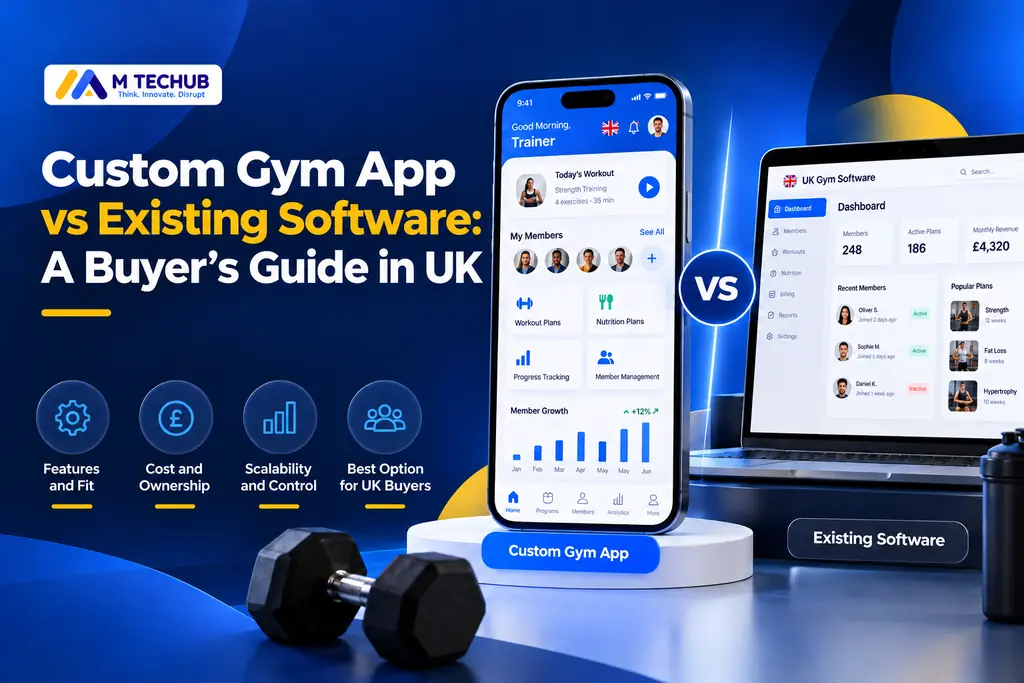
For most UK gyms with standard booking, membership and payment requirements, existing gym management software is the most practical starting point. A white-label app may be better for fitness businesses that want their own branding without developing an application from scratch. A custom gym app becomes worth considering when unusual workflows, complex integrations or distinctive member experiences cannot be supported by existing products.
The choice affects more than your initial software budget. Subscription fees, payment processing, staff administration, data migration and future expansion can all influence what your gym spends over time.
This guide compares the three approaches, explains their advantages and limitations, examines established software providers and shows how to evaluate total costs before making a decision.
What Is the Difference Between Custom Gym Apps and Existing Gym Software?
The main difference is how much of the product has already been built and how much control your business has over its functionality.
Existing Gym Management Software
Existing gym software is a ready-made platform usually accessed through a monthly or annual subscription.
Depending on the provider and plan, it may handle member registration, class scheduling, recurring payments, attendance, reporting and staff administration.
A gym owner configures the available functionality instead of commissioning a new software product.
For example, a small fitness studio offering group classes and monthly memberships may find that an established platform already covers its essential operations.
White-Label Gym Applications
A white-label fitness app uses software developed by an existing provider but allows selected changes to its appearance and branding.
Depending on the package, a gym may be able to display its own name, logo and colours, and offer members a branded app experience.
The provider generally continues to manage the underlying platform. The gym’s ability to add entirely new features remains subject to the supplier’s product and integration capabilities.
Custom Gym Applications
A custom gym app is designed and developed around a business’s documented requirements.
It can incorporate standard features such as bookings and payments alongside specialist functionality, including unusual membership rules, tailored reporting, access-control integrations or multi-location workflows.
Custom development provides greater flexibility, but the business must budget for development, testing, deployment, maintenance and future improvements.
Quick Comparison
| Factor | Existing software | White-label app | Custom app |
|---|---|---|---|
| Starting investment | Usually lower | Low to moderate | Usually higher |
| Implementation | Configure existing features | Configure and brand | Design and develop |
| Branding | Provider-dependent | Greater branding options | Tailored to requirements |
| New functionality | Vendor-dependent | Vendor-dependent | Can be developed |
| Core platform updates | Provider-managed | Provider-managed | Arranged by the business |
| Hosting | Usually included | Usually included | Budget separately |
| Future flexibility | Limited by platform | Limited by platform | Depends on architecture and budget |
| Best suited to | Standard gym operations | Branded member experience | Specialist requirements |
These are general differences between delivery models. Individual products and contracts may vary.
Existing Gym Management Software: Benefits and Limitations
Off-the-shelf software can be a sensible choice for gyms that need to organise everyday operations without building their own technology platform.
Faster Setup for Common Gym Operations
Consider an independent gym preparing to open a second studio.
Its immediate priorities might include transferring members, configuring new class schedules, collecting recurring payments and allowing staff to manage bookings.
An established platform may already support these requirements. The gym can focus on configuration, migration and employee training rather than product development.
The actual implementation period still depends on data quality, payment arrangements and the complexity of the business.
Established Features and Provider Support
Many subscription platforms provide a combination of booking, membership management, payment collection and reporting.
The provider typically manages core infrastructure and platform updates. This reduces the gym’s need to maintain its own application code.
However, support packages differ. Some contracts may include basic assistance while charging separately for advanced onboarding, integrations or additional services.
Where Existing Software Can Become Restrictive
Off-the-shelf platforms are built to serve multiple businesses, so their features may not match every gym’s operational processes.
For example, a fitness chain may need members to access different locations according to complex entitlement rules. If the platform cannot support those rules, staff may need manual workarounds.
Other potential difficulties include limited integration options, subscription increases, restricted data exports and dependence on the supplier’s development roadmap.
When it makes sense: Choose existing software when the platform covers your essential requirements without costly workarounds, and the complete subscription package remains affordable.
Custom Gym App Development: Benefits and Challenges
A bespoke gym application offers greater control over how software supports the business. However, greater flexibility brings additional responsibilities.
Features Built Around Actual Workflows
Custom development can address operational requirements that standard platforms cannot easily accommodate.
For instance, a business offering personal training, group classes and corporate memberships may need different booking entitlements, billing rules and staff permissions.
A tailored application can be designed to manage these processes together, rather than requiring employees to switch between several tools.
Integration With Existing Systems
Some gyms already use separate systems for access control, accounting, customer management or member communications.
A custom solution can be developed to exchange information across these systems, provided the third-party products support the required integrations.
Before development begins, the technical team should check API availability, permissions, licensing restrictions and the cost of maintaining each connection.
Flexibility for Growing Fitness Businesses
A multi-location operator may need centralised reporting, shared member accounts and location-specific administrative controls.
Custom software can be planned around these requirements and extended as operational needs evolve.
However, bespoke development is not automatically more scalable than commercial software. Scalability depends on technical architecture, infrastructure, testing and ongoing investment.
Challenges to Consider
Developing an application introduces responsibilities that may include:
- Defining requirements and managing the project.
- Designing and testing the user experience.
- Securing member information and payment integrations.
- Maintaining hosting and system availability.
- Updating dependencies and mobile applications.
- Supporting users and resolving defects.
- Funding future enhancements.
The gym should also clarify who owns the source code, design assets, infrastructure accounts and related intellectual property.
When it makes sense: Consider custom development when important requirements remain unresolved after evaluating suitable existing products, and the expected business value can justify the investment.
White-Label Gym Apps vs Bespoke Fitness Apps
White-label software provides a middle option between adopting a standard platform and commissioning an entirely new application.
When Branding Is the Main Requirement
Imagine a boutique studio with an established brand and a loyal membership base.
Its members already book classes digitally, but the studio wants a mobile experience that displays its own identity.
If its existing booking and membership workflows are satisfactory, a white-label application may be enough.
The business can introduce stronger branding without paying to rebuild functionality that already works.
What White-Label Apps May Not Provide
Branded applications do not necessarily allow major changes to booking rules, database structures, payment workflows or the underlying software architecture.
Some products also have restrictions on app-store listings, design customisation and third-party integrations.
Therefore, a branded app should not be described as equivalent to a bespoke product simply because it uses the gym’s logo.
When Bespoke Development Is More Appropriate
A custom application may be better when a business requires functionality that cannot be provided through the white-label platform.
For example, a specialist fitness franchise might need an unusual membership structure linked to its own access-control hardware and central billing arrangements.
If established products cannot support these requirements affordably, custom development becomes worth investigating.
The deciding factor is the functional requirement, not branding alone.
Custom Gym App vs Existing Software: Cost Comparison in the UK
Software pricing can appear straightforward until implementation, integrations, payment processing and support are considered.
For a reliable comparison, gym owners should distinguish between initial costs, recurring charges and expenses that depend on usage.
Existing Gym Software Pricing
Subscription software generally involves a recurring charge for access to the provider’s platform.
However, the advertised starting price may not cover all the features a gym requires.
As of October 2026, Mindbody advertises UK business plans starting at £89 per month per location.
Its Starter offering includes core business management tools, integrated payments, booking widgets and basic reporting. Higher plans provide additional capabilities.
The £89 figure is a published starting price, not a final quotation for every gym. The actual price depends on the chosen package and any required additional services.
Mindbody
Businesses should confirm payment processing charges, contract conditions, relevant add-ons and VAT treatment before calculating annual costs.
White-Label Gym App Pricing
White-label apps may require a qualifying subscription, one-off branding charges or additional app-related fees.
For example, ABC Trainerize lists a Pro-level custom branded app with a one-off $169 USD setup fee, subject to having an eligible paid subscription.
The provider also offers branded applications through higher-level packages. Its documentation identifies an additional Apple Developer account requirement for certain independently listed applications.
ABC Trainerize Help Center
+1
These charges are published in US dollars and should not be treated as confirmed GBP prices.
UK businesses should account for the applicable exchange rate, payment provider conversion charges and any relevant taxes when assessing USD-denominated subscriptions.
Bespoke Gym App Development Costs
Custom gym app development does not have one standard UK price.
A project limited to class bookings and member profiles requires a different investment from a full management platform covering multiple locations, payments, reporting and third-party integrations.
The final quotation can be affected by the required features, number of user roles, integration complexity, mobile platforms, data migration, security requirements and support arrangements.
For the three-year example below, £30,000 is used solely as a hypothetical initial development budget.
It is not a verified UK market average or a confirmed quotation. An actual development proposal may be higher or lower depending on the scope.
Costs to Compare Before Signing a Contract
| Expense | What to verify |
|---|---|
| Initial setup | Configuration, onboarding and training |
| Subscription | Monthly charge, pricing tiers and annual increases |
| Custom development | Scope, deliverables and payment milestones |
| Branded app | App design, publishing and renewal requirements |
| Hosting | Whether infrastructure is included |
| Support | Response times and included maintenance |
| Payments | Transaction fees, refunds and recurring billing costs |
| Integrations | Setup, licensing and ongoing connection charges |
| Migration | Export, import and data validation |
| Future upgrades | Charges for new features or major changes |
For UK quotations, also check whether prices include VAT. The standard UK VAT rate is 20% for most taxable goods and services, although the treatment of a particular supply should be confirmed.
Total Cost of Ownership: Which Option Offers Better Value?
The initial price does not show what a gym will spend over the full life of its software.
Total cost of ownership (TCO) combines initial expenditure, recurring charges and other relevant costs across a defined period.
A three-year comparison can help owners evaluate their options, provided the assumptions are clearly explained.
How to Calculate Three-Year Software Costs
A simple model is:
Three-year TCO = Initial costs + (Monthly recurring costs × 36) + Other one-off costs
The calculation can include setup, development, subscriptions, integrations, hosting, support and migration.
It should also account for payment charges, upgrades and internal staff time where these differ meaningfully between options.
An Illustrative Three-Year Comparison
Consider a hypothetical single-location studio that needs member administration, class bookings, payment integration and basic reporting.
The following scenarios show how different purchasing models might affect expenditure.
All figures are illustrative assumptions in GBP, excluding VAT. They are not actual supplier quotations or independently verified UK market prices.
Scenario 1: Existing SaaS
The studio adopts a subscription platform covering standard booking, membership administration and reporting.
The model assumes core platform hosting and routine provider updates are included within the subscription.
The budget includes configuration, migration and an allowance for supplementary services.
Scenario 2: White-Label App
The studio adopts a branded application supported by an established software platform.
The model assumes standard bookings and member access are included, together with the provider’s underlying hosting and routine platform updates.
The higher monthly allowance represents the hypothetical cost of branding and related platform services.
Scenario 3: Bespoke App
The studio commissions software with member accounts, class bookings, administration tools and specified integration functionality.
The model allows separately for initial development, integration work, hosting, support and data migration.
The ongoing maintenance allowance is hypothetical and does not guarantee that major upgrades are covered.
Three-Year Cost Table
| Cost component | SaaS | White-label | Bespoke |
|---|---|---|---|
| Initial setup or development | £1,000 | £1,500 | £30,000 |
| Monthly platform or maintenance | £150 | £300 | £400 |
| Monthly supplementary services or hosting | £40 | £40 | £150 |
| One-off integration development | £0 | £0 | £3,000 |
| Data migration | £900 | £900 | £900 |
| Total over 36 months | £8,740 | £14,640 | £53,700 |
The calculations are:
- SaaS: £1,000 + (36 × £190) + £900 = £8,740.
- White-label: £1,500 + (36 × £340) + £900 = £14,640.
- Bespoke: £30,000 + (36 × £550) + £3,000 + £900 = £53,700.
Illustrative three-year ownership cost
Hypothetical assumptions in GBP, excluding VAT. Not supplier quotations.
£0£15,000£30,000£45,000£60,000Existing SaaSWhite-labelBespoke
Are All Three Options Functionally Equivalent?
Not necessarily. This is an important limitation of the example.
All three scenarios assume some form of member administration, booking and payment connectivity. They do not guarantee equal functionality or service levels.
A subscription package might lack a specialist integration included in the bespoke project. Equally, the bespoke development budget might not include sophisticated reporting, marketing automation or other features available in a commercial platform.
The comparison also excludes separate payment processing charges, major future enhancements, unforeseen technical work and internal operational costs.
Before treating the totals as directly comparable, a gym should obtain quotes against the same list of essential requirements.
The lowest modelled cost does not automatically represent the best-value solution.
When Could Custom Software Justify the Additional Investment?
In this hypothetical comparison, bespoke software costs £44,960 more than SaaS over three years.
To offset that difference evenly across 36 months, the custom option would need to generate approximately £1,249 of additional measurable net benefit per month.
This is a simple break-even illustration, not a forecast of profit or guaranteed savings. It excludes financing effects, discounting and uncertainty around benefits.
Financial value could come from reduced administrative costs, less manual reconciliation or additional contribution profit from services that existing software cannot support.
For instance, if a custom system reduces a repetitive administrative task, the business should establish whether the saved hours actually reduce costs or allow employees to perform other valuable work.
Likewise, any anticipated revenue increase should be supported by realistic customer demand and profit-margin assumptions.
A custom app becomes financially more defensible when these measurable benefits outweigh the additional development and operating costs.
Compare Popular Gym Management Software Options
Mindbody, ABC Glofox and ABC Trainerize are established fitness software providers, but they serve different business needs.
Comparing them solely by subscription price would overlook important differences in bookings, membership administration, coaching, branding and integrations.
Mindbody: Studio Booking and Business Management
Mindbody provides tools for class scheduling, integrated payments, business administration and reporting.
Its Starter plan covers essential operations, while Accelerate and Ultimate introduce additional capabilities such as more advanced analytics, scheduling features and marketing tools.
The platform also allows businesses to appear within the Mindbody consumer app. This should not be confused with automatically receiving an independently branded application.
Best suited to: Studios that want established booking, payment and administrative tools.
Check before purchasing: Higher-tier pricing, payment processing charges, additional services, required integrations and branded app options.
Official source: Mindbody UK pricing.
Mindbody
ABC Glofox: Membership and Gym Operations
ABC Glofox provides membership administration, bookings, scheduling, payments and reporting.
Its published Essential plan includes core gym management functionality and access to Glofox member and staff applications.
Higher plans add capabilities such as advanced reporting, lead capture and additional engagement tools.
A custom-branded member app is listed as an optional add-on for certain plans and included in the Elite package.
Best suited to: Gyms and fitness studios that need centralised membership and class administration, with options for a branded member experience.
Check before purchasing: A UK-specific quotation, branding charges, location requirements, supported integrations and contract conditions.
Glofox advertises plans starting at $99 USD per month, but this is not a verified GBP price for a UK gym.
Official source: ABC Glofox plans.
Glofox
ABC Trainerize: Personal Training and Digital Coaching
ABC Trainerize focuses on workout programming, client communication, training progress and digital coaching.
Its subscriptions provide different client capacities and optional business tools. Some packages include appointment-related functionality, payment integrations and branded app arrangements.
Unlike platforms focused primarily on physical gym operations, Trainerize is particularly relevant for personal trainers and coaching-led businesses.
A gym requiring complex membership administration, access control or multi-location operations should verify whether Trainerize meets those needs or must be paired with another system.
Best suited to: Personal trainers, online coaches and fitness businesses offering personalised programmes.
Check before purchasing: Client limits, add-ons, branded app requirements, payment fees and compatibility with other gym systems.
Trainerize publishes pricing in US dollars. Current GBP costs will depend on currency conversion and applicable charges.
Official sources: ABC Trainerize pricing and Branded app fees.
ABC Trainerize Personal Training Software
+2
H3: Software Provider Comparison
| Factor | Mindbody | ABC Glofox | ABC Trainerize |
|---|---|---|---|
| Primary focus | Studio and business management | Gym and studio operations | Personal training and coaching |
| Class bookings | Supported | Supported | Check required workflow |
| Membership management | Business management tools | Core gym functionality | Primarily client management |
| Branded app | Options depend on offering | Plan-dependent | Tier-dependent |
| Integrations | Verify individual connections | Verify individual connections | Varies by plan and add-ons |
| Published pricing | UK starting price | USD starting price | USD subscriptions |
| Key consideration | Plan features and extra charges | Membership needs and branding | Coaching features and client capacity |
Buying advice: Request a demonstration using your gym’s actual membership rules, booking policies and payment requirements. A platform should be evaluated on the workflows it can support, not simply the number of features advertised.
When Should a UK Gym Choose Existing Software?
Existing gym management software is often appropriate when business requirements are relatively standard and implementation speed matters.
For example, a single-location studio may need online bookings, membership renewals, payment collection and straightforward reporting.
If an established platform can handle these functions reliably, commissioning a bespoke application may introduce unnecessary cost and complexity.
Existing software is particularly worth considering when:
- The business has a limited initial technology budget.
- Standard booking and membership tools cover essential operations.
- Staff need to begin using the system relatively quickly.
- The gym does not have an internal software development team.
- The selected supplier offers suitable support and data export options.
Before committing, test real activities such as cancelling a membership, moving a booking, issuing a refund and exporting member information.
A product demonstration that successfully completes these tasks provides stronger evidence of suitability than a general sales presentation.
When Does a Bespoke Gym App Make More Sense?
Custom development becomes more relevant when a gym has requirements that suitable existing platforms cannot support effectively.
Complex Membership Models
A fitness business might offer corporate access, location-specific memberships, class credits and specialist cancellation rules.
If existing software cannot manage these arrangements without extensive manual work, tailored development may be worth evaluating.
Multiple Locations and Franchises
A growing chain may require centralised reporting, shared member access, different staff permissions and integration with multiple operational systems.
An existing multi-location platform should still be evaluated first. Bespoke development is more appropriate when its particular requirements remain unresolved.
Specialist Integrations
Some gyms use access-control equipment, accounting systems or customer management tools with specific technical requirements.
A custom platform may provide a way to connect them, provided the necessary integration interfaces and permissions are available.
Distinctive Member Services
A fitness business offering proprietary coaching services or specialist membership experiences may need features unavailable through commercial platforms.
Before investing, it should validate demand for those features and establish how they contribute to the business.
Custom development should solve a genuine business problem rather than simply reproduce standard gym software at a higher cost.
How to Choose the Right Gym Software for Your Business
Choosing software becomes easier when the evaluation starts with operational requirements rather than supplier marketing.
Create a Requirements List
Divide your requirements into three categories: essential features, useful extras and future improvements.
For example, recurring payments may be essential for a membership-based gym, while advanced loyalty functionality could be postponed.
This prevents the business from paying for features that provide little immediate value.
Test Everyday Workflows
Ask each shortlisted provider to demonstrate realistic tasks.
These might include signing up a new member, changing a subscription, applying a booking cancellation policy, processing a failed payment and generating a monthly report.
Where possible, involve the employees who will use the software every day.
Compare Complete Quotations
Request itemised costs across the same period and feature specification.
Confirm whether hosting, maintenance, data migration, support and integrations are included.
If one quotation lacks a required function, establish the cost of adding it before comparing the totals.
Review Data Portability and Contract Terms
Find out how member information can be exported and whether the supplier provides support when a contract ends.
Check cancellation arrangements, renewal terms, price changes and potential migration costs.
For bespoke projects, also clarify source-code ownership, documentation and ongoing maintenance rights.
Evaluate Growth Requirements
Consider the number of members, staff and locations you expect the system to support.
Ask how pricing or performance requirements change as those numbers increase.
A system that meets today’s requirements should also provide a practical route for foreseeable growth.
UK GDPR, Payment Security and Accessibility Considerations
Software selection also affects how a gym manages member information and digital services.
These considerations should be part of the purchasing process, regardless of whether the business chooses SaaS, white-label or custom development.
Protecting Member Information
Gym systems commonly store names, contact details, membership information and attendance records.
Business owners should understand where this information is stored, who can access it and how it can be exported or deleted when appropriate.
Useful supplier questions include whether staff permissions can be restricted, whether accounts support suitable authentication and how backups and security incidents are handled.
Handling Health-Related Information
Some fitness applications collect information about injuries, medical conditions or other health-related matters.
Depending on what is collected and what it reveals, this may qualify as special category data under UK GDPR.
Such processing can involve additional legal requirements. The business should assess whether the information is necessary and identify the appropriate basis and safeguards for processing it.
The UK’s Information Commissioner’s Office provides guidance on these obligations.
ICO
Payment Processing Responsibilities
Before adopting a platform, determine which provider processes card payments and how recurring billing, refunds and failed transactions work.
Ask whether the payment service handles sensitive card details directly, what responsibilities remain with the gym and whether there are additional processing fees.
The use of a third-party payment service does not eliminate the need to understand relevant contractual and data protection responsibilities.
The ICO also explains the importance of appropriate contracts between data controllers and processors.
ICO
Making Gym Apps Accessible
Booking classes, managing memberships and completing payments should be straightforward for different users.
When evaluating an app, consider text readability, colour contrast, understandable error messages, clear navigation and accessible form controls.
WCAG 2.2 provides a recognised technical reference for web accessibility, although specific obligations depend on the service and applicable law.
W3C
Choosing an established platform or commissioning a custom application does not automatically guarantee legal compliance.
Common Mistakes to Avoid When Choosing Gym Software
A poor software decision can create unnecessary costs even when the initial product appears affordable.
Focusing Only on Monthly Subscription Prices
An advertised entry-level subscription may exclude required functionality, transaction charges or additional locations.
Compare complete costs rather than headline prices.
Paying for Features the Gym Does Not Need
Advanced reporting, marketing automation and customised member experiences may be valuable to some businesses but unnecessary for others.
Prioritise features that solve current operational problems.
Failing to Test Integrations
Do not assume that a software product can connect with an existing door-entry system, payment provider or accounting platform.
Request technical confirmation before signing a contract.
Ignoring Data Migration
Switching platforms may involve transferring member records, booking information and payment arrangements.
Establish what information can be exported, how it will be transferred and who is responsible for checking its accuracy.
Underestimating Custom App Maintenance
A bespoke application needs ongoing technical attention after launch.
Hosting, security updates, operating system compatibility and future improvements should be included in the financial plan.
Choosing Without Staff Input
The employees managing bookings and memberships are often best placed to identify operational problems.
Their feedback during demonstrations can reveal limitations that are not obvious from marketing materials.
Final Verdict: Custom Gym App or Existing Software?
The best choice depends on your gym’s operational needs, available budget and growth plans.
For an independent gym or small studio, existing management software is often the most reasonable starting point. It can provide booking, payment and membership tools without the expense of developing a new platform.
For an established fitness business that mainly wants stronger branding, a white-label application may provide the appropriate balance between cost and customisation.
For a multi-location operator or specialist fitness company, bespoke software may be justified when existing products cannot accommodate essential workflows or integrations.
Before making a decision, compare each option against the same requirements, request complete quotations and evaluate its likely benefits over several years.
The right software is the one that meets your business requirements reliably at a sustainable total cost—not necessarily the cheapest subscription or the most customised application.