
TL;DR
- Buy or license when a platform passes your essential workflow tests and its terms fit your business.
- Build when essential requirements need custom engineering and you can fund ongoing operation.
- Before signing, verify scope, integrations, total cost, maintenance, and a workable exit.
- Branding does not establish software ownership; outsourcing does not resolve your privacy responsibilities.
Imagine launching a fitness service and finding your coach still copying workout notes into one system, meal changes into another, and progress updates into a spreadsheet.
The app is live, but the workflow remains fragmented.
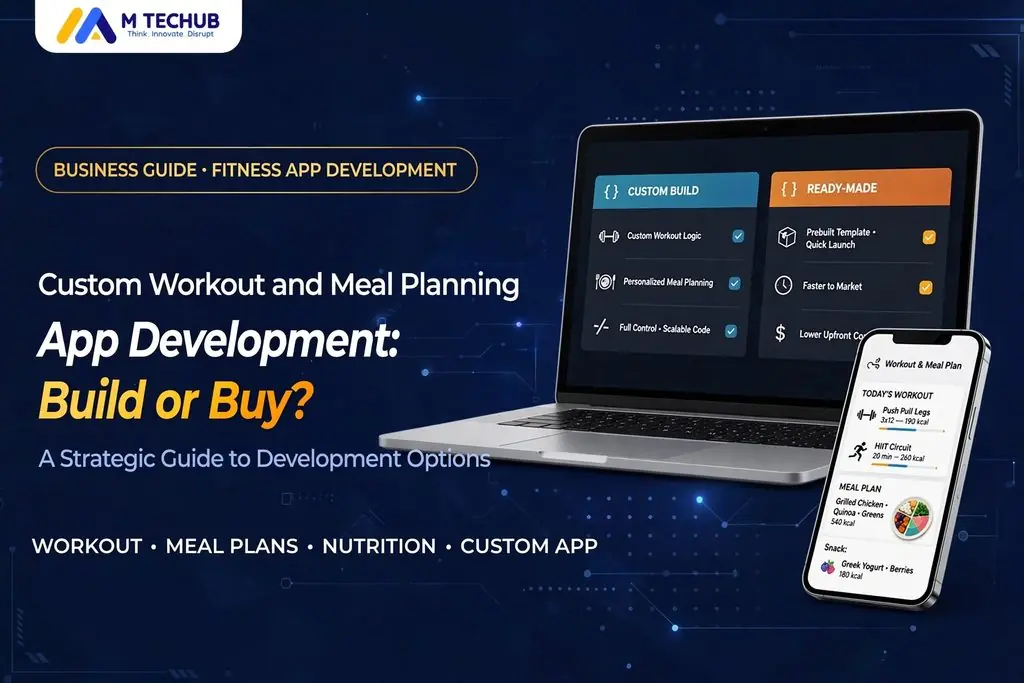
Choosing the wrong delivery approach creates product and operational problems. This guide helps US and UK founders, gym owners, and coaching businesses compare a custom workout and meal plan app with licensed and white-label software—from features and development to costs, privacy, and contract rights.
What does a workout and meal planning app actually include?
It connects training plans, completed workouts, nutrition activities, and progress reviews in one usable journey.
A fitness and meal planner should distinguish intended actions from recorded activity. A meal plan is not a food log. A workout program is not a completed-session record. If a member changes lunch after completing a workout, the dashboard should preserve both facts.
The business model determines the surrounding tools. Consumer subscriptions need content access and billing; coaching services need assignments and check-ins; gym offerings need member administration; B2B platforms need separate organizations and permissions.
Those workflows shape the scope of healthcare and fitness software development.
Start with the smallest useful product
For a coach-led meal and fitness planner, start with onboarding, assigned workouts, simple food logging, and weekly review. Use MVP development to define and test that complete journey before adding secondary features.
Track onboarding completion, check-in response, workout-log completion, and renewal. Use those measures to decide what needs improvement.
Define features around actual users
Beginners need clear instructions, equipment alternatives, and simple progression. Strength logs need sets, repetitions, load, and units; cardio logs need activity-appropriate fields.
Nutrition features require defined portions, recipe quantities, and corrections. A food tracking app for weight gain needs editable goals without promising an outcome. Users should be able to correct automated food identification before saving it.
A couples fitness app can share plans while keeping individual logs and measurements private. Do not infer ability or nutritional needs from gender.
Include eating-disorder-sensitive design: avoid shaming language, restrictive-eating rewards, and compulsory calorie displays. Give users control over reminders and weight-focused information.
Test accessibility through screen-reader labels, scalable text, contrast, captions, touch targets, and alternatives to color-only indicators.
Build, buy, license, or white-label?
These approaches differ in customization, operational responsibility, and contractual rights. The table describes common procurement patterns; the proposal and contract determine what you actually receive.
| Factor | Existing SaaS platform | White-label platform | Custom development |
| Starting point | Supplier’s standard product | Existing product with agreed customization | Your defined scope |
| Initial spending | Subscription and setup | Setup, branding, and subscription | Discovery and engineering |
| Workflow control | Available configuration | Agreed customization limits | Funded requirements |
| Branding | Available branding options | Contracted branding package | Product-specific design |
| Integrations | Connectors and API terms | Package and contract dependent | Built or licensed for scope |
| Software rights | Contracted access rights | Usage, branding, and any code rights | Commissioned-work and dependency terms |
| Maintenance | Supplier’s service commitments | Responsibilities divided by agreement | Internal team or retained provider |
| Exit | Export and termination terms | Data, listing, and branding terms | Handover, accounts, and dependencies |
Trainerize’s custom branded apps illustrate a white-label approach: branding and customization are applied to an existing platform, with options varying by package.
Coaching businesses often compare Everfit, TrueCoach, and My PT Hub alongside Trainerize. Check each for nutrition tracking depth, white-label options, API access, export format, pricing tiers, and support terms.
If you buy source code, inspect its licenses, dependencies, documentation, and build process. A code purchase still requires technical review and launch preparation.
What does building a custom app require?
A custom build requires mobile development, backend services, administration tools, testing, release work, and ongoing ownership.
Native vs. cross-platform
Native applications use platform-specific implementations. Cross-platform development shares parts of the implementation across iOS and Android.
Choose based on integrations, device features, interface requirements, and team capabilities. Shared code does not remove platform-specific permission handling or testing. Separate native applications require coordinated delivery.
Validate the most demanding integration before committing to the architecture.
Backend and admin panel
Define responsibilities for accounts, plans, logs, subscriptions, synchronization, and notifications. Staff need tools to manage members, coaches, content, and support.
Enforce permissions in the backend, including separation between organizations. Preserve plan versions so future edits do not rewrite completed records.
Assign ownership of infrastructure, backups, deployment, exercise content, and third-party integrations.
QA and app-store submission
Test real devices, interrupted entries, poor connectivity, permission changes, duplicate imports, billing events, and account deletion.
Assign responsibility for store accounts, listings, privacy disclosures, screenshots, review responses, and post-launch fixes. Submission requires preparation and review; it does not establish a guaranteed approval date.
In-house team, agency, or freelancer?
| Model | Practical fit | What to establish |
| In-house | Continuous product ownership | Hiring, leadership, specialist coverage |
| Agency | Coordinated delivery across disciplines | Named team, scope, handover, support |
| Freelancer | Bounded work with clear dependencies | Integration responsibility, review, continuity |
Evaluate the actual team and commitments. Keep product decisions and acceptance criteria under clear ownership.
Example: How M TECHUB built an AI fitness app
Savage Mushroom shows how personalized workflows can create a substantial custom-development scope.
In its Savage Mushroom case study, M TECHUB describes a project for an Australian fitness startup. The product combines personalized workouts, AI-generated meal programs, calorie targets, and progress tracking.
M TECHUB reports delivering product strategy, UI/UX, React Native mobile development, backend architecture, Gemini AI integration, QA testing, and launch support.
| Project detail | Reported by M TECHUB |
| Platforms | iOS, Android, admin web panel |
| Technology | React Native, Node.js, PostgreSQL |
| Timeline | 6+ months |
| Team | 8 specialists |
The reported challenges included a deterministic calorie engine, onboarding with 67 data points across 15 screens, AI meal generation, adaptive workouts, and App Store review. M TECHUB reports clearing the App Store review on the first resubmission.
This project is an example of a custom scope shaped by personalized onboarding, calculation logic, and AI features, not a build-versus-buy comparison.
What founders can take from this scope
- Collect purposeful onboarding data. Require each field to support a defined product function; test completion and time to value.
- Separate calculations from generated content. Keep deterministic calculations testable and distinguish them from AI suggestions requiring review.
- Plan for review and release. Allocate responsibility for submissions, disclosures, questions, and revisions.
- Own integrations and content operations. Assign maintenance, licensing, and quality review to named roles.
These are useful planning questions when scoping AI app development.
Want to build something similar? Discuss your requirements with M TECHUB.
Which integrations and data rules matter?
Apps that combine nutrition and fitness tracking need explicit rules for permissions, synchronization, food data, and historical records.
Health data access
Use Apple’s HealthKit authorization guidance and Android Health Connect’s data types to define permitted reads and writes.
Specify sync timing, duplicate handling, source identifiers, and behavior when permission is denied or revoked. A locally recorded workout and its imported copy should not count as two sessions.
Food coverage across markets
USDA FoodData Central provides food and nutrient data through an API. Its availability does not establish coverage of the UK foods, brands, or restaurant items your audience needs.
Evaluate UK-relevant sources and test familiar foods, portions, recipes, and barcode searches.
UK-relevant food datasets can supplement US sources. Options include the UK government’s CoFID composition dataset and the community-built Open Food Facts database. Check licensing and attribution terms, update frequency, barcode coverage, and data quality before depending on either.
Provide manual entry and corrections. Define how food-data updates affect new entries without silently changing historical logs.
Which privacy and compliance rules apply in the US and UK?
Applicability depends on your business relationships, data processing, users, and intended product use.
In the US, HIPAA applies to covered entities and business associates. Handling health-related information alone does not establish coverage. Consult HHS guidance on covered entities and business associates.
The FTC Health Breach Notification Rule can cover health apps outside HIPAA.
State laws such as Washington’s My Health My Data Act and California’s CCPA/CPRA may apply, depending on your users and the data you collect. Washington’s law covers consumer health data and sets consent and disclosure requirements, so confirm applicability for your business with counsel.
In the UK, assess processing under UK GDPR and the Data Protection Act 2018. Special category health data requires an Article 6 lawful basis and an Article 9 condition, with associated requirements where applicable. Consult ICO guidance on special category data.
Turn the assessment into data minimization, permissions, encryption, retention, deletion, vendor oversight, and incident response. Review analytics payloads as well as database access.
General wellness and medical positioning require separate assessment, particularly for dietary guidance and health claims.
A general wellness app is regulated differently from software intended to diagnose, treat, or manage disease. In the US, the FDA’s treatment depends on intended use; in the UK, the MHRA assesses software against its intended purpose. Review dietary guidance, condition-specific features, and marketing claims before launch.
Get a product-specific legal review before launch.
How do you compare total cost?
Compare the same scope, planning period, and usage assumptions across every option.
Total ownership cost = initial delivery + recurring operation + internal administration + expected change and exit costs.
Request an itemized estimate by feature and milestone, with exclusions, assumptions, and maintenance terms stated.
| Cost category | Licensed or white-label | Custom build |
| Initial delivery | Setup, branding, configuration | Discovery, design, engineering, testing |
| Recurring operation | Subscription, add-ons, support | Infrastructure, monitoring, maintenance |
| Internal work | Administration, content, workarounds | Product ownership, content, support |
| Change and exit | Upgrades, exports, migration | New features, handover, dependency changes |
Compare low, expected, and high usage scenarios. Require milestones and acceptance criteria rather than an unexplained price or launch date.
App-store billing
Include billing implementation, subscriber access, refunds, and purchase restoration in the comparison. Establish who controls subscription records and supports payment problems.
Apple and Google set the billing rules and fees for digital subscriptions sold in apps, and Apple’s US external-payment rules are still being worked out in court. Check current terms before modeling revenue, and have your team confirm how checkout, refunds, and subscriber access will work.
Do not assume a white-label subscription includes every billing requirement.
What contract and ownership red flags should you check before signing?
Look for explicit rights, responsibilities, and a workable exit. The following checklist identifies points to negotiate according to the delivery model.
| Clause | Favorable | Risky |
| Code ownership | Commissioned-work rights and third-party components clearly identified | “Your app” language without defined software rights |
| Repository access | Agreed access and complete handover for custom work | Access withheld or incomplete code delivered |
| Data ownership | Control, permitted uses, user rights, and vendor duties defined | Broad reuse rights or unclear control |
| Cloud/app-store accounts | Account holders, access, and transfer obligations specified | Unexplained supplier-only control |
| Exit and export | Defined format, scope, timing, charges, and deletion process | Unusable exports or discretionary access |
| Maintenance | Coverage, response commitments, exclusions, and change process | Undefined support and update responsibility |
| Escrow | Where warranted, current deposits and usable release conditions | Escrow promised without updates or build materials |
| Assignability | Transfer rights and consent requirements explicitly addressed | Restrictions that obstruct a sale or partner change |
| Breach terms | Notification, cooperation, responsibility, and remedies defined | Vague obligations or unexplained liability exclusions |
Source-code escrow may help where a supplier retains essential code; it needs usable deposits and release terms. It does not replace routine access or handover planning.
For SaaS, repository access may not be part of the offering. Decide whether that limitation is acceptable before signing.
Request demonstrations of corrections, permission revocation, exports, and historical records. Obtain contractual confirmation of features essential to your business.
When should you buy, and when should you build?
Buy or license when the platform passes essential workflow tests and its commercial, privacy, maintenance, and exit terms fit.
Choose white-label when the existing product works and the agreed branding meets your needs.
Build when essential requirements need custom engineering and you can fund continued operation.
Use a hybrid when your differentiated experience needs custom work but suitable infrastructure or data services can be licensed.
A gym in Manchester and a startup in the US can each choose either route. Location alone does not decide the software.
Make the decision around fit, cost, and control
- Validate the complete member and coach journey before expanding features.
- Compare delivery and ongoing operation using the same assumptions.
- Make privacy, ownership, maintenance, and exit terms part of procurement.