
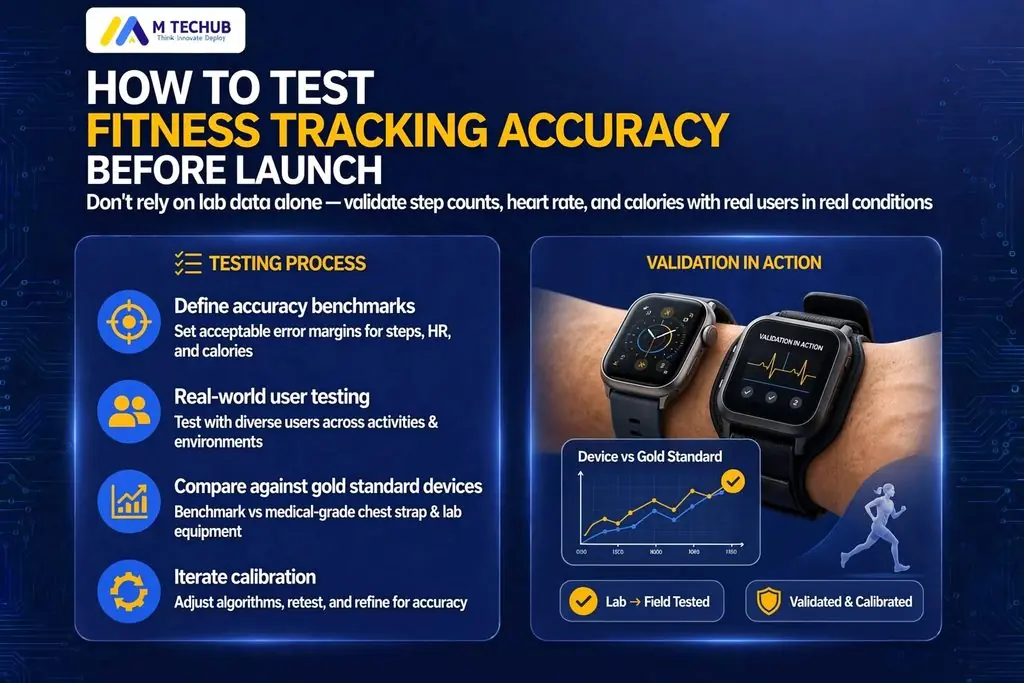
Fitness tracker accuracy testing can reveal missed short walks, unreliable heart-rate readings during intervals, and inflated calorie estimates that a successful treadmill demonstration may conceal. A fitness app can introduce additional errors when it imports, combines, or summarizes otherwise valid measurements.
Testing should therefore establish what the product measures, how its output compares with a suitable reference, and where performance breaks down. For teams launching in the United States and United Kingdom, the evidence should match the users, activities, and claims the product will support.
A practical wearable device sensor validation methodology follows a clear sequence: define each metric and its intended use, select an appropriate reference, collect synchronized measurements across representative users and activities, and analyze error and missing data against criteria agreed before testing. Repeat relevant tests after hardware, firmware, algorithm, or data-pipeline changes.
Start With Intended Use and a Written Validation Plan
Start wearable sensor accuracy validation by writing down the product claim before recruiting participants. “Tracks daily walking” and “provides live heart-rate feedback during interval training” require different evidence.
Define:
- The metric: steps, heart rate, workout energy expenditure, or daily total energy expenditure.
- The population: intended ages, mobility characteristics, fitness levels, and other relevant user characteristics.
- The supported placement: wrist, finger, shoe, pocket, or another specified location.
- The conditions: indoor and outdoor activity, exercise intensity, temperature range, and expected wear duration.
- The output: a live display, workout summary, daily total, or exported data stream.
- The permitted error: acceptable measurement differences, missingness, and delay for the intended user decision.
Specify whether you are validating a sensor system, an algorithm, an app integration, or the complete product.
An app importing third-party heart-rate records can verify faithful transfer and display. That alone does not establish the source sensor’s physiological accuracy.
For US and UK launch testing, include local workflows: pounds and kilograms, miles and kilometers, regional date formats, time zones, and daylight-saving transitions. Define physiological tests around the intended population rather than assuming nationality determines sensor performance.
Use Standards and Expert Recommendations Within Their Scope
addresses test methods for the performance, reliability, and accuracy of wearable step counting. Its published scope explicitly excludes travel-distance and calorie-consumption evaluation.
addresses terms, a measurement protocol, and testing for wearable heart-rate accuracy based on photoplethysmography (PPG). Its scope excludes evaluation of medical devices associated with the IEC 60601 or ISO 80601 series and notes that some countries distinguish heart rate from pulse rate.
These are published International Standards.
is a collaborative expert network that publishes peer-reviewed recommendations for validating consumer wearables. Its frameworks draw on literature reviews and expert judgment.
INTERLIVE recommendations support study design and reporting. They do not replace certification, regulatory authorization, or your product’s release criteria.
The IEC scope descriptions establish what each document covers. Check detailed procedures against the full applicable edition before claiming conformity. The workflow below provides practical QA guidance rather than reproducing either standard.
Match Each Metric to a Suitable Reference
Different tracking outputs require different reference methods.
| Output | Suitable reference approach | Important limitation |
|---|---|---|
| Step count | Direct observation or reviewable video with a defined counting procedure | Obscured feet and inconsistent counting rules can introduce reference error |
| Heart rate | Suitable electrocardiography (ECG)-based measurement with documented signal-quality and processing procedures | ECG can also suffer motion artifacts or electrode problems |
| Activity energy expenditure | Appropriate calibrated indirect calorimetry protocol | Equipment can alter movement; rapid intensity changes complicate comparison |
| Free-living total energy expenditure | Doubly labeled water over a matched observation period | Does not provide minute-by-minute workout energy expenditure |
| App transfer and aggregation | Controlled source records and expected transformations | Demonstrates software correctness rather than physiological sensor validity |
Another consumer watch can help with exploratory comparison, but its readings are not automatically a valid reference.
ECG is appropriate for heart-rate validation. It is not a reference method for step counts or calorie estimates.
How to Test Step Count Accuracy Before Launch
Build the step protocol around the movements your users make. Use the INTERLIVE step-count recommendations to inform reference selection, activity coverage, synchronization, and reporting.
Cover Walking, Running, and False-Step Conditions
Include:
- Slow walking.
- Normal walking.
- Brisk walking.
- Running.
- Stair ascent and descent.
- Short walking bouts with pauses.
- Changes in pace and direction.
Record actual speeds and the procedure used to set them. Add irregular gait or mobility-aid conditions when they belong to the intended population.
Challenge the algorithm with limited arm swing, such as carrying a bag or pushing a shopping cart. Also test non-walking arm movements, such as folding laundry.
These conditions expose different problems: missed real steps and false positive steps.
Do not assume that an activity with substantial movement must produce steps. Cycling and seated hand activity can provide useful negative controls when relevant to the product.
Make the Reference Count Auditable
Define what constitutes a step and how starts, turns, stairs, and ambiguous movements will be counted.
Record the same activity interval for the device and reference. Independent review and a documented adjudication process help resolve uncertain video counts.
Preserve bout-level results. An overcount in one activity and an undercount in another can cancel in a daily total.
When the reference count is zero, report false steps as an absolute count or a rate over the defined period. Percentage error is undefined at a zero reference and unstable for very small counts.
How to Test Optical Heart Rate Sensors Against ECG
PPG estimates pulse-related changes in blood volume optically; ECG records cardiac electrical activity.
Heart rate sensor accuracy testing needs a suitable reference system and explicit processing rules. Wearing two devices simultaneously is only the beginning of the comparison.
Use a reference with evidence supporting its performance in your intended activities. An ECG-based chest strap may be appropriate when its validation, available output, and signal quality fit the protocol.
A chest location alone does not establish reference suitability.
Define a Reproducible Protocol
Record device placement, strap fit, reference-electrode setup, sampling behavior, and the exact analysis windows.
Include rest, steady exercise, changes in intensity, recovery, and activities with relevant wrist movement.
Synchronize clocks before testing and check drift afterward. Compare equivalent windows: an instantaneous reference value and a heavily averaged wearable value are not directly equivalent.
Keep these outcomes separate:
- Measurement error when both systems provide valid readings.
- Time to acquire a usable reading.
- Missing or invalid output.
- Response delay during intensity changes.
Predefine artifact rejection and reference-quality rules. Report exclusions and their reasons.
Shifting traces until they overlap can conceal delay. If alignment correction is used, document it and report latency separately.
The INTERLIVE heart-rate statement provides a framework spanning population, reference, device, conditions, processing, and analysis.
Include Participant and Wear-Condition Diversity
Recruit across relevant ages, body sizes, fitness levels, and skin tones.
Record sensor-site characteristics and conditions such as tattoos, hair, sweat, cold exposure, and fit when relevant to the device.
Describe how skin tone was assessed instead of using race as a substitute. Analyze errors and signal availability by planned groups without treating a small subgroup as conclusive evidence of equal performance.
Research findings can be device- and protocol-dependent. For example, a 2025 Garmin PPG study found no significant skin-tone effect within its tested sample while identifying difficulties during dynamic intensity changes.
That finding does not establish universal performance across sensors, populations, or activities.
Validate Calorie Estimates Against the Right Energy Measure
Fitness tracker calorie calculation validation starts with a definition: does “calories” mean active energy, total workout energy including resting expenditure, or total daily energy expenditure?
Those quantities cannot be compared without reconciling their definitions and time windows.
For activity-specific testing, use a suitable calibrated indirect calorimetry setup and document the calculation method. Distinguish steady-state exercise from rapidly changing or substantially anaerobic activity, where interpretation is more difficult.
For free-living daily total expenditure, doubly labeled water provides a reference over an observation period. It cannot verify the calorie estimate for a particular minute or individual workout.
Deriving activity expenditure from total expenditure also requires additional measurements or assumptions.
The INTERLIVE energy-expenditure recommendations support activity-specific and free-living validation. They also explain why constrained laboratory or semi-free-living activities may poorly represent everyday energy expenditure.
Document required profile inputs, including weight and age, and test their units and update behavior.
Agreement between two watches’ calorie values is not independent validation.
Extend Laboratory Tests Into Everyday Conditions
Laboratory testing helps isolate causes under repeatable conditions.
Semi-free-living testing uses scripted everyday activities, such as walking through rooms, carrying objects, and using stairs.
Free-living validation observes ordinary behavior with less control.
Each stage answers a different question:
| Testing environment | What it helps reveal |
|---|---|
| Laboratory | Speed-dependent errors, controlled activity differences, and repeatability |
| Semi-free-living | Errors during scripted household activities, transitions, and short movement bouts |
| Free-living | Performance during ordinary routines, inconsistent fit, wear interruptions, and unpredictable activity changes |
A treadmill test can expose speed-dependent counting errors. A household circuit can expose false steps. Everyday monitoring can expose charging gaps and inconsistent wear.
Use reference methods appropriate to each setting. Long video observation creates substantial review and privacy burdens; calorimetry equipment can change normal activity.
Record these limitations rather than labeling a convenient outdoor session as comprehensive real-world validation.
Test the Algorithm and the Complete Software Pipeline
When planning how to test fitness wearable data, preserve traceability from input to displayed output. Fitness tracking algorithm validation must cover both the calculations and the data pipeline.
For every test run, record:
- Hardware revision and sensor configuration.
- Firmware and algorithm version.
- App build and phone operating system.
- Reference-system configuration.
- Analysis-script version.
Use separate participants or otherwise appropriately independent data for development and final validation. Tuning and evaluating on overlapping participant data can overstate generalization.
Practical software QA should include:
- Missing data: distinguish unworn periods, rejected signals, sensor failure, and transfer failure. Never silently turn missing heart rate into zero.
- Timestamp alignment: verify units, UTC storage, time-zone presentation, drift, midnight boundaries, and daylight-saving changes.
- Synchronization: test interrupted transfers, delayed uploads, out-of-order records, retries, duplicate events, and corrections.
- Filtering: document smoothing, resampling, interpolation, and artifact removal. Preserve original data where available and permitted.
- Aggregation: verify active versus total calories, daily step totals, overlapping recordings, and source-selection rules.
- Updates: replay retained datasets after changes and add physical testing when sensing, fit, or behavior could change.
Recorded-data replay cannot reproduce every hardware change. A modified enclosure or sampling schedule may require new participant measurements.
For implementation detail, see testing fitness app integrations and handling missing and duplicate wearable workouts.
Analyze Error and Define Release Criteria Before Testing
Let the device value be D and the synchronized reference value be R. Define error as D − R so the sign has a consistent meaning.
| Metric | Calculation or purpose | Interpretation caution |
|---|---|---|
| Mean absolute error (MAE) | Mean of absolute device–reference differences | Retains the metric’s units but does not show error direction |
| Mean absolute percentage error (MAPE) | Mean of 100 × absolute error ÷ absolute reference | Undefined at zero and unstable near zero; small denominators can dominate |
| Mean bias | Mean of D − R | Positive and negative errors can cancel |
| Bland–Altman agreement analysis | Differences versus paired means, with appropriate limits of agreement | Repeated observations, nonconstant variance, and proportional bias require suitable methods |
| Coverage | Valid paired observations relative to a predefined eligible denominator | Report device and reference missingness separately |
| Latency | Delay between reference change and usable product response | Averaging or alignment can conceal lag |
A correlation coefficient alone does not establish accuracy. A device can follow the same trend as the reference while consistently reading too high.
Report uncertainty, participant-level results, activity-specific results, and planned subgroup results.
Do not treat thousands of readings from a few participants as thousands of independent participants. Use statistical methods that account for repeated measurements, such as appropriately designed participant-level summaries or cluster-aware confidence intervals.
Set Defensible Internal Acceptance Criteria
Define numerical gates before final validation, using intended use, product risk, reference uncertainty, pilot evidence, and applicable requirements.
There is no single universal pass mark.
For each gate, specify:
- Metric and unit.
- Activity and population.
- Analysis window.
- Allowed error.
- Coverage requirement.
- Uncertainty rule.
- Action on failure.
Estimate sample size from the planned analysis and required precision, allowing for relevant subgroups and attrition. A convenient volunteer count is not a statistical justification.
For example, a product team might require an activity-specific error criterion and a separate valid-data criterion, then block release if either fails. This illustrates a gate structure rather than an IEC threshold.
Investigate failures, record root causes, fix them, and retest affected conditions plus related regression cases.
Preserve failed results and deviations in the report. Do not quietly relax a threshold after seeing the data.
Reusable Pre-Launch Test Matrix
Use this matrix to plan your tests. Set numerical criteria before testing.
For pre-launch wearable QA testing, retain evidence for each condition and connect every result to the tested product version.
| Test case | Reference or expected result | Evidence to retain | Failure to investigate |
|---|---|---|---|
| Slow, normal, and brisk walking | Observed or video-reviewed steps | Counts by participant, speed, and bout | Speed-dependent undercount |
| Running and stairs | Defined observed counts | Direction, pace, placement, and count | Activity-specific count error |
| Short walks with pauses | Annotated bout counts | Start/stop times and delayed updates | Missed short bouts |
| Pushing a cart or carrying a bag | Observed steps | Arm-use condition and output | Missed steps with reduced arm swing |
| Seated arm activity | Observed zero-step interval | False counts and duration | False positive steps |
| Rest and steady exercise heart rate | Suitable ECG-based reference | Aligned values and quality flags | Bias or signal loss |
| Intervals and recovery heart rate | Suitable ECG-based reference | Error, latency, and missingness | Smoothing delay or motion artifact |
| Supported calorie modes | Suitable calorimetry protocol | Definitions, calibration, and profile inputs | Incorrect or incompatible energy estimates |
| Daily total energy | Matched doubly labeled water period where feasible | Total expenditure and wear coverage | Unsupported daily-energy claim |
| Offline transfer and retries | Controlled source records | IDs, timestamps, units, and totals | Missing or duplicate data |
| US/UK locale and clock changes | Predetermined transformations | Unit conversions and day boundaries | Misallocated daily totals |
| Firmware or algorithm update | Independent holdout and retained regression data | Versioned comparison and new physical tests as needed | Performance regression |
Common Accuracy-Testing Mistakes
- Testing only convenient users: results may not transfer to the intended population. Recruit deliberately and report recruitment limitations.
- Comparing only daily averages: opposing errors and short failures can disappear. Analyze bouts, transitions, and individual participants.
- Excluding every difficult reading: apparent accuracy improves while availability is hidden. Report missingness and exclusions alongside error.
- Using the wrong reference: a second watch or a step-derived calorie formula cannot establish physiological validity by agreement alone.
- Claiming broad validation from controlled tests: evidence from steady walking does not establish performance during household activity or interval training.
- Ignoring software versions: evidence becomes difficult to connect to the shipped product. Maintain a versioned validation record and change-impact review.