
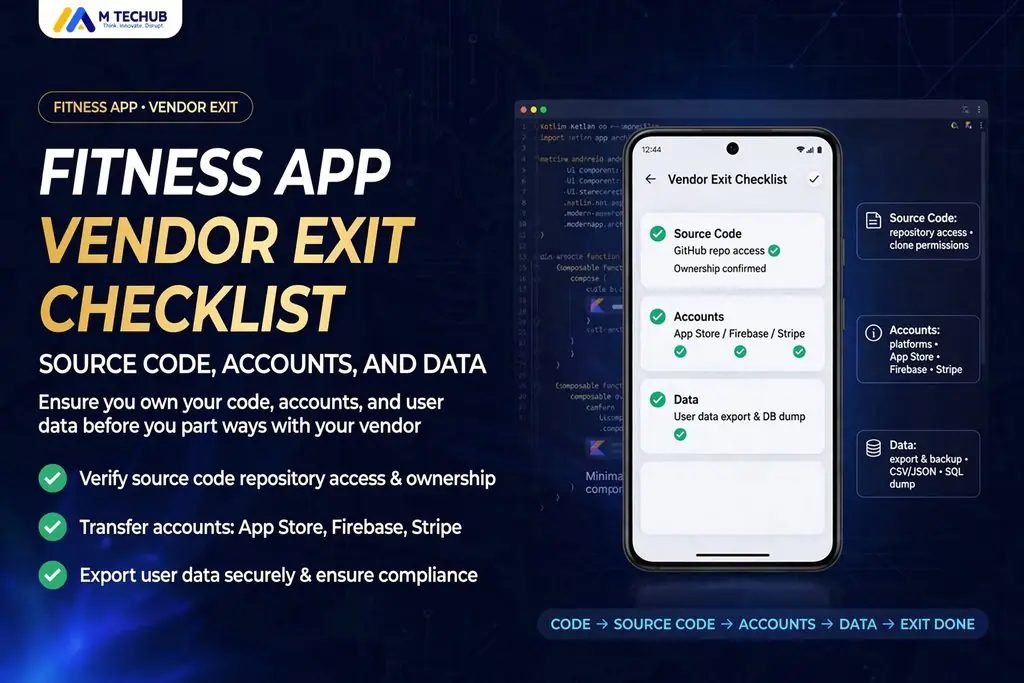
A fitness app development vendor exit checklist identifies the code, contractual rights, accounts, documentation, and data a business needs when changing developers. A complete handover verifies that the incoming team can build, deploy, operate, and recover the application before outgoing vendor access is removed.
If you run a gym booking app or coaching platform, a messy handover reaches members quickly: classes cannot be booked, workout history disappears, or paid access stops working. This checklist shows how to prove your new team can build, release, and support the app before you remove the old vendor’s access.
Why Every Fitness App Business Needs a Vendor Exit Strategy
A development agency may manage your repository, hosting, app releases, and integrations. Transition becomes harder when only the agency can administer them.
Common dependencies include private packages, vendor billing accounts, undocumented deployments, and unclear rights to reusable code.
Start by identifying services where the business lacks independent access. Record each dependency, its current controller, and the evidence needed to confirm takeover.
Fitness App Vendor Exit Checklist: What to Secure First
Request these ten groups of assets. Use the table below to assign verification, rather than marking delivery alone as complete.
- Source code: Mobile, backend, administration, and infrastructure repositories with release history.
- Rights and licenses: Agreements, assignments where relevant, and a software dependency inventory.
- Documentation: Architecture, setup instructions, API references, and environment configuration templates.
- App stores: Account owners, user roles, recovery arrangements, and transfer eligibility details.
- Infrastructure: Cloud resources, domains, DNS settings, billing owners, and renewal dates.
- Data: Necessary backups, exports, schemas, consent records, and file inventories.
- Integrations: Payment, email, analytics, and wearable service projects, API permissions, and subscriptions.
- Operations: Deployment pipeline settings, monitoring, alerts, and incident procedures.
- Unfinished work: Defects, vulnerabilities, pending releases, and remaining support obligations.
- Access closure: Vendor identities, subcontractors, automation accounts, and a credential rotation plan.
Handover Verification and Responsibility
| Asset or area | What to obtain | How to verify it | Responsible party or follow-up |
| Source repository | Code and release tags | Clone and build release | Incoming technical lead |
| Build documentation | Setup and deployment instructions | Follow independently | Incoming engineers |
| App stores | Roles or approved app transfer | Check administration and release access | Business account owner |
| Cloud infrastructure | Resources, billing, recovery access | Inspect resources; deploy to staging | Infrastructure lead |
| Database and files | Required exports, schema, media | Restore and reconcile | Data lead and privacy owner |
| Integrations | Projects, permissions, renewal details | Test connections and paid access | Integration owner and finance |
| Rights and licenses | Agreements and component inventory | Review continued-use rights | Business owner and legal counsel |
| Backups and recovery | Backups and recovery instructions | Run restoration test | Operations lead |
| Open work | Issues and support commitments | Assign unresolved items | Product owner |
| Final access | Identities and temporary exceptions | Check removal and rotation evidence | Security administrator |
Illustrative asset-register entry: Wearable API project — current controller: outgoing vendor; business owner: integration lead; acceptance evidence: test sync succeeds through business-controlled access; status: pending until tested. Keep secret values out of the register.
How to Transfer Fitness App Source Code From Your Developer
Establish Repository Control and Delivery Scope
Transfer code through an agreed repository handover, then verify an independent build. Establish administrator access in a business-controlled organization. Include branches, tags, commit history, relevant issues, and the release corresponding to the live application.
A ZIP archive may omit history, pipeline configuration, private dependencies, or linked repositories. Ask for dependency versions, package access requirements, and any separately stored infrastructure code.
Repository transfer also needs a security review. GitHub states that repository webhooks, secrets, and deploy keys remain associated after transfer. Inspect these connections rather than assuming the transfer removes vendor access.
Plan Knowledge-Transfer Sessions During the Notice Period
Agree on walkthrough calls covering architecture, releases, integrations, recurring jobs, and incident recovery. Have the incoming team shadow one deployment, then perform the next while the outgoing vendor observes. Record sessions with permission and update the written runbooks.
Put the support arrangement in writing: available hours, response expectations, named contacts, notice-period coverage, transition fees, and the end date. Do not assume notice automatically includes unlimited handover assistance.
Verify an Independent Build and Deployment
Ask the incoming team to:
- Clone the agreed release into a clean development environment.
- Install documented tools and exact dependencies.
- Configure test settings using templates without embedded production secrets.
- Build the mobile app and start its backend services.
- Deploy to staging and test a release candidate through the appropriate testing channel.
Record failures and missing inputs. A build that works only on an outgoing developer’s laptop is an unresolved handover dependency.
Having source code does not mean you own its copyright. In the UK, commissioned work does not automatically belong to the commissioner.
In the US, a copyright ownership transfer generally requires a signed writing; work-made-for-hire status has separate conditions and is not established simply by paying a contractor. Review assignment or license terms covering modification and replacement-team access with qualified legal counsel.
App Store and Google Play Handover: App Transfers and Account Control
Separate App Transfer From Account Administration
When the business already controls the developer account, a vendor change may require updated user roles rather than an app transfer. Moving an app from a vendor’s account to a different business account requires the platform’s approved transfer process.
An app transfer does not transfer every connected service or automatically change control of the entire developer account. Verify the actual account structure before choosing a procedure.
For Apple, review eligibility first. The outgoing Account Holder initiates the transfer and the receiving Account Holder accepts it. Apple’s guidance contains separate requirements for subscriptions, Sign in with Apple, push notifications, and other capabilities. Inventory these features and follow their applicable instructions before the next release.
For Google Play, both developer accounts must be registered and active. Google identifies linked-service and signing considerations; financial and bulk export reports do not transfer with the app. Preserve necessary reports and review Firebase, API access, subscriptions, and Play App Signing arrangements.
Verify Services, Signing, and Billing
Record the iOS bundle ID and Android package name, which identify the app. Assign control of signing credentials, push notification credentials, and purchase validation, which checks payments and unlocks paid features.
For Play App Signing, distinguish the upload key used to submit releases from the app signing key managed by Google. If the upload key is lost or compromised, use Google’s approved reset process. This does not reset the app signing key.
Check analytics, crash reporting, maps, email, payment providers, domains, DNS, cloud projects, and subscription renewals separately. Do not assume changing a payment integration moves customer billing records or payment tokens.
Use named identities, permissions limited to the work required, and business-controlled recovery methods. Avoid sharing account passwords. For AWS, official IAM guidance recommends temporary credentials, least privilege, and regular removal of unused access.
Confirm Who Controls the Payment Provider Account
For Stripe or another payment provider, record the legal business registered on the account, account owner, administrators, payout bank account, and responsibility for refunds and disputes. Confirm who controls API credentials and payment webhooks. Check both subscription billing and the app’s paid-feature access.
Changing the account’s owner user is different from moving it to another legal entity. Stripe provides separate procedures for these situations; confirm the required process with the provider before changing ownership or billing.
Check Fitness and Wearable Connections
HealthKit and Health Connect involve app configuration and user permissions; treat them separately from wearable cloud APIs. Verify the required access and data types in the replacement build.
For wearable cloud integrations, inventory API project control, credentials, redirect URLs, and webhooks—callbacks that notify your backend of events. Confirm provider-approved changes and test sync, reconnection, and duplicate handling.
Provider status checked October 14, 2026:
- Garmin: The Garmin Connect Developer Program remains documented and uses OAuth 2.0. Confirm the business’s actual program approval and permissions; program availability does not prove a specific app can take over an existing integration.
- Strava: Its 2026 update introduced Standard Tier subscription requirements and changes to supported endpoints and intermediary integrations. Confirm the app’s tier, capacity, subscription owner, and permitted data use before acceptance.
- Fitbit: Google’s developer documentation says legacy Fitbit Web API support ended September 30, 2026. A later Google-hosted announcement extends API availability to October 30, 2026. Treat remaining legacy use as a migration dependency, not a completed handover. Verify the latest notice and move to Google Health API with Google OAuth, user re-consent, identity mapping, and tests that prevent duplicate syncing. Google Health migration guide, support timeline, and extension notice.
Complete the First Release After Handover
Have the incoming team upload a signed build using the new access and pipeline, then test an upgrade from the existing live version. Check login, stored workout history, booking, wearable sync, notifications, purchases, and restored paid access.
Use TestFlight and a Google Play test track suited to the release. External TestFlight testing may require Apple’s beta review. Google Play internal-track updates generally are not reviewed before release but can face later review. Complete the review required for the selected track and production submission, and record test and review status separately. Test access is not production approval.
Fitness App Data Migration Checklist
Define the Data Scope and Access Permissions
Changing developers does not always require moving databases. If infrastructure stays under business control, verify access and recovery without introducing an unnecessary migration.
Where migration is needed, specify necessary records: profiles and identifiers, workouts, nutrition or activity logs, trainer-client relationships, memberships, paid-feature access records, and consent or preference records. Include database schemas, media files, and storage references.
Document authorization, access restrictions, retention rules, and destination arrangements. Treat these records as potentially sensitive; their legal classification depends on their content, use, and jurisdiction.
Export, Validate, and Plan the Switch
- Prepare backups: Create an encrypted, access-restricted backup and test restoration in an isolated environment.
- Map fields: Document identifiers, relationships, units, time zones, and schema differences.
- Transfer securely: Use encryption and restricted access; keep sensitive records out of ordinary tickets and application logs.
- Reconcile: Compare record counts by category, relationship integrity, file inventories, and selected values. Investigate every unexplained discrepancy.
- Test workflows: Verify login, workout history, bookings, trainer access, and paid-feature access with approved test accounts.
- Control the switch: Define how new writes are captured, who approves switching traffic, and what conditions trigger rollback.
Equal row counts alone do not prove accuracy. A membership may exist but reference the wrong user; an activity record may preserve its value while changing its unit.
Record reconciliation results and acceptance. If users can write to the new system, rollback must address those writes rather than simply restore an older backup. Arrange approved deletion of temporary exports and old copies after the agreed recovery period, subject to applicable retention obligations.
Contract Termination Checklist: Rights, Privacy, and Security
Review Contractual Responsibilities
Check notice and termination provisions, intellectual property terms, third-party licenses, confidentiality, data return or deletion, and subcontractor responsibilities. Resolve outstanding invoices, deliverables, support commitments, and known security issues through the agreed process.
Separate custom code from vendor-owned frameworks and licensed components. Determine whether the incoming team needs replacement licenses or whether continued use is permitted. Contractual rights and legal obligations may require qualified legal counsel.
Apply Relevant UK and US Privacy Requirements
In the UK, assess the UK GDPR and Data Protection Act 2018 as amended by the Data (Use and Access) Act 2025 (DUAA). The Act amends rather than replaces these laws. ICO guidance updated June 19, 2026 states that all DUAA data protection provisions are in force. Most remaining provisions commenced February 5, 2026, with the complaints-procedure requirement commencing June 19. Separate regulator reforms commenced September 30, 2026.
The ICO’s detailed controller-processor guidance is marked under review following DUAA. Its current contracts checklist retains the return-or-delete requirement described below; recheck the live guidance when finalizing offboarding terms.
ICO guidance states that controller-processor contracts must provide for returning or deleting personal data at the controller’s choice when the contract ends, including deletion of existing copies unless law requires storage. Cover subprocessors and obtain evidence of agreed completion.
Health information can be special category data, requiring additional processing conditions. Do not classify every booking or activity record identically; assess what the information reveals.
In the US, HIPAA applicability depends on covered-entity or business-associate status, rather than a fitness label alone. Some non-HIPAA health apps may fall within the FTC Health Breach Notification Rule. Applicable state privacy and consumer health laws also need assessment; Washington’s My Health My Data Act is one example, not a nationwide rule. Check the laws covering your business and users’ locations; this is not an exhaustive state-law review.
For either market, review whether changed processing purposes, recipients, or international transfers require additional measures. Preserve incident evidence and assign responsibility for unresolved vulnerabilities.
Vendor Handover Request Template and Example
What to Request From the Outgoing Vendor
Send this request through your agreed project channel and set delivery dates in the transition plan:
Please confirm the handover owner, delivery dates, and any contractual restrictions for our fitness app transition. We need the repositories and release history; rights and dependency inventory; build and deployment instructions; account, integration, billing, and recovery details; necessary data exports and tested backups; and open defects and support obligations. Please propose walkthrough and shadowing sessions during the notice period, plus agreed support hours and response expectations. We will verify an independent build, a test release, data accuracy, and recovery before acceptance. Arrange credential access through the approved secure process rather than sending secrets by email. Please flag missing items or dependencies that require provider approval.
Hypothetical Example: A Gym App Changes Agencies
A gym changes agencies while keeping its existing cloud database. The incoming team builds the code successfully but finds that payment notifications still reach the old vendor’s server, so a renewed membership does not unlock classes. Before removing vendor access, the teams reconfigure the notification endpoint, verify a test payment updates membership access, and test the first signed app update. The gym records these results and assigns temporary support coverage before accepting the handover. This is an illustrative scenario, not a client case study.
How to Prevent Vendor Lock-In in Fitness App Development
Before starting or renewing an engagement, agree on:
- Business-controlled repositories and named administrators where appropriate.
- Clear ownership, licensing, documentation, and exit-deliverable terms.
- Business-controlled cloud billing and domain registration where feasible.
- Regular backup restoration and export checks.
- Documented deployment and recovery procedures.
- Transition assistance, responsibilities, and commercial terms.
- Periodic access reviews and dependency inventories.
Require documentation to stay aligned with releases. Periodically ask another authorized engineer to build or restore the system using the instructions.
Vendors may legitimately retain reusable frameworks or pre-existing intellectual property. Aim for sufficient rights and operational continuity. Where a dependency cannot transfer, document its continuing license, replacement options, and exit implications before committing.
Final Sign-Off Before Ending the Vendor Relationship
Operate: The incoming team can build, deploy, monitor, and support the app independently.
Control: Required rights, accounts, recovery methods, integrations, and billing are confirmed.
Recover: Data validation, backup restoration, and rollback checks pass.
Resolve: Remaining issues have named owners, deadlines, and recorded acceptance conditions.
Close access: Vendor access and relevant credentials are removed, rotated, or explicitly time-limited after takeover.
Coordinate access removal with integration and background-job updates. Retest dependent services and record final responsibilities. Temporary support access needs an expiry and responsible administrator.
Conclusion
A successful vendor exit connects code delivery, contractual rights, account control, data validation, and operating capability. Begin with an asset inventory, review your agreements, and test the incoming team’s ability to maintain the app before signing off.