
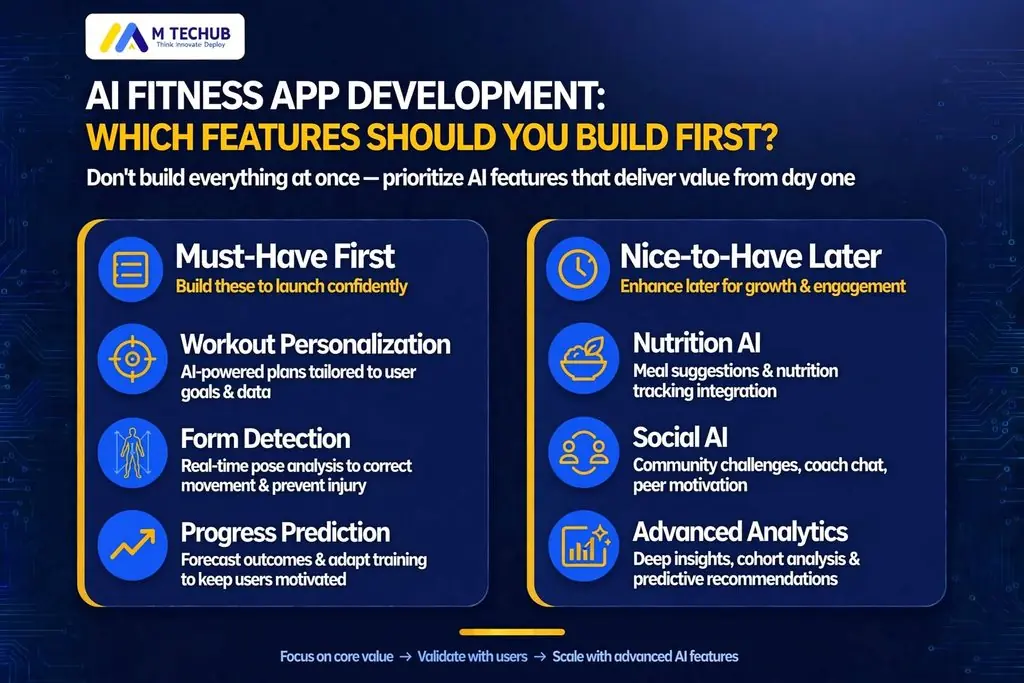
For most early products, AI fitness app development should begin with focused onboarding, a reviewed exercise library, practical workout planning, session logging, and simple personalization. Add machine learning or generative AI where it solves a validated problem and can meet clear quality, safety, and cost requirements.
The first release should help a specific audience choose a suitable workout, complete it, record what happened, and make a useful adjustment next time.
An unrestricted chatbot, camera-based form analysis, and multiple wearable integrations should enter the roadmap when evidence supports their value.
What Makes a Fitness App AI-Powered?
Fitness apps use different approaches to deliver personalized experiences. Understanding the distinction helps founders avoid unnecessary complexity.
| Approach | Fitness app example | Main requirement |
|---|---|---|
| Conventional functionality | Timers, exercise videos, session history | Reliable application logic |
| Rules-based personalization | Selecting workouts by equipment and experience | Reviewed, testable rules |
| Machine learning | Ranking suitable workouts using previous feedback | Relevant data and measurable improvement |
| Generative AI | Explaining a workout or summarizing activity | Grounded responses and output evaluation |
A personalized workout does not automatically require machine learning.
If the task is to choose a reviewed session based on available equipment and time, explicit rules may meet the requirement. A model becomes useful when it improves an identifiable limitation of that approach.
For a custom AI fitness coaching app, assign each capability a clear role. Application logic can enforce exercise constraints, while a language model explains the approved plan in understandable language.
Essential AI Fitness App MVP Features
Start by defining one audience and one recurring problem.
For example:
Adults familiar with basic gym exercises who struggle to plan workouts around changing schedules and equipment availability.
That audience needs a different product from rehabilitation patients, competitive athletes, or trainers managing clients.
Focused Onboarding and Goal Setting
Collect information that changes the experience:
- Training goals.
- Exercise experience.
- Available equipment.
- Session duration and availability.
- Preferences and relevant constraints within the supported scope.
Explain why questions matter and allow users to update their answers.
Avoid collecting detailed health information without a defined purpose and an appropriate workflow for handling it.
Reviewed Exercise Content
Workout recommendations depend on the underlying content.
Each exercise should include clear instructions, equipment requirements, approved alternatives, and the tags needed by the planning system.
Have appropriately qualified professionals review exercise guidance and progression boundaries. Generated descriptions should go through the same content review process.
Workout Planning and Controlled Personalization
A practical planning system should:
- Select from approved exercises or templates.
- Apply reviewed selection rules.
- Check the proposed session against defined constraints.
- Present instructions and explanations.
- Record feedback for future adjustments.
Keep exercise selection and progression inspectable. A conversational interface should not silently bypass those controls.
Session Logging and Feedback
Let users record what they actually completed, including substitutions, incomplete sessions, and perceived difficulty.
Keep logging brief enough to use during exercise.
Missing information should remain visible. An unlogged session does not establish that someone skipped a workout.
Basic Progress Summaries
Start with facts the app can support:
- Completed sessions.
- Recorded repetitions, loads, or duration.
- User-reported difficulty.
- Changes in logged performance.
Separate observations from interpretations. Completing more sessions does not, by itself, establish improved health or reduced injury risk.
What Existing Fitness Products Demonstrate
Established products illustrate different approaches to digital coaching.
| Product | Published approach | Useful MVP lesson |
|---|---|---|
| Fitbod | Personalized strength workouts based on goals, fitness level, and equipment | Connect relevant inputs to workout selection |
| Freeletics | AI Coach providing personalized training | Adaptation can be central to the product experience |
| Future | Personalized training with a human coach | Human support can remain part of the service |
These descriptions come from the companies’ published materials. They illustrate product approaches rather than independently verified performance outcomes.
The founder’s task is to identify which approach fits the audience, rather than reproduce a mature product’s entire feature set.
How to Prioritize Features
Prioritize user value, evidence, effort, feasibility, and risk together.
| Capability | Potential MVP priority | Delivery and expansion criteria |
|---|---|---|
| Onboarding and goals | High | Keep questions purposeful; investigate irrelevant recommendations |
| Reviewed exercise library | High | Expand when users encounter meaningful content gaps |
| Workout planning | High | Measure acceptance, completion, and reasons for rejection |
| Logging and feedback | High | Check whether feedback supports useful adjustments |
| Progress summaries | High | Show recorded facts and missing information clearly |
| AI explanations | Conditional | Compare accuracy and comprehension with fixed text |
| Wearable integration | Conditional | Include when imported data materially improves the core workflow |
| Open-ended chat | Usually later | Require evidence that structured help cannot meet repeated needs |
| Camera-based feedback | Usually later | Require validation within supported movements and conditions |
| Custom-trained models | Usually later | Demonstrate improvement over rules or existing models |
Apply Release Gates Before Scoring
Some requirements should not compete with engagement features.
A recommendation feature needs:
- A defined intended use.
- Reviewed content and boundaries.
- Appropriate data handling.
- Tested failure responses.
- A reporting mechanism.
- Monitoring and rollback controls.
Unresolved safety or privacy issues should block release regardless of a feature’s popularity.
Define an Expansion Trigger
Every deferred capability should have a reason to reconsider it.
Wearable synchronization might become a priority when manual entry prevents users from completing the workflow.
Conversational coaching might become useful when repeated questions cannot be addressed through clearer screens or structured help.
This keeps feature prioritization connected to observed problems.
Which Features Can Wait?
Open-Ended AI Coaching
An unrestricted AI fitness coach app can receive questions about pain, pregnancy, rehabilitation, supplements, and medical conditions.
That expands the testing and operational burden.
Begin with narrower tasks, such as explaining an approved workout or summarizing logged sessions. Define how the system responds outside its supported scope.
Camera-Based Form Analysis
Movement feedback requires more than identifying body landmarks.
Camera angle, lighting, occlusion, exercise variation, and the supported population affect validation. Start with a tightly defined use case before promising reliable technique assessment.
Advanced Nutrition Features
Meal-photo analysis and individualized nutrition guidance introduce additional accuracy, content, and safety requirements.
Include them when they address the validated problem. Otherwise, they can distract from the workout experience.
Wearable Integration
Include wearable data at launch when it is necessary to the core product promise.
Apple’s HealthKit privacy documentation and Android’s Health Connect setup guide describe platform-specific authorization requirements. Android also documents availability checks and handling revoked permissions.
Before implementation, establish:
- Which records are required.
- Whether they are available in the target environment.
- How missing, delayed, and duplicate records will be handled.
- What happens when permission is denied.
- Whether the app remains useful without synchronization.
For a deeper validation workflow, see how to test fitness tracking accuracy before launch.
Custom Model Training
Custom training needs suitable data, a clear objective, and evidence of improvement.
Compare rules and existing models first. Training a model should address a demonstrated limitation rather than serve as a branding decision.
How Much Does an AI Fitness App Cost?
Clutch’s 2026 mobile app pricing guide reports that most reviewed app projects fall between $10,000 and $49,999, with reported agency rates around $25–$49 per hour. These figures cover general app development, rather than AI fitness MVPs specifically.
To budget a particular product, define its scope and divide the work into deliverables.
A Worked MVP Budget
Consider a cross-platform workout app with onboarding, reviewed workout templates, logging, a basic backend, administration, and constrained AI explanations.
The following example uses 1,000 team-hours at $40 per hour. For straightforward GBP comparison, it assumes $1 = £0.75.
| Workstream | Planned effort | Example budget: USD / GBP |
|---|---|---|
| Discovery and requirements | 80 hours | $3,200 / £2,400 |
| UX and interface design | 120 hours | $4,800 / £3,600 |
| Mobile application | 300 hours | $12,000 / £9,000 |
| Backend and administration | 200 hours | $8,000 / £6,000 |
| Planning rules and AI integration | 120 hours | $4,800 / £3,600 |
| QA, security testing, and release | 180 hours | $7,200 / £5,400 |
| Total | 1,000 hours | $40,000 / £30,000 |
The workstream hours are planning assumptions, not figures reported by Clutch. At the same rate, a defined scope of 900–1,100 hours would produce a development budget of $36,000–$44,000, approximately £27,000–£33,000 at the stated conversion.
This scope excludes substantial original video production, custom model training, camera analysis, fitness app wearable integrations, medical-device work, taxes, and recurring services.
Development Timeline
For this worked example, a team delivering about 80 combined project hours per week would need approximately 12–14 working weeks for 900–1,100 hours.
Allowing additional calendar time for decisions, feedback, and release preparation produces a planning schedule of roughly 14–18 weeks. Content readiness, integration findings, staffing, and changes to scope can alter that schedule.
Ongoing Operating Costs
Budget separately for hosting, storage, model usage, monitoring, support, security updates, and repeated evaluations.
Estimate model usage with:
Monthly model expense = active users × requests per user × average request cost
Use current provider prices and measured request sizes. Include retries and evaluation runs rather than counting only successful user requests.
Need a scope-specific budget? Discuss your fitness app requirements with M TECHUB.
Fitness App MVP Development: From Validation to Launch
Validate the Problem
Ask prospective users about recent workouts and current workarounds.
Investigate what happened when time was limited, equipment was unavailable, or a session felt unsuitable.
Document the proposed experience before automating it. This guide to coaching workflow documentation provides a related starting point.
Define a Testable Hypothesis
For example:
Matching workouts to available time and equipment will help our target users move from planning to completing sessions.
Decide what would support or weaken that hypothesis.
Measure session starts, completion, substitutions, repeated use, and reasons for rejection. These indicate product behavior rather than health outcomes.
Build the Complete Coaching Workflow
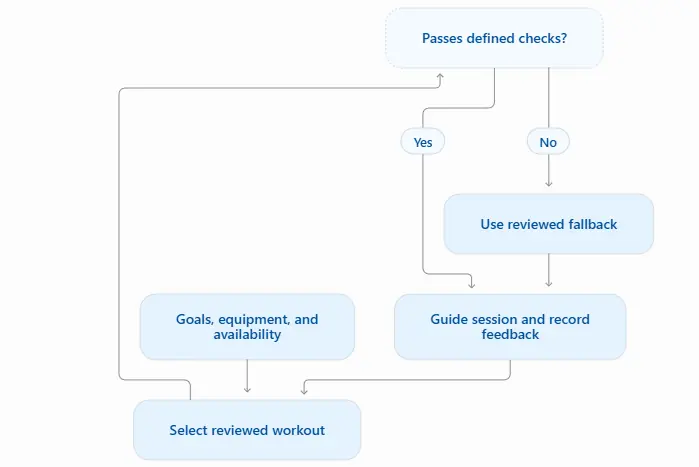
Feedback informs future selection while the checks remain in place. It should not authorize unrestricted changes to exercise intensity or progression.
Test the Biggest Uncertainty
Prototype the assumption most likely to invalidate the approach.
This might be data availability, recommendation quality, permission handling, or response time.
Set acceptance criteria before testing.
Pilot and Expand
Use a limited release to examine the complete experience.
Combine behavioral data with user feedback, professional review, recommendation complaints, latency, and operating costs.
Expand when evidence supports additional complexity.
Privacy and Regulatory Requirements
UK GDPR and Health Information
Information revealing health status may be special category data.
The ICO’s guidance explains that processing requires both an Article 6 lawful basis and an Article 9 condition. Platform permission alone does not establish those requirements.
US Health Privacy Requirements
HIPAA applicability depends on the organization’s role and relationships. Consult the HHS resources for health app developers.
Other requirements can apply outside HIPAA, including the FTC Health Breach Notification Rule.
Washington’s My Health My Data Act is a specific state example addressing consumer health data outside HIPAA’s protections. Assess its applicability against the business and processing activities.
Wellness and Medical Claims
The FDA’s general wellness guidance addresses low-risk products promoting a healthy lifestyle.
MHRA guidance on software applications explains when software may qualify as a medical device in the UK. Intended purpose and claims affect the assessment.
Obtain qualified review of the actual data flows, intended purpose, and claims before release.
Practical Data Controls
Collect only necessary information, restrict administrative access, and define retention and deletion procedures.
Review AI vendors’ data retention, training-use terms, subprocessors, and contractual protections.
Keep sensitive content out of routine analytics and error logs. Send models only the information needed for the task.
Testing AI Workout Recommendations
OpenAI’s Evaluation Best Practices guide explains why variable generative outputs require task-specific evaluations and continued testing
Test Recommendations and Failure Cases
Evaluate:
- Unsupported exercise references.
- Conflicting goals and constraints.
- Missing history.
- Unavailable equipment.
- Requests outside the supported scope.
- Attempts to bypass restrictions.
- Failed or slow model responses.
Compare AI-assisted features with a simpler baseline. A generated explanation should improve understanding without adding unsupported claims.
Monitor and Control Changes
Version prompts, models, content, and rules.
Repeat relevant evaluations when they change. Provide a way to investigate reports, disable affected features, and restore a previously tested version.
Have appropriately qualified professionals review exercise guidance and responses to health-related concerns.
Choosing a Development Partner
For AI personal trainer app development, ask prospective teams to explain the complete workflow and its failure conditions.
Useful questions include:
- Which decisions use rules, and which require AI?
- What baseline will the AI feature be compared against?
- Who reviews exercise content?
- How are vendor and privacy requirements handled?
- What happens when an integration fails?
- Can recommendations be investigated and rolled back?
- What assumptions support the estimate?
- Who owns the code, content, data, and accounts?
Ownership and exit arrangements deserve attention before signing. Use the fitness app vendor exit checklist to examine those requirements.