
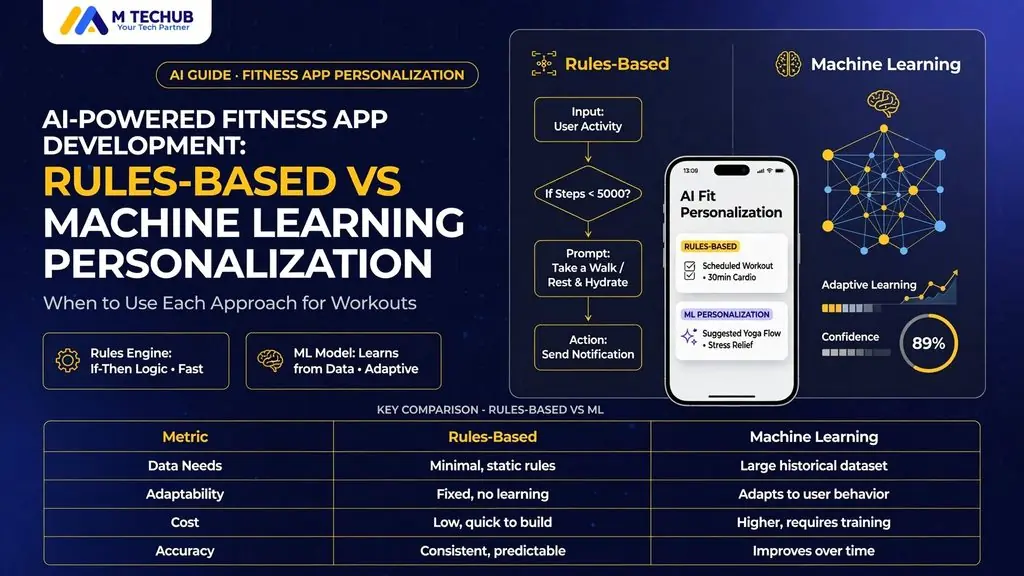
AI fitness app development is moving beyond static workout logs toward personalized coaching that responds to goals, schedules, performance, and preferences. The engineering challenge is deciding which recommendations should follow explicit rules and which should learn from user outcomes.
A chatbot alone does not solve that problem. A useful fitness coach needs reliable calculations, suitable exercise content, trustworthy data, and a feedback loop.
Our recommendation is to launch with reviewed rules, capture meaningful outcomes, and introduce machine learning when it improves a specific decision. Generative AI adds flexibility in explanations and content, while independent services validate numerical targets and eligibility constraints.
TL;DR
- Rules deliver reproducible personalization without a proprietary training dataset.
- Machine learning predicts outcomes or ranks options using historical examples.
- Generative AI creates explanations and proposals; it should not control unchecked nutrition calculations or exercise prescriptions.
- A focused MVP requires a different budget from a platform with custom models, wearable integrations, and computer vision.
- React Native and Flutter both support shared mobile development. Benchmark the workloads your product actually needs.
- Privacy and regulatory obligations depend on markets, business relationships, data processing, and product claims.
The strongest starting point is a hybrid architecture: rules enforce boundaries, models improve selected decisions, and the interface explains the accepted recommendation.
Rules-Based Personalization
Rules-based personalization uses conditions defined by engineers and qualified domain specialists.
Given the same inputs, reference data, and rule version, a deterministic engine produces the same result. This makes recommendations easier to explain, test, and correct.
How the Rules Engine Works
A practical implementation separates five responsibilities:
- Collect and validate profile inputs.
- Filter exercises or meals against eligibility constraints.
- Select a suitable plan.
- Apply approved progression rules.
- Store the inputs and decision version.
Profile + session feedback
↓
Validate inputs → Request missing information if needed
↓
Apply equipment, schedule, and preference constraints
↓
Select workout or meal plan
↓
Validate recommendation + record rule version
↓
Collect completion and feedback → Update next plan
For example, no gym access excludes machine exercises. A shorter training window selects an approved shorter session. Repeated incomplete workouts trigger a lower-volume alternative.
These decisions are adaptive, even though no model was trained.
Personalization describes the user experience. Machine learning describes one method of producing it.
Nutrition Calculations: Mifflin–St Jeor
The Mifflin–St Jeor equation estimates resting energy expenditure. A commonly used rounded form is:
| Equation variant | Estimated resting energy expenditure in kcal/day |
| Male equation | 10 × weight (kg) + 6.25 × height (cm) − 5 × age (years) + 5 |
| Female equation | 10 × weight (kg) + 6.25 × height (cm) − 5 × age (years) − 161 |
The original research describes a predictive equation, not a direct measurement of total daily energy requirements.
Keep the resting-energy estimate, activity assumptions, and goal adjustments separate. Store original inputs, converted units, equation versions, and adjustment policies.
For US and UK audiences, convert pounds, stones, feet, and inches into consistent internal units before calculation. Preserve each user’s display preference.
Deterministic arithmetic does not make a physiological estimate exact. The interface should communicate that distinction.
Heart-Rate Calculations: Karvonen
The Karvonen method uses heart-rate reserve:
Target heart rate = resting heart rate + intensity fraction × (maximum heart rate − resting heart rate).
The research on heart rate and exercise intensity provides context for heart-rate-based training recommendations.
Store whether maximum heart rate was measured, estimated, or manually entered. Support perceived exertion and session feedback rather than relying exclusively on a calculated zone.
A reviewed coaching policy should define when the calculation is appropriate and when another approach is required.
Benefits and Limitations
Rules work well for onboarding, equipment compatibility, dietary exclusions, substitutions, and approved progression boundaries.
Their principal limitation is maintenance complexity. Supporting more goals and circumstances creates overlapping exceptions.
Separate eligibility, selection, progression, and presentation logic. Avoid duplicating recommendation policies across mobile screens, backend services, and notifications.
When a decision requires an expanding collection of special cases, evaluate whether learned ranking offers a better solution.
Machine Learning Personalization
Machine learning identifies relationships between inputs and observed outcomes.
AI-driven fitness apps use this approach to rank eligible workouts, estimate session completion, and identify declining engagement. Each application requires a defined target and a suitable evaluation.
Choose Models Around Decisions
| Model approach | Fitness application | Evaluation priority |
| Regression | Estimate duration or completion probability | Prediction error and calibration |
| Tree-based models | Predict completion from structured activity data | Missing data, leakage, and segment performance |
| Ranking models | Order eligible workouts or meal alternatives | Ranking quality and actual outcomes |
| Neural networks | Analyze images or movement sequences | Accuracy, latency, device coverage, and resource use |
Opening a workout screen is not equivalent to completing a session. Optimizing the wrong label encourages recommendations that attract attention without supporting follow-through.
Define the outcome before selecting features or models.
Adaptive Workouts and Wearable Inputs
Candidate inputs include completed sets, reported effort, missed sessions, substitutions, and available time.
Wearable records add potential signals such as sleep, resting heart rate, and heart-rate variability. Preserve timestamps, units, device provenance, freshness, and missing-data indicators.
Test whether these signals improve recommendations against a baseline without them. An integration needs to justify its permission burden and operating cost.
The model estimates suitability. A separate rules layer checks equipment compatibility, exclusions, and approved progression limits.
Computer Vision and Churn Prediction
MediaPipe Pose Landmarker detects body landmarks that support movement analysis. Repetition counting and exercise feedback still require exercise-specific implementation and validation.
Test camera placement, lighting, occlusion, movement speed, and device performance. Offer manual tracking when confidence is insufficient.
For churn prediction, evaluate the intervention as well as the score. Identifying disengagement does not prove that a notification improves retention.
A shorter plan or trainer outreach should be tested against a control group.
Generative AI Has a Separate Role
An LLM generates coaching explanations or meal proposals. It does not automatically become a model trained on your users’ fitness outcomes.
Use this sequence:
Approved targets → user constraints → generated proposal → independent validation → accepted plan.
Keep nutrition calculations, ingredient exclusions, and exercise eligibility outside unrestricted generated text.
Rules vs ML Comparison
| Factor | Rules-based personalization | Machine learning personalization | Hybrid architecture |
| Initial cost | Lower data and model complexity | Adds dataset preparation and evaluation | Funds learning selectively |
| Time to market | Suitable for a focused first release | Depends on data and model readiness | Launches a baseline before model rollout |
| Data requirements | Profiles, reference content, and feedback | Representative examples and outcomes | Collects outcomes while rules serve users |
| Explainability | Traces decisions to explicit conditions | Depends on model and explanation method | Records predictions and policy checks |
| Retention | Requires product-level measurement | No guaranteed improvement | Tests against the existing baseline |
| CPU overhead | Modest for ordinary plan logic | Varies from lightweight inference to intensive vision | Assigns workloads to appropriate runtimes |
| Scaling challenge | Conflicting rules and maintenance | Serving, pipelines, monitoring, and drift | Maintains separate responsibilities |
| Failure handling | Approved default or request for inputs | Confidence checks and fallback | Returns to a reviewed baseline |
Concrete Scenario: A Shortened Workout
Consider a hypothetical user with a 45-minute strength session who reports that only 20 minutes are available.
A small rules sample is enough to make an immediate adjustment:
IF available_time < planned_duration:
choose an approved shorter session
IF required_equipment is unavailable:
replace the affected exercise with an eligible alternative
IF the proposed plan fails eligibility checks:
return a reviewed fallback plan
An ML ranking service adds a different capability. Among eligible 20-minute sessions, it ranks options using previous completion, accepted substitutions, and reported effort.
The rules determine what is allowed. The model estimates which allowed option best fits this user.
Evaluate the model by comparing completion and feedback against the rules-only baseline—not by assuming that learned recommendations are better.
Development Costs and Timelines
The following ranges are illustrative planning estimates, not published market averages or fixed M Techub health care development quotations.
They assume one cross-platform mobile codebase, a backend, an administration interface, and a focused wellness scope.
| Build scope | Illustrative budget | Planning timeline | Typical scope |
| Rules-based MVP | $25,000–$50,000 | 12–20 weeks | Onboarding, plans, logging, basic reporting, admin tools |
| Expanded platform | $50,000–$100,000 | 5–8 months | Meal planning, subscriptions, richer analytics, selected integrations |
| Advanced AI platform | $100,000–$250,000+ | 8–12+ months | Custom ML, multiple integrations, deeper evaluation, potentially vision |
These estimates exclude ongoing hosting, AI usage, licensed content, specialist legal work, clinical studies, and continuing model operations.
Data collection is a separate dependency. Completing the application does not guarantee enough representative examples for custom model training.
What Changes the Estimate?
Major scope drivers include exercise videos, nutrition databases, wearable vendors, offline requirements, billing, and multi-location gym administration.
Computer vision adds device testing and exercise coverage requirements. Medical functionality introduces a separate regulatory and validation workstream.
Our app development services should be scoped around a defined initial audience, measurable outcomes, and explicit exclusions.
Need a scoped estimate? Request an architecture review to map your first release, integration dependencies, and conditions for custom ML investment.
Mobile Architecture and Wearables
Cross-platform mobile frameworks support shared product delivery, but framework selection is separate from personalization strategy.
React Native and Flutter
Modern React Native architecture uses JSI and supports native capabilities through its New Architecture. The official documentation explains the move away from the legacy bridge.
Keep intensive camera and sensor processing outside ordinary JavaScript UI updates. React state management should distribute compact results rather than trigger broad rendering for every raw measurement.
For implementation services, see our React Native page.
Flutter widgets compose the interface, and mobile release builds compile Dart to native machine code. The architecture overview explains native interoperability.
Impeller addresses rendering predictability. Model inference remains a separate execution concern.
Choose React Native or Flutter in 2026 by benchmarking representative release builds. Measure dropped frames, inference latency, memory growth, battery use, and workout recovery after interruption.
Health Records vs Live Streaming
Apple HealthKit and Android Health Connect provide platform-specific health-data access.
Direct BLE streaming is a separate integration concern.
| Requirement | Integration to evaluate |
| Historical health records | HealthKit or Health Connect |
| Live supported Apple Watch workout metrics | Native workout-session APIs |
| External heart-rate sensor stream | BLE integration |
| Manufacturer-specific records | Vendor SDK or API |
Apple’s workout-session documentation describes live workout updates.
Confirm data availability, permissions, and background behavior before promising real-time coaching.
Savage Mushroom Case Study
We built Savage Mushroom for AIVATAR PTY LTD using React Native, Node.js, and PostgreSQL.
Our team delivered iOS and Android applications, an admin panel, a deterministic calorie engine, Gemini-powered meal generation, adaptive workouts, and progress tracking.
React Native supported a shared mobile codebase. Our published case study reports a six-plus-month timeline and eight specialists.
| Project-reported result | Figure |
| Pre-launch waitlist | 10,000+ users within three weeks |
| Onboarding completion | 94% across 15 screens and 67 data points |
| Time to first workout | Under eight minutes from download |
These figures describe the published project results, not an independent clinical evaluation or a forecast for another product.
The architectural lesson is to combine deterministic calculations, flexible generated content, and adaptive programming with distinct responsibilities.
MVP Features and Monetization
Focus the First Release
For an adult wellness product, prioritize:
- Goal, schedule, and equipment onboarding.
- Reviewed exercise content.
- Rules-based planning and substitutions.
- Session logging and basic progress reporting.
- Offline workout persistence.
- Consent, export, and deletion workflows.
- Administration and recommendation versioning.
- Subscription entitlements, if charging at launch.
Add meal planning when nutrition is central to the promise. Add wearables when their data supports a specific decision.
Select a Monetization Model
| Model | Product context | Engineering requirement |
| Consumer subscription | Recurring plans and coaching | Renewals, restoration, entitlements |
| Freemium | Free logging with paid personalization | Consistent feature gating |
| Gym licensing | Member services across locations | Organization access and administration |
| Paid coaching | Human support alongside digital plans | Scheduling and service permissions |
Evaluate StoreKit and Google Play Billing for platform purchase flows. RevenueCat is an option for coordinating subscription entitlements.
Test refunds, cancellations, account changes, and purchase restoration. Successful payment alone does not establish correct access.
Exercise videos require reliable playback, captions, buffering behavior, and resume handling. Include content production and delivery costs in the budget.
Compliance and Health Data
Assess markets, business relationships, data flows, and intended use before selecting vendors or finalizing the scope.
HIPAA When Applicable
A consumer fitness app is not automatically subject to HIPAA because it stores health information.
Applicability depends on covered-entity or business-associate circumstances. Use the HHS health-app guidance to evaluate the operating model.
Where applicable, address contracts, risk assessment, access controls, and vendor suitability. Encryption alone does not establish compliance.
GDPR, UK GDPR, and California Privacy
Determine territorial applicability and the lawful basis for each processing purpose.
Under UK GDPR, health data requires additional protection. Processing special-category data requires an Article 6 basis and an Article 9 condition. High-risk processing requires a data protection impact assessment, as explained in the ICO guidance.
Explicit consent is one possible condition, not the universal answer for every business model.
Assess EU GDPR separately for relevant EU operations. For California, evaluate CCPA applicability and corresponding notices and rights using the Attorney General’s guidance.
US apps outside HIPAA also need an assessment of other obligations, including the FTC Health Breach Notification Rule where applicable.
Consent and Store Policies
Separate health access, optional analytics, marketing, and any reuse for model training.
Explain collection purposes, recipients, retention, and withdrawal mechanisms. Operating-system permission does not replace privacy disclosures.
Wellness vs Medical Device
General fitness support differs from diagnosing, treating, or managing a medical condition.
Assess intended purpose, functionality, and marketing claims. The FDA’s general wellness guidance addresses low-risk wellness products.
Obtain a separate assessment for the applicable UK framework. A disclaimer does not neutralize medical functionality or claims.
Three-Phase Development Roadmap
Phase 1: Reliable Rules-Based MVP
Launch one audience-specific promise. Version the rules, validate inputs, and measure plan acceptance and workout completion.
Delivery gate: users complete the core journey, and the team reproduces recommendation decisions.
Phase 2: Outcome Data and Integrations
Capture recommendations, substitutions, completion, and feedback. Add integrations with defined purposes and data-quality checks.
Delivery gate: recommendations connect to meaningful outcomes with adequate coverage.
Phase 3: Validated ML Personalization
Select one ranking or prediction problem. Compare it with the rules baseline, run shadow evaluation, and conduct a controlled rollout.
Delivery gate: measurable improvement with acceptable latency, operating cost, and fallback behavior.
Our AI services should support a defined evaluation plan rather than an unrestricted promise of personalization.
References
- React Native New Architecture
- FTC Health Breach Notification Rule
- FDA general wellness guidance
- Flutter Impeller
FAQs
Does an AI fitness app need machine learning at launch?
No. A rules engine delivers personalized plans using goals, equipment, schedules, and feedback. Introduce machine learning when suitable outcome data shows that it improves a specific decision.v
How much does AI fitness app development cost?
Illustrative planning budgets are $25,000–$50,000 for a focused rules-based MVP, $50,000–$100,000 for an expanded platform, and $100,000–$250,000+ for advanced custom AI. These estimates are not fixed quotations.
How long does development take?
Allow 12–20 weeks for a focused MVP, 5–8 months for an expanded platform, and 8–12 months or more for advanced AI. Integrations, content preparation, and data readiness affect the schedule.
Are rules-based workout plans personalized?
Yes. Rules personalize workouts using goals, equipment, experience, available time, and session feedback. Personalization describes the experience; machine learning describes one implementation method.
Does every fitness app need HIPAA compliance?
No. HIPAA applicability depends on covered-entity and business-associate circumstances. Other privacy, breach-notification, consumer protection, and platform requirements still need assessment.