
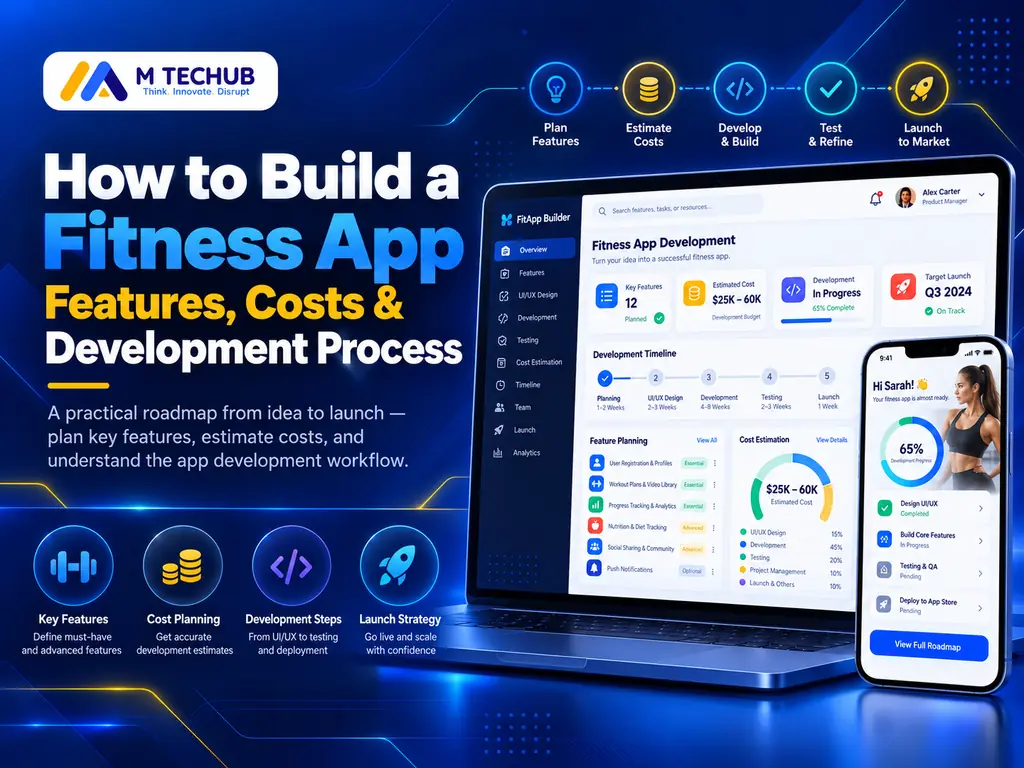
Building a fitness app development requires more than an attractive interface. You need to decide who the app serves, which problems it solves, what features belong in the first release, and how much you can afford to build and maintain.
A gym owner may want easier class booking and membership management. An independent personal trainer might need a way to assign workout programmes, review progress, and communicate with clients. Both are fitness applications, but their development requirements are different.
The most practical approach is to start with a minimum viable product (MVP) that solves one important user problem, then add features based on actual demand.
This guide covers essential fitness app features, development costs in the US and UK, technology choices, security considerations, and the steps involved in taking a fitness app from idea to launch.
What Type of Fitness App Should You Build?
Choosing the type of application is one of the first decisions because it shapes the development budget and technical requirements.
| Fitness app type | Main users | Priority features |
|---|---|---|
| Workout tracking app | Individual fitness users | Workout plans, logging, progress tracking |
| AI fitness coaching app | Users seeking personalised training | Recommendations, plan adjustments, coaching feedback |
| Gym management app | Gym owners and members | Memberships, class booking, payments |
| Personal trainer app | Independent trainers and clients | Client onboarding, programmes, progress reviews |
| On-demand fitness app | Online fitness audiences | Workout videos, content access, subscriptions |
| Wearable-connected app | Runners and active users | Activity data, wearable synchronisation |
Workout and Personal Training Apps
A workout application helps people follow training programmes, record sessions, and monitor progress.
For a basic workout tracker, users may only need an exercise library, workout calendar, activity history, and progress dashboard.
Personal training applications serve a different purpose. Trainers need to create programmes, assign them to clients, review progress, and provide feedback.
That difference affects the backend architecture because trainers and clients need different account permissions.
Gym and Studio Management Apps
Gym owners usually care about daily operations: managing memberships, booking classes, handling cancellations, and communicating with members.
Consider a boutique fitness studio offering ten classes each day. Its initial app might only need a class calendar, member accounts, reservations, waiting lists, and staff administration.
Adding AI workout coaching would not necessarily help the studio solve its main operational problem.
Existing gym management software should also be evaluated before investing in a replacement system.
AI-Powered Fitness Coaching Apps
AI-assisted applications can recommend exercises, modify workout schedules, and help users understand training progress.
For example, an app could suggest alternative movements when a user does not have access to particular equipment.
However, an AI feature requires more than connecting a language model. Developers must consider the quality of training data, recommendation limits, testing, user safety, and ongoing operating costs.
AI should support an identifiable user need rather than simply appear in the app’s marketing.
Video, Nutrition, and Wearable Apps
On-demand workout platforms require content management, reliable video playback, and potentially subscription access.
Nutrition applications may need food databases, meal logging, and nutritional calculations.
Wearable-connected fitness apps introduce permissions, synchronisation, and data-consistency requirements.
These capabilities can be introduced later if they are not essential to the first release.
Essential Fitness App Features: What Should You Build First?
The right feature set depends on the application’s intended users.
A useful MVP delivers one complete experience. It does not need every feature competitors advertise.
User Accounts and Onboarding
Onboarding may collect training goals, fitness experience, workout preferences, and available equipment.
Only request information that the app genuinely needs.
A simple workout tracker may not require users to answer a lengthy fitness questionnaire before recording their first exercise.
Workout Plans and Exercise Libraries
Workout applications usually need structured exercise information, including:
- Exercise names and instructions.
- Sets, repetitions, duration, and rest periods.
- Equipment and difficulty levels.
- Workout scheduling and completion tracking.
Exercise demonstrations can improve usability, but recording hundreds of videos before launch may increase costs unnecessarily.
Progress Tracking
Progress tracking should match the training activity.
A strength-training app may record weights, repetitions, and completed sessions. A running application may focus on distance, duration, and pace.
A straightforward progress chart can be more useful than a complicated analytics dashboard filled with measurements users do not understand.
Trainer-Client Communication
Personal training apps may need messaging, workout feedback, and progress reviews.
Real-time chat introduces additional infrastructure and notification requirements. If weekly trainer feedback is enough, an asynchronous communication feature may be more economical.
Class Booking and Membership Management
Gym applications need accurate schedules, reservation limits, cancellation rules, and membership access.
The backend must prevent conflicting reservations. A mobile interface showing an available class does not guarantee that a space remains available when multiple members book simultaneously.
Payments and Administration
Paid products need suitable billing, subscription access, cancellation management, and administrative controls.
Business owners may also require an admin dashboard to manage users, programmes, bookings, and customer-support requests.
These tools should be included in the project scope from the beginning.
MVP vs Advanced Features
| Feature | MVP priority | Add later when needed |
|---|---|---|
| User onboarding | Usually essential | Advanced personalisation |
| Exercise library | Essential for training apps | Expanded media content |
| Workout logging | Essential for tracking apps | Detailed performance analytics |
| Class booking | Essential for gym booking apps | Multi-location scheduling |
| Subscription billing | Essential for paid digital products | More complex billing models |
| Trainer communication | Important for coaching apps | Live video sessions |
| Wearable integration | Optional | Multiple devices and data sources |
| AI recommendations | Optional | More sophisticated personalisation |
| Camera-based form analysis | Usually unnecessary initially | Specialised movement feedback |
Practical example: A personal trainer launching a coaching app may benefit more from reliable programme assignments and client reviews than an expensive AI exercise-analysis feature.
Build the workflow customers will actually use before investing in advanced functionality.
Advanced Fitness App Features and Their Development Impact
Some features look simple to users but introduce significant work behind the scenes.
AI Workout Personalisation
An AI coaching feature may analyse workout history and user preferences to recommend training adjustments.
Developers need to define what data the system uses, how recommendations are evaluated, and which situations require safeguards or human review.
AI-generated exercise recommendations should not be described as medically validated without supporting evidence.
The operating budget may also include model usage, monitoring, and evaluation.
Camera-Based Exercise Analysis
Camera-based features use computer vision to estimate body positions and movement patterns.
Their reliability can change with lighting, camera angle, visibility, and exercise type.
Before building this capability, test whether it provides useful feedback on the exercises the app intends to support.
Apple HealthKit and Android Health Connect
HealthKit allows compatible Apple applications to request access to relevant health and fitness information.
Health Connect provides supported Android applications with mechanisms for accessing health and fitness data through user-controlled permissions.
Health Connect availability depends on the Android version and device environment.
Applications must handle denied permissions, missing measurements, and synchronisation failures.
Official documentation:
- Apple HealthKit
- Android Health Connect
Live and On-Demand Workouts
Recorded workout videos require storage, playback, and access management.
Live sessions add broadcasting, scheduling, connectivity, and potentially participant interaction.
A startup offering a small library of recorded sessions does not need the same infrastructure as a platform delivering simultaneous live classes.
How Much Does It Cost to Build a Fitness App in the US and UK?
Fitness app development costs vary considerably because products have different requirements.
A workout-tracking MVP and an advanced AI coaching platform should not be compared using the same fixed price.
What Published Market Research Shows
Clutch’s mobile-app pricing guide, updated September 21, 2026, reports an average project cost of approximately $90,780 across its general app-development dataset.
This is not a fitness-app-specific average or a US-only figure.
Source: Clutch Mobile App Pricing Guide 2026.
Clutch’s UK mobile-development guide also publishes these indicative general mobile-app budgets:
| UK project category | Published pricing |
|---|---|
| Feature-light application | £30,000–£80,000 |
| Mid-complexity application | £80,000–£200,000 |
| Enterprise or regulated application | £200,000+ |
Source: Clutch UK Mobile App Developers.
These figures provide market context, but they are not guaranteed prices for fitness applications.
Illustrative US and UK Fitness App Budgets
To understand how development effort affects pricing, consider three hypothetical project scopes.
The calculations use assumed blended development rates of $75/hour for the US example and £90/hour for the UK example.
| Project scope | Estimated effort assumption | US example | UK example |
|---|---|---|---|
| Focused MVP | 600–1,000 hours | $45,000–$75,000 | £54,000–£90,000 |
| Mid-complexity app | 1,200–2,200 hours | $90,000–$165,000 | £108,000–£198,000 |
| Advanced platform | 2,500–4,500 hours | $187,500–$337,500 | £225,000–£405,000 |
Research date: October 23, 2026.
These are illustrative calculations, not verified national averages, fixed market prices, or quotations. The effort ranges are planning assumptions, and actual project estimates may fall outside them.
What Each Scope Includes
Focused MVP: A limited feature set, core onboarding, workout tracking or booking, straightforward backend functionality, basic administration, UX/UI design, testing, and launch preparation.
Mid-complexity app: Broader user roles, subscription management, reporting, notifications, selected integrations, and more extensive testing.
Advanced platform: Complex administration, AI-assisted capabilities, wearable integrations, video functionality, advanced user roles, and more substantial engineering and security requirements.
What Is Excluded?
Unless explicitly included in the supplier’s quotation, allow separate budgets for cloud hosting, content production, video licensing, AI usage, payment charges, marketing, legal reviews, customer support, taxes, and ongoing maintenance.
A lower project quote may simply exclude work that another supplier has included.
Before comparing proposals, confirm which deliverables are covered.
Fitness App Development Cost Breakdown
A complete development budget covers more than mobile programming.
Discovery and Planning
The development team defines the product requirements, user roles, primary workflows, integrations, and release scope.
Clear requirements make quotations more comparable and reduce avoidable changes during development.
UX/UI Design
Design includes wireframes, interactive prototypes, reusable components, and accessibility considerations.
Fitness interfaces should be easy to navigate while users are exercising, not just attractive in presentation images.
Mobile and Backend Engineering
Mobile engineering covers application screens, navigation, device functionality, and platform integrations.
Backend engineering manages information such as accounts, workout history, memberships, bookings, and access permissions.
Both should be included when evaluating the total project.
Integrations and Testing
Payment systems, wearable APIs, video platforms, and existing gym software may require additional implementation and testing.
Quality assurance should cover failed payments, booking conflicts, offline behaviour where relevant, permissions, and supported devices.
Launch and Maintenance
The budget should also include store preparation, monitoring, security updates, customer support, and future compatibility work.
Apple’s standard Developer Program membership is $99 annually, while Google Play Console charges a $25 one-time registration fee. Applicable local pricing and account requirements should be confirmed during enrolment.
References:
- Apple Developer Program
- Google Play Console
How to Avoid Budget Overruns
Request a written scope describing features, platforms, admin tools, integrations, testing, ownership, and launch support.
Agree on how additional work will be approved and priced.
For a startup, postponing an unnecessary integration is usually a better cost-control decision than reducing essential security testing.
Step-by-Step Fitness App Development Process
Step 1: Validate the Product Idea
Identify the target customers and the problem they want solved.
Interview potential users and examine how they currently manage the task.
For example, a gym may discover that members struggle with booking cancellations more than with accessing workout content.
Output: Problem statement and product goals.
Step 2: Define the Business Model
Decide whether revenue will come from subscriptions, training programmes, coaching services, studio licences, or another suitable model.
The commercial model influences payment flows and administrative requirements.
Output: Revenue model and user-role definitions.
Step 3: Prioritise the MVP
Select the features necessary to complete the principal user journey.
Describe business rules as well as screens. A class-booking feature, for example, needs capacity management and cancellation behaviour.
Output: Feature backlog and acceptance criteria.
Step 4: Design and Test Prototypes
Create wireframes and interactive designs.
Test onboarding, workout logging, class booking, and other essential workflows with representative users.
Output: Approved designs and user flows.
Step 5: Select the Technology Stack
Choose the mobile framework, backend, database, hosting, and integration approach.
Consider platform requirements, future maintenance, security, and team experience.
Output: Technical architecture and delivery plan.
Step 6: Develop the Application
Build the mobile interface, server-side functions, administrative tools, and integrations.
Review complete user journeys during development rather than approving isolated screens.
Output: Working application increments.
Step 7: Test Functionality and Security
Test important workflows on supported devices.
Check permissions, payments, account access, booking rules, synchronisation, and error handling.
Output: Tested release candidate.
Step 8: Prepare and Launch
Create developer accounts, complete app-store information, configure production services, and submit the app for review.
Allow for review feedback rather than assuming approval will occur on a particular date.
Output: Submitted and approved app release.
Step 9: Evaluate and Improve
Monitor crashes, onboarding completion, completed workouts, bookings, subscription behaviour, and support requests.
Use those findings to decide what to improve next.
Output: Post-launch improvement roadmap.
How Long Does Fitness App Development Take?
There is no dependable universal timeline.
A focused workout tracker with prepared content and a straightforward backend has different delivery requirements from a platform that combines live video, complex subscriptions, AI coaching, and wearable data.
The delivery schedule should come from task estimates and available team capacity.
Ask suppliers to identify dependencies such as API access, content delivery, design approvals, payment setup, testing, and app-store preparation.
A milestone-based schedule is more useful than a fixed launch promise unsupported by project requirements.
Choosing the Right Fitness App Technology Stack
A suitable technology stack supports the product’s functionality without making maintenance unnecessarily difficult.
Native Development
Swift and Kotlin are common choices for native iOS and Android development.
Native applications can provide direct access to platform capabilities, although separate implementations may increase development and maintenance work.
Cross-Platform Development
Flutter and React Native allow substantial application code to be shared between iOS and Android.
They can be practical when both platforms have similar core workflows.
Some device integrations may still require platform-specific engineering.
Backend and Database Architecture
Backend services may handle authentication, subscriptions, booking rules, workout records, notifications, and reporting.
Choose technologies based on the data model, integrations, scalability needs, and the development team’s ability to support them.
Practical decision: A simple coaching app may not need an elaborate distributed architecture. Begin with a maintainable design that supports the current product while leaving room for justified improvements.
Privacy, Security, and Compliance in the US and UK
Fitness applications may process activity histories, body measurements, fitness goals, location information, and wearable-generated data.
The applicable legal obligations depend on how that information is collected, used, and shared.
US Health-Data Considerations
HIPAA does not automatically cover every consumer fitness application.
Its applicability depends on the organisation, its relationships with regulated entities, and the services it provides.
Consumer health applications may also be subject to other federal and state requirements.
The FTC’s amended Health Breach Notification Rule may apply to qualifying health-data products and services.
In September 2026, the FTC withdrew its older 2021 policy statement on health apps. The amended rule remains relevant.
Sources:
- HHS Mobile Health App Guidance
- FTC Health Breach Notification Rule
UK GDPR and Health Information
UK businesses must assess their obligations under applicable data-protection law.
Information revealing physical or mental health status may be special category data under UK GDPR.
Where that classification applies, organisations need an appropriate Article 6 lawful basis and an Article 9 condition for processing, together with other applicable safeguards.
Not every isolated activity measurement automatically establishes health status.
Source: ICO Special Category Data Guidance.
Practical Security Measures
Build security into the product from the beginning.
Relevant measures may include secure authentication, access controls, encryption, data minimisation, retention policies, backups, logging safeguards, and deletion processes.
For example, trainers should only access client records they are authorised to view.
Privacy and compliance decisions should be reviewed in the context of the actual product. These engineering practices are not, by themselves, proof of legal compliance.
How to Monetize a Fitness App
Users generally pay for a valuable experience rather than for a long feature list.
The revenue model should match what the product delivers.
Monthly or Annual Subscriptions
Subscriptions can provide continued access to training programmes, coaching content, or premium functionality.
Plan for renewals, cancellations, billing failures, and access management.
Freemium Access
Offer a useful free experience while charging for selected advanced functionality.
The difference between free and paid features should be clear.
Paid Training Programmes
Personal trainers may sell structured plans or coaching packages.
This can suit businesses whose customers prefer purchasing defined services rather than subscribing indefinitely.
Gym and Studio Subscriptions
A business-focused platform may charge gyms or studios for booking, administration, reporting, or client-management functionality.
Corporate Wellness Contracts
Employer-focused products may use organisation-level contracts and need additional administration, reporting, and procurement support.
App Store Payment Rules
Apple and Google distinguish between various digital products and physical services.
Google Play generally requires its billing system for covered digital fitness subscriptions but excludes transactions primarily for physical services such as gym memberships, subject to policy conditions.
Apple has specific exceptions for qualifying real-time person-to-person services, including certain individual fitness-training sessions.
Regional alternatives and programme-specific rules can affect implementation.
Review the official policies before building the purchase flow:
- Apple App Review Guidelines
- Google Play Payments Policy
Common Fitness App Development Mistakes
Building too much before validation. Start with the main problem rather than trying to reproduce every competitor feature.
Ignoring business administration. Include the management tools gym staff and trainers will actually use.
Underestimating integrations. Check API access, pricing, permissions, and data compatibility early.
Adding AI without a clear purpose. Define what users gain from automated recommendations before investing in them.
Ignoring ongoing costs. Budget for hosting, support, infrastructure, maintenance, and third-party services.
Overlooking data security. Assess sensitive information, permissions, and access controls during design.
Choosing suppliers only by quoted price. Compare deliverables, exclusions, ownership terms, testing, and support.
Launching without useful analytics. Measure whether people successfully complete the tasks the application was built to support.
Pre-Development Checklist
Before asking a development company for a quotation, clarify:
- Who will use the application?
- What problem should the first version solve?
- Which functions are essential for launch?
- Will the app support iOS, Android, or both?
- Are payment, gym-management, or wearable integrations needed?
- Will the business produce its own workout content?
- What personal information will be processed?
- What development and operating budget is available?
- What evidence would show that the MVP is working?
- Who will own the code, accounts, and infrastructure?
These answers make it easier to compare development proposals fairly.
How to Choose a Fitness App Development Company
Choose a team that understands the product’s business goals and can translate them into an achievable development plan.
Ask prospective suppliers about their discovery process, relevant technical experience, security practices, testing approach, and post-launch support.
Request a detailed proposal listing deliverables, exclusions, milestones, costs, and ownership arrangements.
Where a supplier claims relevant project experience, request examples that can be verified.
A useful proposal should explain trade-offs—not simply recommend the largest possible project.
Conclusion
A successful fitness application begins with a well-defined problem and a manageable first release.
Decide what users need, prioritise the essential features, and compare development quotations against the same documented scope. Budget for maintenance and operational expenses from the beginning.
Advanced functionality should be introduced when there is a clear reason to invest in it.