
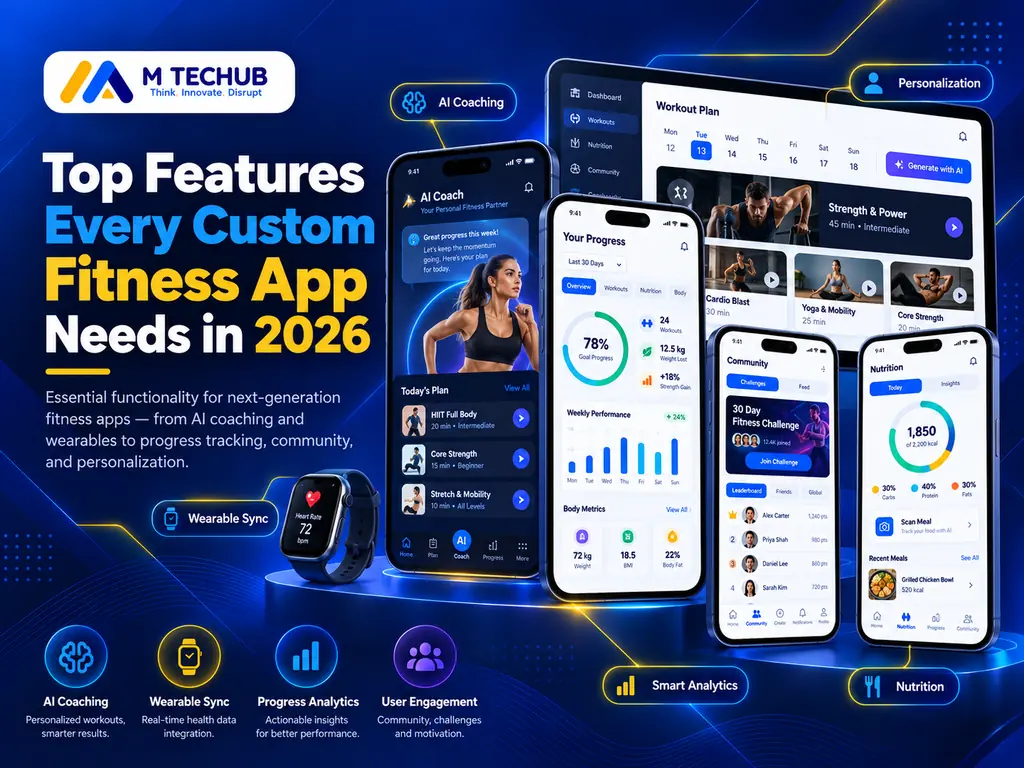
Choosing features for a custom fitness app is not about building the longest feature list. It is about deciding what users need to accomplish, which capabilities support your business model, and which additions justify their development and maintenance requirements.
For US fitness startups, gyms, personal training businesses, and wellness platforms, those decisions can look very different. A workout planning app may depend on exercise recommendations and progress tracking. A gym membership app may need reliable booking, payments, and attendance management before any AI features.
This guide explains which custom fitness app features are worth considering in 2026, how they support different fitness businesses, and when to build, integrate, or delay them.
What Features Should a Custom Fitness App Have in 2026?
Most custom fitness apps should evaluate these five foundational capabilities:
- User onboarding and profiles: Collect information necessary to deliver a relevant experience.
- Workout planning and exercise content: Help users find, follow, or receive suitable training sessions.
- Progress tracking: Record completed activities and display useful history.
- Notifications and reminders: Support scheduled activities without overwhelming users.
- Secure accounts and privacy controls: Protect user information and provide control over personal data.
These are starting points, not universal requirements. A class-booking app may not need a workout library, while an individual training product may not need membership administration.
Other features, including trainer dashboards, payments, wearable connectivity, AI recommendations, and streaming, should be selected according to the product’s intended workflow.
A useful feature-selection question is: What must users accomplish in the first release, and which features are necessary to make that experience work reliably?
For example, a boutique studio member needs to find and reserve a class. A personal training app user needs to receive, complete, and review a workout. The two products require different priorities.
Essential Features for Custom Fitness Apps
User Registration, Onboarding, and Fitness Profiles
Onboarding should collect information that changes how the app serves the user.
For a workout planning product, relevant inputs might include experience level, goals, equipment availability, preferred activities, and the time available for a session.
Consider someone who trains at home for 30 minutes. An app that knows they only have resistance bands can recommend an appropriate session instead of presenting gym equipment exercises they cannot complete.
However, not every fitness app needs an extensive questionnaire.
A gym booking app may only require an account, membership association, and communication preferences.
When to build it: Include the minimum profile information needed for the main user journey. Add more detailed preferences only when the app can make practical use of them.
Development considerations: Authentication, profile editing, account recovery, data deletion, and clear explanations of why personal information is requested.
Workout Planning and Exercise Libraries
Workout planning helps users select and complete training sessions without repeatedly starting from scratch.
A useful exercise library may include demonstrations, equipment requirements, difficulty categories, clear instructions, and approved alternatives.
For a personal training platform, coaches may assign exercises directly. A consumer workout app may generate schedules from reviewed templates and user preferences.
The main challenge is maintaining useful exercise content rather than simply accumulating hundreds of entries.
An exercise library should support the product’s actual training approach. If the application promises equipment-aware workouts, its exercise data must identify the necessary equipment and alternatives consistently.
When to build it: Essential for workout planning, coaching, and training apps. Usually unnecessary for a product focused only on gym access or class reservations.
Build-or-integrate decision: A business with proprietary training methods may benefit from a custom exercise and programming system. An early-stage product could use licensed exercise content where suitable, but should verify usage rights, content quality, data formats, and whether the provider permits the intended application.
Development considerations: Structured exercise records, media storage, content review, substitutions, and workout versioning.
Progress Tracking and Fitness Analytics
Progress tracking should help users understand what they completed and how their recorded performance changes over time.
A strength training app might show repetitions, sets, and logged weights. A running app may prioritize distance, duration, and pace.
For example, someone following an eight-week program could compare their recorded sessions and exercise performance without navigating several dashboards.
Not every fitness metric deserves equal attention.
If users are trying to maintain a consistent workout schedule, completed sessions may be more relevant than a complex readiness score.
Applications should distinguish directly recorded information from calculated estimates. Calorie expenditure, for example, should not be represented as an exact measurement.
When to build it: Prioritize tracking when measurable progress is central to the app. Start with a small set of meaningful metrics rather than an elaborate analytics system.
How to evaluate it: Measure whether users successfully record workouts, review their history, and return to complete planned sessions. Investigate abandoned logging sessions and missing records before adding more charts.
Development considerations: Data sources, time zones, editing history, missing records, and synchronization.
Smart Notifications and Workout Reminders
Notifications are most useful when they support an action users already intend to take.
A gym application could send a class reminder or booking cancellation notification. A coaching platform might notify users when a trainer updates their workout plan.
A generic daily reminder, by contrast, may have little value when it ignores the user’s actual training schedule.
Users should be able to control reminder frequency, notification categories, and quiet periods.
When to build it: Include important transactional alerts where needed. Add behavioral reminders when users demonstrate a need for them.
How to evaluate it: Check notification delivery, user preferences, opt-outs, and whether reminders are followed by the intended activity. A notification being opened does not necessarily mean it provided value.
Development considerations: Push permission handling, time zones, scheduling changes, notification preferences, and delivery failures.
Secure Accounts and Privacy Controls
Account security and privacy controls are fundamental to fitness app development, particularly when the product processes information about users’ physical activities or health.
Practical capabilities include secure authentication, appropriate permissions, account recovery, data deletion, and controlled access to administrative tools.
A coaching platform should not expose one client’s private training history to another client. A multi-location gym application may need different permissions for reception staff, trainers, and regional administrators.
Security requirements should be incorporated into the architecture rather than treated as optional features.
When to build it: From the first functional release.
Development considerations: Role-based access, encryption, credential management, retention policies, and security testing.
US privacy obligations depend on the business and the information collected. HIPAA does not automatically apply to every consumer fitness app. However, other rules, including the FTC’s Health Breach Notification Rule, may apply to qualifying health applications.
Source: FTC — Complying with the Health Breach Notification Rule.
Business-Specific Features for Gyms, Studios, and Coaching Platforms
Trainer Dashboards and Client Management
Trainer dashboards help coaching businesses coordinate programs, feedback, and client activity.
For example, a trainer managing clients with different workout schedules may need to assign sessions, review completion records, and adjust future plans from a central interface.
Useful capabilities might include client lists, workout assignments, progress reviews, and secure messaging.
The business should determine whether trainers need a full administrative dashboard or a simpler workspace that supports a few recurring tasks.
When to build it: Important for personal training businesses and coaching platforms. Usually unnecessary for self-directed consumer workout apps.
Development considerations: Access permissions, assignment workflows, messaging history, and client data visibility.
Membership Management and Class Booking
For gyms and boutique fitness studios, booking reliability may matter more than advanced workout technology.
Members should be able to review available classes, reserve places, cancel bookings, and receive accurate confirmations.
A studio with limited class capacity needs the system to handle concurrent reservations without allocating the same final space twice.
Waitlists, attendance records, and membership eligibility may also be necessary.
Build, integrate, or use existing software?
A studio already using gym management software should first check whether its current platform provides member-facing booking features or supported APIs.
Using an existing booking platform may avoid rebuilding scheduling rules, attendance records, cancellation handling, and staff workflows.
A custom booking system may be justified when the business has requirements that existing products cannot adequately support, such as specialized reservation rules across multiple locations.
However, a custom system also creates responsibility for availability calculations, concurrency, maintenance, and operational support.
When integrating a third-party platform, verify that its API supports the necessary operations, not just displaying a schedule. Some providers may allow schedule retrieval but restrict reservation creation or cancellation.
When to build it: Essential for booking-focused apps and many physical fitness businesses.
How to evaluate it: Track booking completion rate, booking failures, cancellation processing, class attendance, and reservation conflicts. Measure completion against users who actually begin a booking, rather than treating every app visit as an attempted reservation.
Development considerations: Capacity rules, existing software integrations, payment status, scheduling conflicts, and cancellation policies.
Subscriptions and Payment Management
Fitness businesses may charge for digital training programs, coaching sessions, memberships, or on-demand content.
Each model requires appropriate purchase and subscription workflows.
For example, purchasing premium digital workout content differs from paying for an in-person training session.
Apple’s App Review Guidelines distinguish digital purchases, qualifying real-time person-to-person services, and services consumed outside an app. Google Play also has billing requirements and policy exceptions that depend on the transaction and applicable programs or markets.
Developers should confirm the current rules for the planned purchase flow before selecting payment providers.
Sources: Apple App Review Guidelines and Google Play Payments Policy.
Build-versus-integrate decision: Most fitness businesses should evaluate established payment infrastructure rather than developing payment processing from scratch.
The application may still need custom purchase screens, subscription access rules, member entitlements, and billing-related workflows.
The payment provider manages supported transaction processes, while the fitness business remains responsible for ensuring that access changes correctly after successful payments, failed renewals, refunds, and cancellations.
Third-party payments reduce some implementation responsibilities but introduce service dependencies, processing fees, and integration maintenance.
When to build it: Include payments when users need to purchase through the app or when paid access is central to the product’s business model.
How to evaluate it: Measure checkout completion, failed payments, subscription conversion, successful renewals, and cancellation behavior. Review these metrics by purchase type and platform where appropriate.
Development considerations: Subscription entitlements, failed payments, refunds, renewals, cancellations, and transaction reconciliation.
Admin Dashboards and Business Reporting
Administrative tools allow fitness businesses to operate the product without requiring developers to perform routine tasks.
Depending on the business, administrators may need to publish workout content, manage classes, update trainer access, resolve member issues, and review subscriptions.
A multi-location gym may need separate location managers and organization-level administrators.
Reporting should answer operational questions rather than display every available metric.
For example, a studio may benefit from class occupancy and cancellation reporting, while a subscription product may prioritize active subscriptions and cancellation reasons.
When to build it: Include essential administrative workflows alongside the functionality they support. Expand reporting after identifying real business decisions it can improve.
Development considerations: Role permissions, audit trails, export capabilities, and reporting definitions.
Advanced Fitness App Features Worth Evaluating in 2026
AI-Powered Personalized Workout Plans
AI-powered workout planning can use relevant user information to help select or adapt exercise recommendations.
Potential inputs include experience level, workout history, equipment, session preferences, and user feedback.
However, personalization does not automatically require machine learning.
A rules-based system can select reviewed exercises based on experience and equipment. Machine-learning models may help rank alternatives when sufficient appropriate data exists. Generative AI can explain recommendations conversationally, but its output still requires suitable controls.
For example, a product could use predefined progression rules to select a training plan while allowing an AI assistant to explain how the plan works.
This separates workout selection from unrestricted text generation.
When are rules-based recommendations sufficient?
For an initial product, rules may be enough when recommendations depend on a manageable set of known conditions, such as available equipment, experience level, exercise preferences, and session duration.
They are also easier to inspect and test against defined training rules.
Machine learning becomes worth evaluating when the team has a specific recommendation problem, relevant and appropriately obtained data, and evidence that a model can improve on a simpler baseline.
How to test a narrow AI use case
Rather than attempting to create a completely autonomous personal trainer, begin with one defined task.
For example: Suggest an alternative exercise when equipment is unavailable.
The team can then:
- Define supported exercises, equipment categories, and excluded recommendations.
- Prepare realistic test cases covering different user preferences and constraints.
- Compare AI recommendations against reviewed rules or trainer-approved alternatives.
- Check unsupported suggestions, inconsistent outputs, and failures to respect user-provided limitations.
- Test how the system responds when information is insufficient.
- Use qualified review where recommendations require professional training judgment.
The application should be able to decline an unsupported recommendation or request more information rather than inventing a suitable exercise.
Before launch, test output consistency, privacy handling, failure cases, and performance across representative users.
When to build it: Consider advanced AI when personalization is central to the product and a simpler approach cannot adequately meet the requirement.
How to evaluate it: Compare recommendation acceptance, workout completion, user-reported usefulness, and correction frequency against a rules-based baseline. These measures help assess product behavior but do not independently prove better fitness outcomes.
Development considerations: Data quality, recommendation evaluation, approved content, error handling, and human oversight where appropriate.
AI Pose Detection and Exercise Form Feedback
Camera-based pose estimation can identify body landmarks from images or video and estimate movement patterns.
A workout app might use these estimates to count repetitions or provide limited feedback for supported exercises.
For example, a squat-tracking feature could estimate movement depth from visible landmarks under controlled camera conditions.
However, pose estimation does not automatically establish whether an exercise is safe or biomechanically correct.
Camera position, lighting, occlusion, body movement, and model limitations can affect its output.
A company planning form feedback should define which exercises, conditions, and feedback types it can validate rather than advertising universal correction capabilities.
How to approach the first implementation
Begin with one or two supported exercises and a narrow objective, such as repetition counting under documented camera conditions.
Define where the camera should be placed, how much of the user’s body must remain visible, and what the application can reliably measure.
Then test across:
- Different body proportions, clothing, and movement speeds.
- Front, side, and partially obstructed camera views.
- Bright, dim, and uneven lighting.
- Different supported phones and processing capabilities.
- Incomplete repetitions and movements outside the supported exercise.
A pose model that successfully identifies landmarks does not automatically produce accurate exercise feedback. The rules that interpret those landmarks require separate validation.
Handling unreliable feedback
When confidence is insufficient or the required landmarks are not visible, the app should avoid giving definitive technique corrections.
It may instead ask the user to reposition the camera, improve visibility, or continue without automated feedback.
For features that make claims about exercise technique, teams should compare outputs with appropriately qualified human evaluations and document where the system is unreliable.
When to build it: Usually an advanced feature, unless movement analysis is the product’s main differentiator.
How to evaluate it: Track repetition-counting errors, incorrect feedback, unrecognized movements, performance on supported devices, and the frequency of sessions where feedback must be withheld.
Development considerations: Representative testing, on-device performance, consent, video handling, and misleading feedback.
Wearable Device and Health Platform Integrations
Wearable integration allows fitness applications to access supported activity and health information with appropriate authorization.
Two important platform options are:
Apple HealthKit: Provides a framework for accessing and sharing supported health and fitness information across Apple’s ecosystem. Applications must request authorization for relevant data types, and users can control access.
Android Health Connect: Supports sharing specified health and fitness data types between compatible Android applications. Apps must declare and request the relevant permissions, with additional requirements for certain access patterns.
Sources: Apple HealthKit Authorization and Android Health Connect Documentation.
Apple Watch and Wear OS can also be relevant when the product needs an experience directly on a wearable device.
Garmin, Oura, and WHOOP integrations may be useful for products focused on activity, sleep, or recovery, but businesses should verify developer access, supported metrics, and any approval requirements.
Not every device exposes identical data, and synchronized information may arrive late or be incomplete.
For example, if someone records the same walk with a phone and watch, the app needs a defined approach to avoid misleading totals.
Choosing the right integration approach
Start by identifying the exact data the application needs.
| Integration approach | Appropriate use case | Important trade-off |
|---|---|---|
| Phone-based tracking | Basic movement, activity logging, or supported phone sensor measurements | Availability and accuracy vary by device, permissions, and usage conditions |
| Apple HealthKit | Reading or writing supported health and fitness information on Apple platforms | Requires data-type authorization; available data depends on sources and user permissions |
| Android Health Connect | Exchanging supported health and fitness records with compatible Android apps | Requires supported data types, permissions, and compatible platform behavior |
| Direct wearable-platform API | Accessing particular vendor-supported metrics or connected services | Requires checking API eligibility, data availability, restrictions, and ongoing access |
These approaches are not necessarily alternatives in every situation. A product may use phone-based activity logging alongside HealthKit or Health Connect, while a direct vendor integration may be required for a specific supported feature.
Questions to answer before development
- Does the application need steps, workout sessions, heart rate, sleep records, or another specific data type?
- Is the information required during the workout, or is delayed synchronization acceptable?
- Can the chosen framework access that data from the intended sources?
- Does access require additional permissions, eligibility, or provider approval?
- What should the user see when information is missing or permissions are changed?
- How will duplicate records from multiple sources be identified?
- Can the core feature work without the integration?
For example, a workout journaling app may function well with manual entries in its first release. A connected coaching product built around device-recorded activity may need an integration from the beginning.
Handling synchronization problems
Teams should define data-source precedence, record identities, timestamps, and duplicate-handling rules.
If synchronization is delayed, the app should show when information was last updated instead of implying that all metrics are live.
If users revoke permissions, the product should stop accessing the affected data and explain which features may no longer work.
HealthKit also has privacy behavior that prevents apps from always determining whether read permission was denied or matching records simply do not exist. Applications should not treat an empty result as proof that a user recorded no activity.
When to build it: Include wearable connectivity early when connected data is essential to the app’s value. Otherwise, validate the product’s main experience before adding multiple integrations.
How to evaluate it: Measure successful connections, synchronization failures, data freshness, duplicate handling, and the percentage of users able to complete essential tasks without wearable access.
Development considerations: Permissions, data freshness, duplicate records, platform compatibility, and third-party API changes.
Gamification, Social Challenges, and Community Features
Gamification can add participation-based experiences such as voluntary challenges, achievements, workout streaks, and community groups.
A gym chain might organize a monthly class attendance challenge across participating locations.
A consumer workout application might allow friends to share selected workout milestones.
These experiences should match the audience’s motivations.
Public rankings may be inappropriate for users who prefer private tracking, and streak mechanics should not pressure people to exercise when rest is appropriate.
When to build it: After establishing that users want social participation or that community interaction is part of the product’s central value.
How to evaluate it: Examine voluntary participation, repeat participation, opt-outs, and qualitative feedback. Compare these with the feature’s moderation and maintenance requirements.
Development considerations: Privacy settings, moderation, notification controls, and fair participation rules.
Gamification should be evaluated through actual user behavior rather than assumed to increase retention.
Recovery, Sleep, Nutrition, and Wellness Tracking
Some fitness platforms benefit from supporting habits beyond workouts.
Potential capabilities include sleep summaries, recovery trends, nutrition journals, hydration tracking, and user-reported energy levels.
For instance, a broader wellness app may let users review sleep history alongside completed workouts.
The information presented should remain within the product’s intended purpose.
A wearable-generated recovery score is not necessarily a medically validated assessment. Apps should explain the limitations of inferred metrics rather than using them to make unsupported health or injury-prevention claims.
When to build it: Relevant for wellness-focused products and coaching platforms with a demonstrated need for broader tracking.
Development considerations: Additional sensitive data, metric interpretation, user input burden, and integration quality.
Live Training and On-Demand Workout Videos
Live classes and recorded workouts can support digital coaching businesses and hybrid gym memberships.
A boutique studio may offer recorded sessions to members who cannot attend in person.
A personal training business may need live one-to-one sessions instead of an extensive video library.
The technical requirements differ.
On-demand video involves content storage, access permissions, and playback quality. Live instruction may require scheduling, low-latency communication, and interactive features.
Build-versus-integrate decision: An established video delivery or communication service may be suitable for an initial release, particularly when streaming technology is not the business’s main differentiator.
A custom-built experience may be appropriate when the product requires specialized session controls, deeply integrated coaching interactions, or functionality that available services cannot support.
Before choosing a provider, evaluate recording requirements, participant limits, access controls, reliability, data-handling terms, and vendor dependencies.
Building streaming infrastructure from scratch introduces additional operational work that may not be justified for an early-stage product.
When to build it: Essential for video-led fitness products. Optional for workout logging, booking, or analytics applications.
How to evaluate it: Review successful playback or session connection rates, interruptions, session completion, and actual content usage.
Development considerations: Streaming infrastructure, bandwidth, recording permissions, content management, and service costs.
Fitness App UX, Accessibility, Privacy, and Performance
A fitness app’s usability depends on how easily people can complete its main activities.
Design for Workout Conditions
Fitness apps are frequently used while people are moving or completing exercises.
Make important controls easy to locate. Keep text readable, reduce unnecessary navigation, and ensure users can record activities without complicated interactions.
A strength training app, for example, should make recording a completed set straightforward.
Accessible design should support appropriate text scaling, screen readers, contrast, and touch targets.
The W3C provides guidance on applying accessibility standards to mobile experiences.
Source: W3C — Mobile Accessibility.
Understand US and UK Privacy Requirements
For US fitness businesses, legal obligations depend on the organization’s activities, relationships, data practices, and applicable federal and state rules.
Consumer fitness apps are not automatically HIPAA-regulated. However, businesses may have other obligations concerning sensitive information, privacy representations, and breach notifications.
For UK users, health information may qualify as special category personal data under the UK GDPR, requiring an applicable lawful basis and a separate special-category processing condition where relevant.
These considerations should inform data collection, retention, applicable consent requirements, vendor agreements, and user controls.
Sources: FTC — Health Breach Notification Rule and ICO — Special Category Data.
Plan for Reliable Everyday Use
Fitness applications should handle interrupted sessions, unstable connections, device changes, and delayed synchronization.
For example, a workout logging app should preserve a user’s recorded sets if connectivity disappears during a gym session, then synchronize them appropriately when the connection returns.
Businesses should test these everyday conditions alongside the main feature demonstrations.
Fitness App MVP vs. Advanced Features: What Should You Build First?
A fitness app MVP should contain the capabilities required for users to complete the product’s core activity.
The table below provides a starting point for choosing features.
| Feature | Typical priority | Best suited for |
|---|---|---|
| User onboarding | Core where personalization matters | Workout and coaching apps |
| Secure accounts | Core | Account-based fitness apps |
| Workout planning | Core for training products | Consumer workout apps |
| Progress tracking | Core for tracking products | Workout and coaching apps |
| Notifications | Conditional | Scheduling and training apps |
| Trainer dashboards | Business-specific | Coaching businesses |
| Membership and booking | Core for booking products | Gyms and studios |
| Subscriptions and payments | Business-specific | Paid fitness services |
| Admin dashboards | Business-specific | Operational fitness platforms |
| AI personalization | Advanced or defining feature | Personalized coaching products |
| Pose detection | Advanced | Movement-analysis apps |
| Wearable integration | Conditional | Connected fitness products |
| Social challenges | Optional | Community fitness apps |
| Recovery and nutrition | Optional | Wellness platforms |
| Video streaming | Conditional | Digital classes and coaching |
These are typical priorities, not fixed requirements.
A useful decision is to ask what would happen if a feature were absent.
If the user could not complete the product’s primary activity, the feature is probably essential.
If the activity still works but becomes more convenient or engaging, the feature may be suitable for a later release.
If it adds a new business model or major technical dependency, evaluate it as a separate investment.
Example 1: Gym or Boutique Studio Booking App
Consider a boutique fitness studio that wants members to reserve classes and manage their bookings without contacting staff.
Main user task: Find an available class, reserve a place, and manage the reservation.
First-release priorities:
- Member accounts and membership verification.
- Class schedules and availability.
- Booking confirmation, cancellation, and capacity controls.
- Essential reminders.
- Administrative tools for staff.
Payment functionality may also be necessary if the studio sells memberships or classes through the application.
Features that can wait: AI workout recommendations, camera-based form feedback, wearable integrations, community leaderboards, and extensive progress tracking.
These features do not directly support the initial booking workflow.
Build or integrate?
If the studio already has management software with supported booking capabilities, integration may be the practical starting point. The custom app can focus on presenting a branded member experience without duplicating existing scheduling infrastructure.
If the existing system cannot support essential booking rules, a custom booking service may be worth considering after assessing migration and maintenance requirements.
How to evaluate the release: Measure booking completion, booking errors, attendance records, and whether staff still need to intervene in routine reservations.
Example 2: AI-Powered Personal Training App
Consider a startup developing personalized workout plans for people who train at home.
Main user task: Receive an appropriate workout, complete it, and understand what to do next.
First-release priorities:
- Fitness goals, training experience, and equipment preferences.
- A reviewed exercise library.
- Structured workout plans.
- Completed-workout tracking.
- A defined recommendation process.
- Secure account and data management.
If AI personalization is central to the product’s value proposition, the first release should test a narrow, controlled recommendation feature. It does not necessarily need a fully conversational AI coach.
Features that can wait: Social leaderboards, comprehensive nutrition tracking, live classes, integrations with multiple wearable brands, and camera-based correction.
Build or integrate?
The startup may choose to build its own workout progression rules while using an external AI service for carefully bounded explanatory features.
Alternatively, it may begin with reviewed rules alone and introduce machine-learning recommendations after collecting suitable evidence that more complex personalization is needed.
How to evaluate the release: Measure workout-plan generation success, recommendation acceptance, completed sessions, repeat use, and reports of inappropriate or unusable recommendations.
These two examples illustrate why the same feature can be essential for one product and unnecessary for another.
Technical Considerations for Custom Fitness App Development
Choose Technology Based on Required Capabilities
Fitness apps may be developed natively for iOS and Android or with cross-platform technologies.
The decision should account for performance, hardware integration, user experience, development expertise, and long-term maintenance.
For example, a booking-focused gym app may have different platform requirements from an application processing live camera frames during exercise.
The technology decision should follow the feature requirements rather than determine them in advance.
Define Integration Dependencies
Before committing to an external service, identify the data and operations the app needs.
A booking platform may need reliable access to class capacity and membership status. A wearable integration may require particular health data types and permissions.
Check API documentation, access eligibility, ongoing costs, usage limits, and failure behavior.
A feature that works in a demonstration is not necessarily ready for production if its dependencies have not been verified.
A practical build-versus-integrate framework
- Build: When the capability differentiates the product, requires specialized business rules, or cannot be adequately supported by existing services.
- Integrate: When a reliable external service supports the required workflow and the business accepts its technical and commercial dependencies.
- Use existing software: When an established gym, booking, or membership platform already handles the core operational process.
- Delay: When users can complete the main activity without the feature and its value has not yet been demonstrated.
For example, a gym may reuse its booking platform, integrate a payment provider, and build a custom member interface.
An AI workout startup may build its training rules, use a third-party model for a narrowly defined assistant, and delay wearable integrations until they are necessary.
These decisions should be revisited if the product’s requirements or provider capabilities change.
Account for Ongoing Maintenance
Fitness applications require maintenance after launch.
Activities may include operating system updates, security patches, infrastructure monitoring, app store compliance, content revisions, and integration updates.
Advanced AI and wearable features may require additional testing when models, devices, or APIs change.
Separate essential maintenance from future feature expansion when planning the product.
Measure Whether Features Deliver Value
A feature should be evaluated against the task it is intended to support.
Teams can define a baseline before adding the feature, then examine whether users complete the intended workflow successfully.
| Product objective | Useful measures |
|---|---|
| Simplify gym reservations | Booking completion, booking errors, class attendance |
| Support regular workouts | Workout completion, repeat usage, abandoned sessions |
| Sell digital fitness subscriptions | Checkout conversion, renewals, cancellations |
| Deliver connected fitness data | Integration success, sync failures, missing or duplicate records |
| Provide personalized workouts | Recommendation acceptance, completion, inappropriate suggestions |
These metrics require careful interpretation.
For example, higher workout completion may reflect changes in the user population, workout difficulty, or scheduling rather than the effect of a new recommendation feature.
Similarly, a subscription conversion rate should use a clearly defined population of eligible users rather than all application visitors.
Product teams should combine quantitative measures with user feedback, support reports, and reliability testing.
A feature that receives frequent use but creates misleading information or excessive administrative work may still require redesign.
How to Choose Features for Your Fitness Business
For Fitness Startups
Start with the specific activity users are trying to complete.
A strength training startup may prioritize exercise planning, logging, and useful progress summaries.
It may not need class bookings, a social feed, or multiple device connections.
Feature selection should follow observed user needs rather than competitor feature counts.
For Gyms and Boutique Studios
Prioritize repeated member and staff workflows.
Bookings, membership status, cancellations, trainer communication, and administrative tools may have more immediate value than AI workout recommendations.
Check existing management systems before deciding to replace or replicate their functionality.
For Enterprise Fitness and Wellness Providers
Enterprise products may require more detailed access controls, integration requirements, reporting, and governance.
A company operating across several facilities might need organization-level administration and location-specific permissions.
Security, accessibility, and integration planning should begin before the product architecture is finalized.
For enterprise deployments, feature decisions should also reflect existing IT systems, vendor review procedures, audit requirements, and the responsibilities of different administrators.
Conclusion
The most important custom fitness app features in 2026 are the ones that allow users to complete meaningful activities reliably.
Workout planning, progress tracking, account security, and clear navigation provide a foundation for many fitness products. Trainer dashboards, membership management, payments, wearable integrations, and advanced AI should be selected according to the business model.
Before development, define the primary user journey, identify which features are essential, decide what can be integrated, and establish how each major feature will be evaluated.