
Building a fitness app requires more than adding workout videos, step counters, and attractive progress charts. The real challenge is deciding which features users need, how those features should work together, and whether the technology can support the product as it grows.
For US fitness startups, gym operators, and wellness brands, choosing the wrong features can lead to unnecessary development expenses, complicated user experiences, and costly changes after launch.
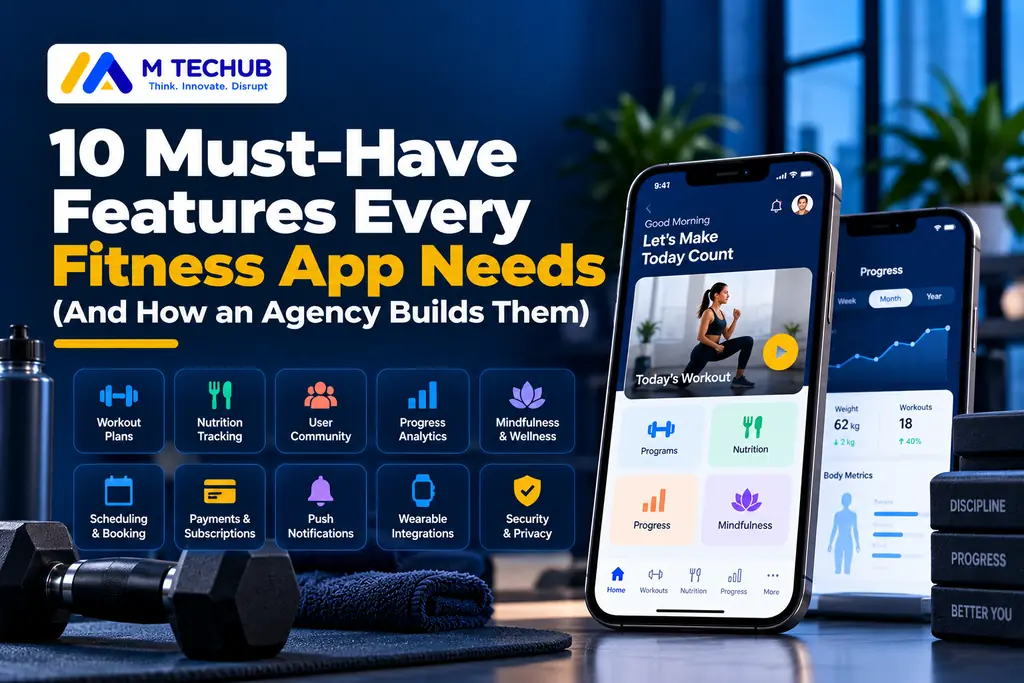
The ten essential fitness app features are personalized onboarding, workout planning, activity tracking, progress analytics, wearable integrations, AI recommendations, notifications, social accountability, secure data management, and administrative tools.
However, not every feature requires advanced functionality from the beginning. A successful fitness app development strategy starts with a clear target audience, a focused minimum viable product (MVP), and an architecture that supports future improvements.
This guide explains what each feature does, how a professional development agency implements it, and which capabilities deserve priority before launch.
1. User Onboarding and Personalized Profiles
User onboarding determines how quickly someone can begin using a fitness application. Instead of presenting every available workout, the app should understand the user’s goals and provide a relevant starting point.
A beginner interested in strength training needs a different experience from an experienced runner preparing for a marathon.
How an Agency Builds Personalized Onboarding
Fitness app developers typically create a structured onboarding flow that collects relevant information, including fitness goals, experience level, available equipment, preferred workout duration, and training schedule.
The mobile interface communicates with backend APIs that validate this information and store it in a user profile.
Developers then use profile information to determine which workouts or programs should appear.
The implementation generally includes:
- Secure account creation and authentication.
- Mobile onboarding screens with appropriate input validation.
- Backend services for storing and updating preferences.
- Database relationships between users, goals, and workout plans.
- Personalization rules for displaying relevant content.
Users should be able to skip unnecessary questions and change their preferences later.
Practical Example
Consider a US fitness startup developing an application for people who exercise at home.
A new user selects general fitness improvement as a goal, identifies as a beginner, and chooses three workout days per week. They also indicate that they only have resistance bands.
Instead of displaying exercises requiring gym machines, the application recommends beginner-friendly sessions using available equipment.
If the user changes their schedule from three days to two, the backend adjusts future workouts without deleting previous activity records.
This is why developers should keep user preferences, workout schedules, and completed activities in separate, well-structured database entities.
MVP priority: Account creation, goals, experience level, equipment preferences, and editable profiles.
Later enhancements: Adaptive onboarding, more detailed assessments, and recommendations informed by training history.
Key consideration: Collect only information that serves a defined product purpose.
2. Workout Planning and Exercise Libraries
Workout planning allows users to organize training sessions, follow structured programs, and understand how to perform exercises correctly.
For fitness businesses, it also supports consistent workout content across different trainers, members, or locations.
How an Agency Builds Workout Planning
A development team usually separates exercise information from individual workout plans.
An exercise library stores reusable information such as:
- Exercise name and description.
- Primary muscle groups.
- Equipment requirements.
- Difficulty level.
- Instructions and demonstration media.
- Relevant exercise variations.
Workout plans reference these exercises and add information about sets, repetitions, duration, rest periods, and scheduled training days.
This prevents developers from duplicating the same exercise data across multiple programs.
The backend manages exercise relationships, while the mobile application provides interfaces for browsing, scheduling, and completing workouts.
Practical Example
A personal training business wants to deliver four-week strength programs through a branded application.
A trainer creates a program using exercises already available in the database. Members receive scheduled sessions and can record their completed sets and repetitions.
If the trainer updates the program for future participants, the changes should not unexpectedly overwrite another member’s completed workout history.
Developers handle this through appropriate workout-template versioning and separate activity records.
Exercise videos also require efficient media delivery and caching to avoid excessive loading times.
MVP priority: Searchable exercise library, predefined programs, workout logging, and basic scheduling.
Later enhancements: Trainer-created programs, video feedback, and advanced workout customization.
Key consideration: Build a reliable content structure before adding hundreds of exercise videos.
3. Activity and Fitness Tracking
Activity tracking records what users complete and provides the information needed for progress reporting and workout personalization.
Depending on the application’s purpose, it may track training duration, sets, repetitions, distance, pace, steps, or other relevant measurements.
For founders researching how to build a fitness tracking app, defining the tracking system is one of the most important early technical decisions.
How an Agency Implements Activity Tracking
Developers begin by identifying which activities and measurements the application needs to support.
A strength-training app may prioritize repetitions and lifted weight, while a running app may focus on duration, distance, and pace.
The backend typically stores structured activity records containing:
- User and workout identifiers.
- Activity type and measurement units.
- Start and completion timestamps.
- Duration and recorded performance.
- Data source and synchronization status.
- User corrections and relevant notes.
Mobile applications submit these records through APIs. Backend services validate them before storing the information.
For applications supporting offline workouts, developers can save records locally and synchronize them when internet access becomes available.
Practical Example
A user starts a workout in a gym basement where the internet connection is unreliable.
The app records the session locally. Once connectivity returns, it uploads the completed workout.
However, the upload request might be retried if the connection drops before the server confirms success.
Without proper safeguards, the same workout could be saved twice.
Developers can prevent this by assigning a stable identifier to the workout and making the backend operation idempotent. Repeating the same request should not create another completed session.
This protects activity history and prevents misleading progress calculations.
MVP priority: Manual workout logging, activity history, and basic measurements.
Later enhancements: GPS tracking, automatic activity detection, advanced metrics, and wearable-based synchronization.
Key consideration: Define activity completion and duplicate-handling rules before building analytics.
4. Progress Tracking and Fitness Analytics Dashboards
Progress dashboards help users understand their training history and recognize changes over time.
A useful fitness app dashboard UI should make important information easy to understand without overwhelming users with unnecessary charts.
For example, beginners may want to see weekly workout consistency, while experienced lifters may prefer training-volume comparisons.
How an Agency Builds Progress Analytics
Developers identify the measurements that matter for the application’s core purpose.
These can include:
- Completed workouts.
- Weekly training frequency.
- Total workout duration.
- Personal performance records.
- Changes in training volume.
- Progress toward user-defined goals.
Backend services aggregate activity records and prepare the information for visualization.
The frontend displays charts, summaries, and relevant comparisons.
Developers must also define how canceled, incomplete, edited, and duplicated workouts affect reported metrics.
Practical Example
Imagine a gym chain providing members with a branded fitness application.
A member completes twelve workouts over four weeks.
The dashboard shows twelve completed sessions, total training duration, and weekly consistency.
However, if the same workout arrives through manual tracking and a connected device, the application could incorrectly report thirteen sessions.
The backend should identify the overlapping records according to established reconciliation rules before producing the dashboard summary.
Users should also have a way to correct inaccurate information without losing legitimate activity history.
A trustworthy progress dashboard depends on reliable data, not simply attractive visualizations.
MVP priority: Workout history, weekly summaries, and basic performance charts.
Later enhancements: Advanced training analytics, coach-facing reporting, and personalized progress insights.
Key consideration: Agree on metric definitions before designing reporting screens.
5. Wearable and Health Platform Integrations
Wearable integrations allow fitness applications to access supported activity information from connected devices and health platforms.
Depending on hardware capabilities and permissions, an app may use information such as step counts, heart rate, workout sessions, or other activity measurements.
For US fitness products supporting iPhone and Android users, integration requirements should be evaluated during planning rather than added unexpectedly near launch.
How an Agency Connects Wearable Data
On Apple platforms, developers can use HealthKit to access supported health and fitness information with appropriate user authorization.
On Android, Health Connect provides permission-controlled access to supported health and fitness records.
Both platforms require developers to handle permissions and limitations carefully.
An agency typically follows these steps:
- Identify the measurements the product genuinely needs.
- Determine which platforms and devices support those measurements.
- Implement authorization and permission handling.
- Normalize incoming timestamps, units, and data formats.
- Apply duplicate detection and reconciliation rules.
- Test missing records, revoked permissions, and synchronization failures.
Direct integrations with wearable manufacturers may require additional APIs, authentication, or provider approval.
How Developers Handle Inaccurate Wearable Data
Wearable information can arrive late, contain gaps, or overlap with data recorded by another application.
For example, a user might record a 30-minute run on a smartwatch while also manually recording the same session.
If both records are imported without appropriate checks, the app could count the run twice.
Developers address these problems through several safeguards.
Source identification: Store information about where imported records originated, when the platform provides that information.
Deduplication: Use stable identifiers and synchronization metadata to recognize repeated imports. Distinguish true duplicates from separate activities that happen to have similar timestamps.
Data validation: Check units, timestamps, missing measurements, and values outside expected limits.
Conflict resolution: Define how the application handles overlapping manual and wearable-generated records without automatically deleting legitimate user information.
Synchronization recovery: Handle interrupted imports, record updates, deleted information, and repeated synchronization requests.
For example, Android Health Connect provides record identifiers, data-origin metadata, and client-controlled identifiers and versions that can support synchronization and conflict handling.
Practical Example
A user completes a treadmill workout and records it through two different sources.
The app detects overlapping activity records and presents one workout in the user’s history while preserving the underlying source information according to its reconciliation policy.
If the device reports an unexpected heart-rate reading, the system should not automatically use it to generate a higher-intensity workout recommendation.
Instead, the application can flag questionable measurements and avoid relying on them until appropriate validation is possible.
MVP priority: One relevant platform integration if wearable data is essential to the product.
Later enhancements: Additional wearable providers, richer synchronization, and device-specific capabilities.
Key consideration: Connected data should not automatically be treated as accurate simply because it came from a wearable device.
6. AI-Powered Workout Recommendations
Artificial intelligence can make fitness applications more adaptive by helping users discover workouts suited to their preferences, schedules, and recorded activity.
However, AI workout app development should solve a defined user problem rather than simply introduce a chatbot.
How an Agency Builds AI Recommendations
Developers first determine what the recommendation system should accomplish.
For example, the application might recommend workouts based on available equipment, experience level, completed sessions, or preferred training duration.
The underlying architecture may include:
- Structured user profiles.
- An approved exercise library.
- Activity history and user feedback.
- Recommendation rules or machine learning models.
- Safety constraints.
- Backend services for generating recommendations.
- Monitoring and evaluation tools.
A rule-based system may be sufficient for the initial release.
More advanced AI can help rank or adapt appropriate workout options, provided the application has reliable information and clearly defined limits.
Practical Example
A user usually trains for 45 minutes but has only 20 minutes available today.
The application recommends a shorter workout using exercises suitable for their experience level and available equipment.
If the user’s workout history contains missing sessions or questionable wearable measurements, the recommendation engine should not interpret that incomplete information as proof of improved or reduced physical capacity.
Instead, it can use established training preferences or ask the user for clarification.
AI Limitations and Safety
AI-generated workout advice can sound convincing even when it is unsuitable.
Developers can reduce this risk by restricting outputs to approved exercise content, applying programming constraints, and allowing users to reject recommendations.
Applications should not use incomplete fitness data to diagnose injuries, prescribe medical treatment, or guarantee specific health outcomes.
MVP priority: Goal-based recommendations using structured templates and defined rules.
Later enhancements: Adaptive workout planning, personalized recommendation models, and conversational fitness assistance.
Key consideration: Recommendation quality and user safety matter more than the sophistication of the AI model.
7. Notifications, Reminders, and Engagement
Notifications help users stay aware of scheduled workouts and maintain their preferred routines.
However, excessive reminders can frustrate users and lead them to disable notifications.
How an Agency Builds Notification Systems
Developers connect workout schedules to mobile notification infrastructure.
On iOS, notifications may use Apple Push Notification service. Android applications can use Firebase Cloud Messaging as part of their messaging infrastructure.
Backend services determine which messages should be scheduled and whether a user has opted to receive them.
Important implementation requirements include notification preferences, device token management, time-zone handling, scheduling logic, and delivery failure monitoring.
Practical Example
A member schedules workouts for Monday, Wednesday, and Friday at 6:00 PM.
The application schedules reminders around those preferences.
If the member changes their training schedule, the notification service updates future reminders rather than continuing to send outdated messages.
Users should also be able to pause or disable nonessential notifications.
MVP priority: Workout reminders and notification preferences.
Later enhancements: Personalized engagement campaigns, milestone notifications, and behavior-based reminders.
Key consideration: Measure useful actions, such as completed workouts, rather than assuming notification volume improves engagement.
8. Social Features and Accountability
Social functionality can help fitness businesses support accountability and community participation.
For gym chains and personal training platforms, shared challenges and group activities may be more useful than building a complete social network.
How an Agency Builds Social Functionality
Developers first identify the interactions that support the product’s business model.
A gym membership app might use group challenges, while a coaching platform might prioritize trainer-to-client communication.
The backend manages user relationships, participation records, group permissions, and content visibility.
Possible components include group management, challenge scoring, progress sharing, leaderboards, reporting tools, and moderation controls.
Practical Example
A gym chain launches a monthly workout-consistency challenge.
Members voluntarily join and earn points for eligible completed sessions.
The backend checks activity records against scoring rules to prevent the same workout from being counted repeatedly.
Participants can compare their standings without exposing private health measurements or unrelated account information.
MVP priority: Simple challenges, optional progress sharing, or limited accountability groups.
Later enhancements: Community feeds, messaging, team challenges, and advanced social interactions.
Key consideration: Build social functionality around a specific accountability need and provide appropriate visibility and moderation controls.
9. Secure Accounts, Privacy Controls, and Data Management
Fitness applications may collect personal details, activity records, body measurements, and information from connected devices.
Protecting this information is a core development responsibility.
How an Agency Builds Secure Data Management
A professional implementation should incorporate security requirements from the architecture stage.
Common requirements include:
- Secure authentication and account recovery.
- Appropriate session management.
- Server-side authorization.
- Protected API endpoints.
- Encrypted network communication.
- Appropriate encryption and key management.
- Privacy preferences and data-access controls.
- Account deletion and data export workflows.
- Audit logging for sensitive administrative operations.
The OWASP Mobile Application Security Verification Standard provides a useful reference for mobile application security controls involving storage, authentication, cryptography, network communication, and privacy.
Backend APIs require their own security assessments because securing the mobile interface does not automatically protect server-side systems.
Does Every Fitness App Need HIPAA Compliance?
No.
HIPAA applicability depends on the organization operating the application, its relationships with regulated entities, and the information involved.
A consumer fitness app is not automatically subject to HIPAA simply because it collects health-related information.
However, other privacy and security obligations may still apply, including certain federal and state requirements.
For example, the Federal Trade Commission’s Health Breach Notification Rule can apply to certain businesses handling identifiable health information, depending on the rule’s requirements and the business model.
Founders should assess the application’s actual data flows, third-party services, contracts, and legal obligations with qualified professionals.
Practical Example
A fitness startup integrates an external analytics service to understand which workout screens users visit.
Before launching the integration, the development team should examine what information the service receives.
User identifiers, health-related attributes, and workout details should not be transferred unnecessarily.
The app should also ensure that administrative permissions do not expose members’ private information to unauthorized employees.
MVP priority: Secure authentication, appropriate authorization, essential privacy controls, and required account and data-management functionality.
Later enhancements: Enterprise access management and expanded administrative auditing.
Key consideration: Essential security and applicable legal requirements should never be postponed simply to launch faster.
10. Admin Dashboards, Analytics, and Content Management
Fitness applications also need tools for the businesses operating them.
Without administrative functionality, updating exercises, managing accounts, and reviewing operational issues may require unnecessary engineering support.
How an Agency Builds an Admin Dashboard
Developers usually create a separate web-based administration interface connected to secured backend APIs.
The dashboard may provide:
- User account administration.
- Exercise and workout content management.
- Content publishing and updates.
- Operational analytics.
- User reports and moderation.
- Administrative role management.
- Audit records for sensitive changes.
A suitable content management system allows authorized staff to update exercise descriptions and workout programs without requiring a new mobile application release.
Practical Example
A fitness business operates multiple gym locations.
Each location manager needs to update local workout programs and manage relevant member services.
However, managers should not automatically gain access to every user’s private information across the organization.
Developers implement role-based authorization and location-specific access rules to support the business structure.
MVP priority: Basic administration, exercise content management, and essential operational reporting.
Later enhancements: Multi-location management, advanced business analytics, and enterprise integrations.
Key consideration: Administrative tools should reflect actual staff responsibilities rather than include unnecessary functionality.
How AI Improves Fitness App Personalization — and Where Human Oversight Matters
AI can help fitness applications move beyond fixed workout schedules by adapting recommendations to individual preferences, goals, and recorded activity.
However, effective personalization requires more than connecting an application to a language model.
Developers must define which information the system can use, how recommendations are evaluated, and what safeguards prevent unsuitable advice.
How AI Personalizes Workout Recommendations
A personalization engine may use information such as:
- Fitness goals and experience level.
- Workout preferences and available equipment.
- Completed training sessions.
- Preferred workout duration.
- User-reported difficulty.
- Feedback on previous recommendations.
For example, consider a beginner who plans to exercise three times per week but completes only two sessions.
Instead of automatically increasing workout intensity, the application could recommend maintaining a manageable schedule and ask whether previous workouts felt appropriate.
A more advanced system might recognize that the user regularly prefers shorter sessions and recommend options that fit their available time.
This approach should use appropriate activity information without interpreting incomplete records as definitive evidence of physical ability.
How Developers Evaluate AI Recommendations
AI recommendations should not be considered successful simply because they sound personalized.
Development teams need clear evaluation criteria.
A fitness recommendation system should be tested to determine whether it:
- Matches the user’s available equipment.
- Respects stated workout preferences.
- Follows defined exercise programming constraints.
- Handles incomplete or unreliable activity data.
- Avoids unsupported claims.
- Produces understandable recommendations.
- Allows users to reject unsuitable suggestions.
Developers can also compare AI-generated recommendations with structured, rule-based workout plans.
For example, a startup could evaluate whether AI recommendations are more relevant to user preferences than its existing workout-selection rules.
Workout completion, user feedback, and recommendation acceptance can provide useful product signals, but they should not be treated as proof of clinical effectiveness or medical safety.
Where Human Oversight Matters
AI systems can generate plausible recommendations that are inappropriate for individual circumstances.
For example, a system might suggest a more demanding workout after detecting improved performance without knowing that the user experienced pain during the previous session.
A responsible application should allow users to report problems, reject recommendations, and adjust their preferences.
For products providing professional fitness coaching, qualified trainers can review programming recommendations and intervene when individual judgment is needed.
AI should not diagnose injuries, prescribe medical treatment, or claim that a workout is medically safe based solely on general activity data.
Should AI Be Included in the Fitness App MVP?
Not every fitness application needs advanced AI in its first release.
For many startups, rule-based workout selection and structured training templates can provide useful personalization with fewer technical dependencies.
Advanced AI becomes more relevant when the product has identified a specific personalization problem, has access to appropriate data, and can evaluate recommendation quality.
The objective should be better workout decisions and a useful user experience, not AI functionality added purely for marketing.
How a Fitness App Development Agency Builds These Features
A professional development agency should not begin by coding every requested feature immediately.
The process starts with discovery, technical planning, and prioritizing the functionality needed for the initial product.
1. Discovery and Product Planning
The agency works with stakeholders to define target users, business goals, essential workflows, and technical constraints.
A workout-tracking startup has different requirements from a gym chain building a member engagement platform.
Discovery should produce a prioritized feature backlog, user journeys, technical assumptions, and measurable acceptance criteria.
2. UX/UI Design and Prototyping
Designers create wireframes, user flows, and interactive prototypes.
The team validates essential interactions such as onboarding, workout selection, activity logging, and progress tracking.
Accessibility should be incorporated through readable typography, sufficient color contrast, usable controls, and appropriate support for assistive technologies.
3. Architecture and Technology Selection
Technology choices depend on the application’s requirements rather than current trends.
| Component | Possible Technologies | Purpose |
|---|---|---|
| Mobile application | Swift, Kotlin, Flutter, React Native | iOS and Android interfaces |
| Backend | Node.js, Python, .NET | APIs, business logic, and integrations |
| Database | PostgreSQL or another suitable database | User profiles, workouts, and activity records |
| Cloud infrastructure | AWS, Azure, Google Cloud | Hosting, storage, and deployment |
| Analytics | Event tracking and reporting services | Product usage and operational insights |
| Health integrations | HealthKit, Health Connect, approved third-party APIs | Supported fitness and activity information |
Native development may be appropriate for applications requiring specialized platform capabilities.
Cross-platform development can share parts of the application codebase, but platform-specific integrations and testing may still be required.
4. Development and Integrations
Developers implement functionality in manageable increments.
Core user workflows are generally developed before secondary enhancements.
External integrations should be tested using realistic scenarios, including permission denial, missing data, interrupted synchronization, and service failures.
5. Quality Assurance and Security Testing
Testing should cover the entire product, not simply whether screens function.
A fitness application may require:
- Functional and regression testing.
- Device and operating system compatibility testing.
- Accessibility reviews.
- API and integration testing.
- Data validation and synchronization testing.
- Security assessments.
- Performance and reliability testing.
For example, the testing team should verify that losing internet connectivity during a workout does not result in lost or duplicated activity records.
6. Launch and Maintenance
Before launch, the development team prepares production infrastructure, monitoring, support procedures, and app store submissions.
After launch, maintenance includes bug fixes, security updates, third-party integration changes, and operating system compatibility improvements.
A maintenance plan should identify responsibilities, expected response procedures, and the process for evaluating future improvements.
How to Prioritize Fitness App Features for an MVP
An MVP should contain enough functionality to deliver the product’s core value and test an important business assumption.
It does not need every advanced feature before launch.
For example, a workout-tracking startup needs accurate activity logging more urgently than a complex community feed.
The following table provides a practical starting point.
| Feature | Suggested MVP Priority | Initial Scope |
|---|---|---|
| User onboarding | Essential | Goal-based profiles |
| Workout planning | Essential | Exercise library and predefined programs |
| Activity tracking | Essential | Manual logging and history |
| Progress dashboard | Essential | Basic workout summaries |
| Wearable integrations | Conditional | One relevant platform when central to the product |
| AI recommendations | Optional | Rule-based personalization |
| Notifications | Useful | Workout reminders |
| Social features | Conditional | Basic accountability functionality |
| Security and privacy | Essential | Appropriate protections from launch |
| Admin dashboard | Essential | Basic administration and content management |
These priorities should be adjusted to match the business model.
An AI coaching startup may require recommendations in its first release. A wearable-centered application may require device synchronization immediately.
Similarly, a gym membership platform may need booking or payment functionality that falls outside the ten core features discussed here.
The goal is to validate the product’s essential value before investing heavily in secondary capabilities.
How Much Does Fitness App Development Cost?
Fitness app development cost depends on the product’s complexity, supported platforms, integrations, infrastructure, and ongoing maintenance requirements.
There is no reliable universal price because two applications with similar interfaces can have very different technical architectures.
When founders ask how much it costs to make a fitness app, the most useful answer begins with a clearly defined scope.
Key Factors Affecting Development Cost
Feature complexity: Basic workout logging generally requires less engineering than adaptive training recommendations, advanced analytics, or real-time device synchronization.
Supported platforms: Developing for iOS, Android, and web administration increases the scope. Cross-platform development can reduce some duplicated work but does not eliminate platform-specific requirements.
Backend infrastructure: Authentication, data storage, content management, reporting, synchronization, and monitoring require ongoing engineering support.
Wearable integrations: Permissions, data normalization, provider compatibility, and synchronization testing increase complexity.
AI capabilities: Advanced AI may require model integration, evaluation systems, data preparation, operational monitoring, and safety controls.
Security and privacy: Appropriate security design, testing, and applicable regulatory requirements must be included in the project scope.
Maintenance: Cloud hosting, third-party services, security updates, bug fixes, and operating system compatibility create continuing expenses.
How to Estimate a Fitness App Project
A development proposal should separate discovery, UX/UI design, frontend development, backend development, integrations, quality assurance, deployment, and maintenance.
Founders should request clear assumptions and identify which third-party costs are excluded.
Comparing agency quotes only by their total price can be misleading. A lower proposal may reflect fewer integrations, limited testing, or a narrower delivery scope.
A realistic estimate should explain exactly what the business will receive and how additional requirements will be handled.
How to Choose the Right Fitness App Development Agency
Selecting a development partner requires evaluating technical understanding, product planning, communication, and long-term support.
A polished portfolio alone does not demonstrate whether an agency can implement the specific workflows your application requires.
Evaluate Relevant Technical Experience
Ask how prospective fitness app developers approach workout data models, offline activity tracking, wearable synchronization, and sensitive information.
Relevant experience should be supported by verifiable work, technical examples, or clear explanations of implementation decisions.
Review the Discovery Process
A reliable agency should ask about the target audience, business model, MVP priorities, operational requirements, and technical constraints before promising a solution.
Be cautious of proposals that include advanced functionality without discussing dependencies or limitations.
Confirm Code Ownership and Documentation
Contracts should define intellectual property ownership, repository access, source-code handover, technical documentation, deployment credentials, and third-party licenses.
These details matter if the business later changes its internal team or development partner.
Examine Testing and Support Commitments
Ask which devices, integrations, and failure scenarios the agency will test.
Clarify how bugs are categorized, what launch support includes, and how ongoing maintenance is priced.
Request a Milestone-Based Proposal
A development proposal should identify deliverables, timelines, acceptance criteria, responsibilities, and change-control procedures.
This allows founders to evaluate actual progress rather than relying on vague completion percentages.
Common Fitness App Development Mistakes to Avoid
Building Too Many Features Before Validating Demand
Adding AI coaching, social communities, wearable integrations, and advanced analytics simultaneously can make an initial release unnecessarily complicated.
Better approach: Identify the central user problem and develop the functionality needed to solve it reliably.
Ignoring Data Accuracy
Duplicate workouts, incorrect measurements, and inconsistent activity records can undermine progress reports and personalization.
Better approach: Establish validation, deduplication, measurement, and synchronization rules early.
Treating Wearable Integrations as Simple Plug-Ins
Connecting external health data involves authorization, data formats, device limitations, and synchronization failures.
Better approach: Validate the most important integration through an early technical prototype.
Adding AI Without a Clear Purpose
An advanced recommendation engine adds complexity when the business cannot demonstrate what user problem it solves.
Better approach: Define a specific personalization objective and evaluate whether AI improves the experience compared with simpler alternatives.
Overlooking Privacy and Administrative Permissions
Fitness applications may expose sensitive information through inappropriate access controls or third-party services.
Better approach: Define collection purposes, data-access rules, retention requirements, and security responsibilities during discovery.
Failing to Plan Post-Launch Maintenance
Mobile operating systems, device APIs, and user expectations evolve.
Better approach: Include monitoring, updates, security reviews, and technical support in the initial product plan.
Final Thoughts: Build the Right Fitness App Features First
Successful fitness app development depends on how effectively features work together, not simply how many are included.
Personalized onboarding, workout planning, accurate activity tracking, and useful progress dashboards provide the foundation for many fitness applications.
Wearable integrations, AI recommendations, and social functionality can add value when they address specific user needs.
For US fitness startups and gym businesses, the most effective approach is to define the product’s central purpose, prioritize a manageable MVP, and select a development partner capable of building reliable, maintainable software.
A well-planned application should provide a useful experience today while allowing the business to improve its product as user needs evolve.
Planning a Custom Fitness App?
Whether you’re developing a fitness tracking platform, an AI-powered workout application, or a branded gym experience, the first step is translating your business requirements into a realistic development plan.
MTechub offers healthcare and fitness software development services for businesses exploring custom digital fitness solutions.
Discuss your product requirements, technical integrations, and MVP priorities to determine an appropriate development approach.
References
1. Apple Developer — HealthKit Documentation
2. Android Developers — Health Connect Data Format
3. OWASP — Mobile Application Security Verification Standard
4. US Department of Health and Human Services — HIPAA Guidance on Mobile Health Apps
5. Federal Trade Commission — Complying with the Health Breach Notification Rule