
Dubai’s Smart City program and the UAE AI Strategy 2031 have pushed demand for custom software beyond what local teams can supply. For founders and CTOs, that turns choosing a software development company in Dubai into a strategic decision. The wrong partner costs you months, money, and market timing.
This guide covers the types of agencies you’ll come across, what projects cost in AED and USD, which UAE-specific requirements matter, and how to vet a partner before you sign.
Executive Summary
- Best-value model: A global engineering company with a Dubai office usually costs 40 to 60 percent less than a purely local boutique agency, with the same in-person client management.
- 2026 budget ranges (global delivery model): A simple MVP costs AED 90K to 200K, a mid-range app AED 185K to 550K, and a complex platform AED 370K to 1.1M.
- UAE essentials: Arabic RTL UI/UX, local payments (Tabby, Tamara, Network International, Apple Pay), TDRA compliance, and UAE data residency.
- Vetting basics: A verifiable trade license, live apps you can test, independent reviews, and at least 3 months of post-launch support.
- Timelines: An MVP in 2 to 4 months, a mid-range app in 4 to 7 months, and a complex platform in 7 to 12+ months.
Why Dubai Is a Strong Base for Software Projects
Several factors make Dubai an attractive base for companies building digital products.
Government-led digital demand. Investment in AI, blockchain, smart city infrastructure, and digital government services drives steady demand and supports a deep network of talent, accelerators, and enterprise buyers.
Access to the GCC. From Dubai, you can serve Saudi Arabia, Qatar, Kuwait, Bahrain, and Oman. A Dubai-based partner already understands how the region buys, what Arabic users expect, and how people prefer to pay.
Global talent access. Dubai Internet City, Dubai Silicon Oasis, and DIFC draw engineers from around the world. Paired with distributed teams, Dubai companies can combine local relationships with global capacity.
Types of Software Development Companies in Dubai
| Company type | Hourly rate | Best for | Limitation |
| Local boutique agency (10-30 people) | AED 400-800 ($110-220) | Small UAE businesses, Arabic-first apps, local integrations | Limited scalability and specialisation |
| Regional mid-size company (30-150 people) | AED 300-600 ($80-165) | GCC enterprise projects, government work, regulated industries | Higher cost than global alternatives |
| Global company with a Dubai office (50-500+ people) | AED 180-450 ($50-120) | Local presence plus specialised global engineering | Confirm the Dubai operation is real |
| Freelancer | AED 150-500 ($40-135) | Simple projects under about AED 75,000 ($20K) | No backup, no QA team, no post-launch support |
M TECHUB LLC fits into the third category. Our Dubai team handles client relationships and regional requirements, while delivery runs through a team of more than 200 people across Sterling (Virginia, USA, our headquarters), London, Dubai, and Islamabad.
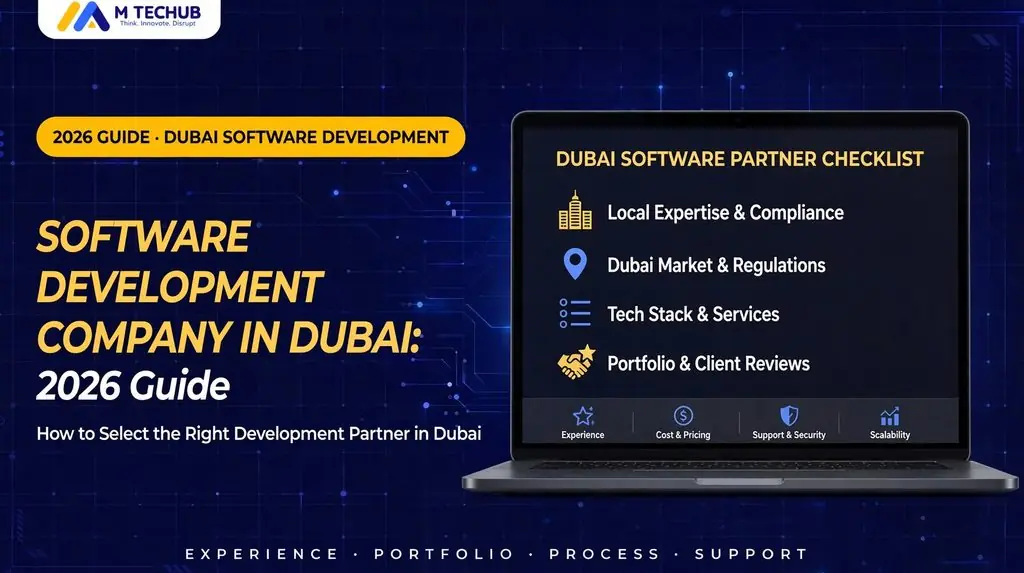
8-Point Checklist for Evaluating a Dubai Software Company
1. Verify the trade license and office
Licenses come from the Department of Economy and Tourism (mainland) or a free zone authority such as DMCC, DIFC, DSO, or DIC. Ask for the license number and confirm there’s a real office address, not a virtual desk.
2. Test their live apps
Screenshots prove very little. Download the apps from the App Store and Google Play and judge their speed, UX, and stability for yourself. Our portfolio includes SadaPay, Gate.com, OnSkin, Freenow, Alison, and Polarsteps.
3. Check independent reviews
Testimonials on a company’s own website don’t count as verification. Look for verified reviews on Clutch or a similar platform, ideally from clients in your region.
4. Confirm regional experience
Ask about Arabic RTL layouts, local payment gateways, and UAE data residency. A partner who has handled these before can save you weeks of rework.
5. Review the delivery process
A dependable process goes from discovery to wireframes you approve, then agile sprints with regular demos, QA, deployment, and support. At M TECHUB LLC, development never starts until you approve the prototype, and demos happen every 14 days.
6. Require post-launch support
Apps need updates for new iOS and Android versions and for changes in how people use them. Ask for at least 3 months of included support. Our contracts include 3 to 6 months.
7. Insist on transparent pricing
Ask for an itemized quote in AED or USD with a cost breakdown per feature and payments tied to milestones. Steer clear of lump-sum quotes. Our standard setup is 30/30/40 milestones linked to deliverables.
8. Assess team depth
Anything more than a simple app needs a project manager, a designer, two to four engineers, and QA. Our projects have 5 to 12 dedicated specialists, and we can grow or shrink teams without hiring delays.
Growing Talent Pool
Dubai Internet City, Dubai Silicon Oasis, and DIFC attract thousands of tech professionals from all over the world. With remote engineering teams in the mix, Dubai-based companies can tap global talent while keeping client-facing work local.
Software Development Cost in Dubai (2026)
Cost depends on scope, integrations, compliance, and the delivery model. The table below shows typical totals.
| Project type | Dubai boutique | Dubai mid-size | Global company with Dubai office |
| Simple MVP app | AED 185K-330K ($50K-90K) | AED 150K-275K ($40K-75K) | AED 90K-200K ($25K-55K) |
| Mid-range app (custom UI, payments, admin panel) | AED 370K-920K ($100K-250K) | AED 300K-735K ($80K-200K) | AED 185K-550K ($50K-150K) |
| Complex platform (AI, real-time, enterprise) | AED 735K-1.8M ($200K-500K) | AED 550K-1.5M ($150K-400K) | AED 370K-1.1M ($100K-300K) |
Why the gap exists. Engineering runs across several global offices instead of carrying Dubai overhead, so you get local meetings and regional know-how at 40 to 60 percent lower development cost.
What changes your final quote:
- Feature scope: payments, real-time features, AI modules, and admin tools.
- Integrations: BNPL, card processing, and banking or government APIs.
- Compliance: data residency, VAT logic, and industry regulations.
- Platforms: iOS, Android, web, or cross-platform.
Ask every vendor for a per-feature estimate. If a vendor can’t provide one, they haven’t properly scoped your project.
UAE-Specific Requirements Your Partner Must Handle
Building for the UAE is different from building for a general global audience. These five areas set experienced teams apart from the rest.
Arabic language and RTL UI/UX
Arabic support means more than translation. It requires mirrored navigation, right-to-left rendering, handling of mixed-direction text, and Arabic fonts that display properly on every device. Adding RTL late in a project is a common cause of rework, so plan for it from the design stage.
Local payment integration
UAE customers expect more than a card checkout. Common integrations include:
- Tabby (buy now, pay later)
- Tamara (BNPL across the GCC)
- Network International (card processing)
- Apple Pay and Samsung Pay
- Direct debit from local banks
UAE data residency
Government, healthcare, and banking projects often require data to stay in the region. Your partner should set up AWS Middle East or Microsoft Azure UAE regions with encryption, access controls, and documented residency policies. Confirm the exact region your sector requires before the architecture is locked in.
TDRA compliance
The Telecommunications and Digital Government Regulatory Authority (TDRA) oversees telecom and digital government services in the UAE. If your product connects with government digital channels or telecom services, check which TDRA guidelines apply early on, and make sure your partner builds them into the design rather than adding them later.
VAT
The UAE charges 5% VAT. E-commerce and SaaS products need VAT calculation, display, and reporting built right into the app.
How M TECHUB LLC Works With UAE Clients
Local relationship, global delivery. Our Dubai team runs discovery workshops, kickoffs, and milestone reviews in person. Engineering comes from the same company behind products like SadaPay and Gate.com.
Time-zone coverage. With offices in the USA, UK, UAE, and Pakistan, we can run development almost around the clock when a deadline calls for it. Account managers work on Gulf Standard Time (GMT+4).
- 700+ products delivered across 35+ countries
- 200+ team members across 4 offices
- Clutch and DesignRush top-rated
- Global Excellence Award USA 2024-25
Selected Projects for UAE, GCC, and Middle East Users
Gate.com: cryptocurrency exchange. A mobile app used by more than 53 million people worldwide, including a large UAE and GCC user base, with AED currency and Arabic language support.
AI health assistant. A multi-specialty medical consultation app with over 100,000 downloads across the Middle East, built for Dubai-based client Digital Roots Technologies and covering more than 8 medical specialties.
Jet-Hunter: aviation charter marketplace. A global charter marketplace with more than 400 operators and 13,000+ aircraft, active in Dubai, Abu Dhabi, Riyadh, Doha, and other GCC hubs.
Enterprise software. Workflow automation, CRM, and internal management platforms for UAE businesses, with Arabic language support and local compliance features.
Dubai vs. Other Outsourcing Locations
| Location | Advantages | Trade-offs |
| Dubai-based company | GCC time zone, Arabic expertise, UAE compliance knowledge, in-person meetings | Highest local rates |
| India | Large talent pool, lower rates | Less regional context, no local presence |
| USA | Largest talent pool, US legal system for US-focused products | Much higher cost, time-zone gap for GCC |
| Eastern Europe | Strong engineering talent | Limited Arabic and GCC experience |
| Dubai office + global engineering | Local presence at globally competitive rates | Engineering is distributed |
Rate: AED 180 to 450 an hour ($50 to $120 an hour) for a global company with a Dubai office.