
Learning how to build an MVP in 8 weeks begins with one simple idea: an MVP is not an unfinished app. It is the smallest, most focused version of your product that can prove your main business assumption with real users. If you follow a disciplined 8-week plan (strategy in week 1, design in weeks 2 and 3, development in weeks 4 to 7, and testing and launch in week 8), you can move from a rough idea to a live, store-ready product without spending your whole budget. This playbook takes you through every phase and shows you what to build, what to leave out, and how to sidestep the mistakes that slow down most startup launches.
What an MVP Actually Is (And What It Is Not)
People misuse the term MVP all the time. Some founders see it as an excuse to release something broken. Others slap the label on a full product they just decided to launch a little early.
Both views miss the point. A Minimum Viable Product is a product with only enough features to solve one core problem for a clear group of users, give them a usable experience, and produce real data on whether your business model holds up. The scope is minimal, but the product still has to be viable. In practice, that means it runs reliably, looks polished enough for people to take it seriously, and gives them real value.
An MVP is not there to impress investors with a long feature list. Its job is to answer one big question as fast and as cheaply as you can: do people really want this? Every screen, every feature, and every design choice in your MVP should help you answer that question.
Week 1: Strategy and Scope Definition
Week one matters more than any other. This is when you decide what your MVP will do, who it serves, and how you will measure success. Founders who skip this step or hurry through it nearly always end up rebuilding the product later.
Define Your Core Hypothesis
Write one sentence that sums up the assumption your MVP is meant to test. For example: “Parents of children aged 5 to 12 will pay $9.99 a month for an AI tutoring app that adjusts to how fast their child learns.” Tie every feature decision back to that sentence. If a feature does nothing to help you test it, leave it out of the MVP.
Identify Your Core User
You don’t have to serve every possible user with your MVP. Choose the one user type that matters most, the person whose problem you understand best and who is most likely to pay for a fix. Build for that person first. Other user types can come later.
Map the Core User Journey
Draw out the key path your core user follows from opening the app to getting real value from it. In a food delivery app, that path could look like this: browse restaurants, pick items, check out, track the order, and receive the food. That path is your MVP scope. Anything outside it, such as loyalty programs, restaurant analytics dashboards, or advanced search filters, moves to version two.
Create a Feature Priority Matrix
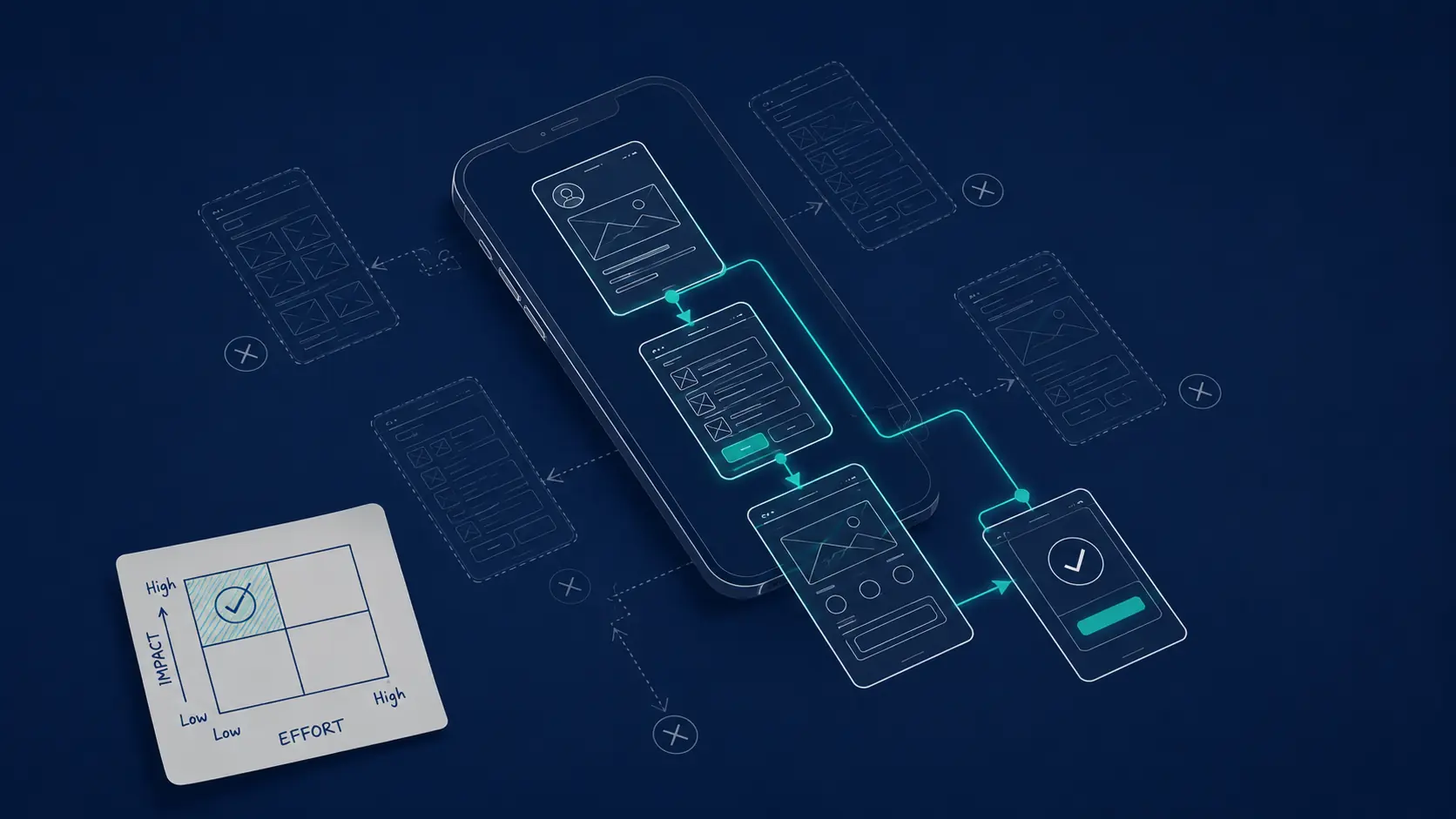
Write down every feature you have ever pictured for the product. Rate each one on two things: how much it helps test your core hypothesis and how much work it takes to build. Features with high impact and low effort make it into the MVP. High-impact features that take a lot of effort get a simpler version. The rest get cut. It can hurt to do this, but nothing works better for keeping scope creep under control.
Weeks 2 to 3: Design
User Experience Before Visual Design
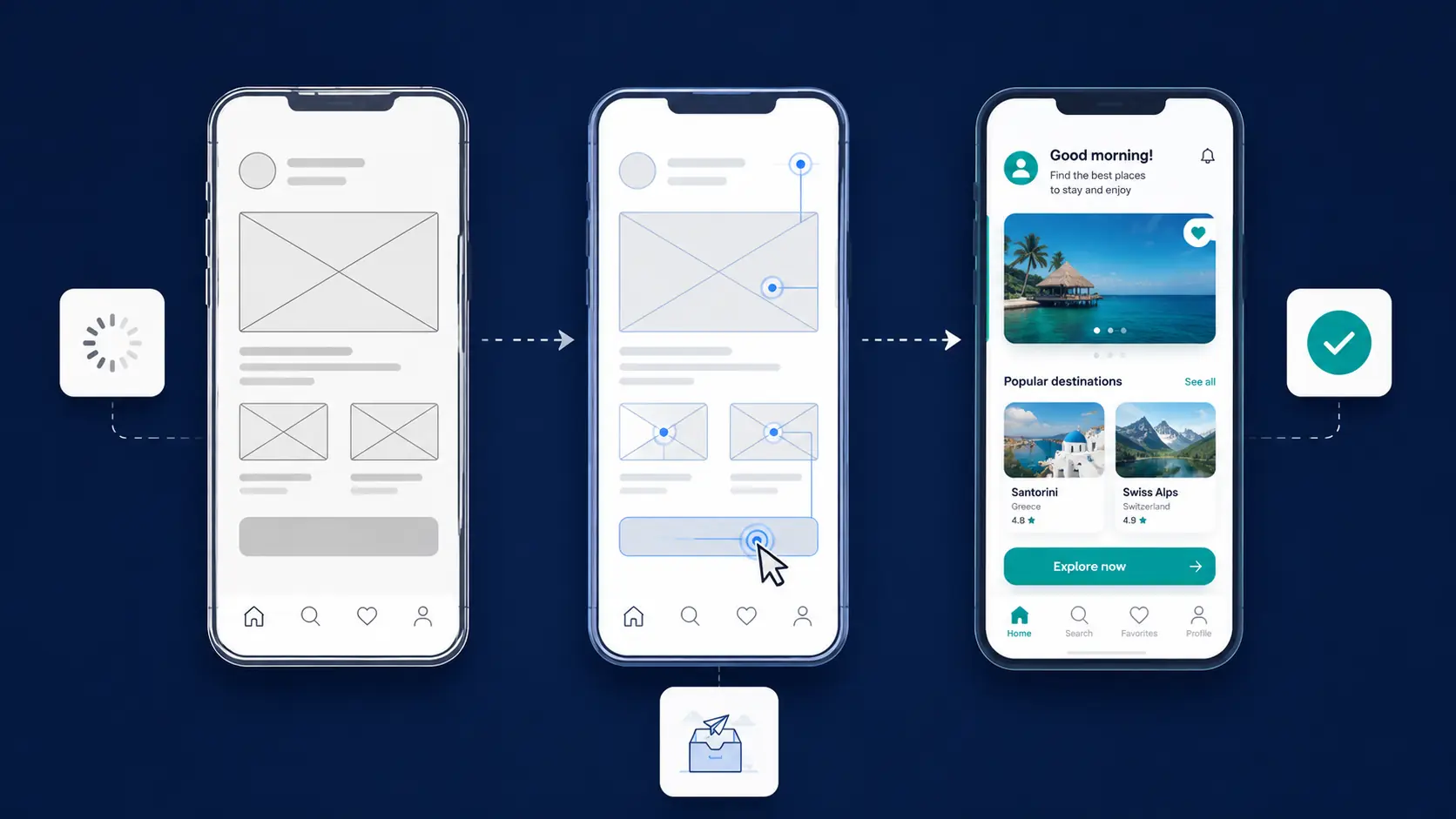
Begin with wireframes instead of polished mockups. Wireframes are quick to make, simple to change, and let you check the user flow before a single line of code is written. Tools like Figma let you build clickable prototypes that feel close to the real app. Put these prototypes in front of five to ten potential users. Half an hour of user testing will teach you more than three months of debate inside your team.
Visual Design That Ships Fast
After the wireframes are validated, move on to visual design. An MVP doesn’t need a fully custom design system. Go with a clean, modern look that uses consistent fonts, a clear color palette, and familiar UI patterns. At this stage, users care much more about clarity and ease of use than about anything visually new.
The design phase should deliver a full set of screens for every state in the core user journey, including loading, empty, error, and success states. Developers will build from these screens, so having all of them ready removes guesswork during development.
Weeks 4 to 7: Development
Choose the Right Tech Stack
For most MVPs in 2026, the best stack pairs a cross-platform mobile framework (React Native or Flutter) with a Node.js or Python backend and a managed database such as PostgreSQL or MongoDB. This setup gives you quick development, a big pool of available developers, and enough room to scale when you need it.
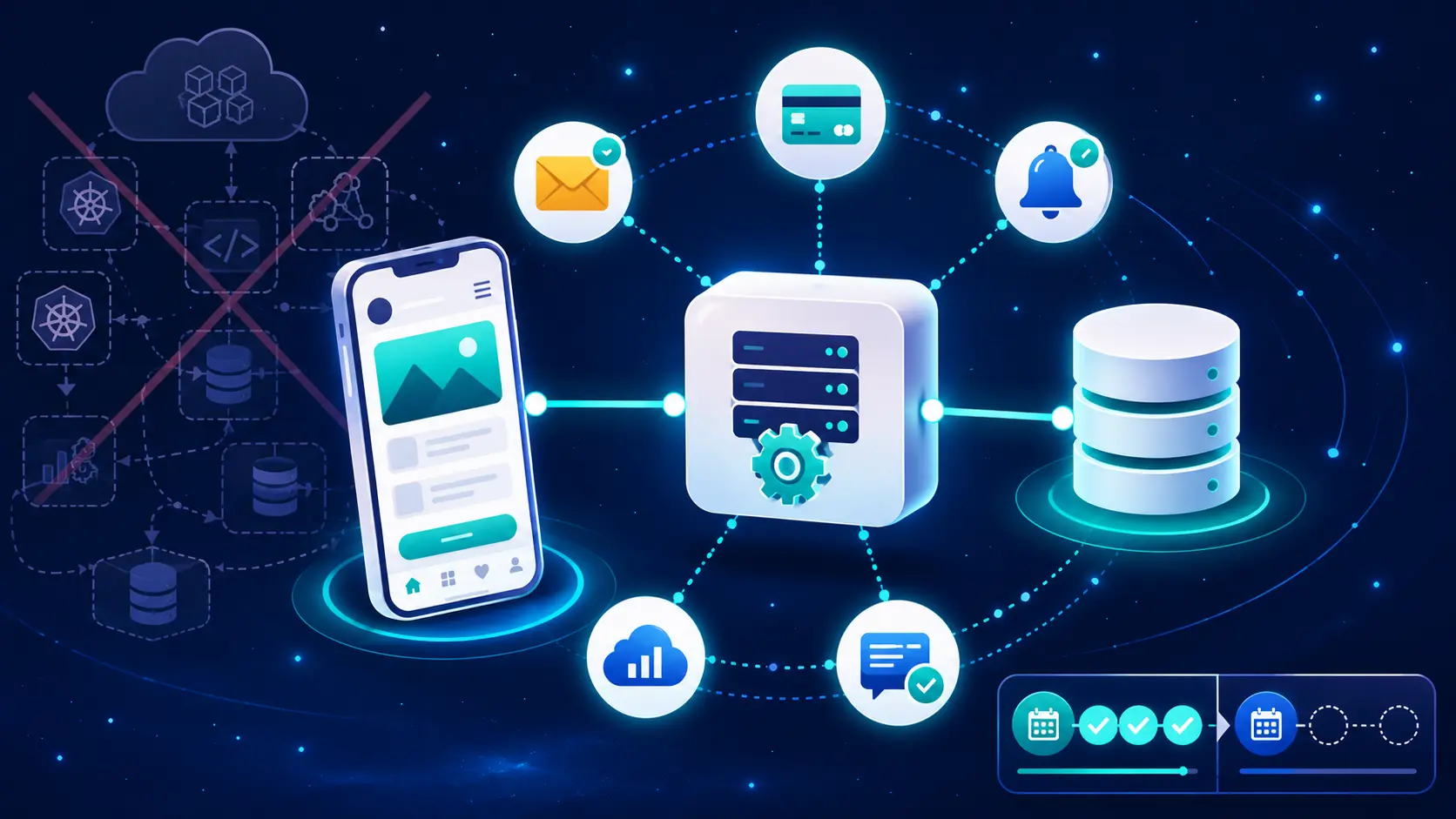
Don’t overbuild your tech stack for an MVP. Microservices, Kubernetes, and custom event-driven systems are not needed yet. A tidy monolithic backend, a managed database, and one cross-platform mobile app will get you to launch faster than anything else.
Sprint-Based Development
Split the four weeks of development into two-week sprints. The first sprint handles the groundwork: login, the database schema, the main API endpoints, and the screens for the primary user flow. The second sprint covers the remaining features, third-party integrations like payments and notifications, and final polish. Every sprint should finish with a working build the team can test on real devices. This rhythm gives you natural checkpoints and avoids the risky habit of coding quietly for a month and then rushing to stitch everything together.
What to Build vs What to Buy
Never build what you can buy or plug in. Need payments? Use Stripe. Email notifications? Try SendGrid or Brevo. Push notifications? Firebase Cloud Messaging handles that. Login? Go with a managed auth provider. Analytics? Mixpanel or Firebase Analytics will do the job. Each hour your developers put into common infrastructure is an hour taken away from the features that make your product different. Save your engineering time for the work only your team can do, which is the set of features behind your unique value.
The Features You Should Almost Always Skip in V1
Admin dashboards can be swapped for direct database queries or simple tools like Retool during the first few months. Advanced search and filters can begin as plain keyword search. Social features such as comments, sharing, and following belong in V1 only if your hypothesis depends on them. Multiple languages, dark mode, and accessibility refinements matter, but they can wait for V2 once the product is validated. Detailed analytics dashboards for users can be replaced with simple summary screens.
Week 8: Testing and Launch
Quality Assurance
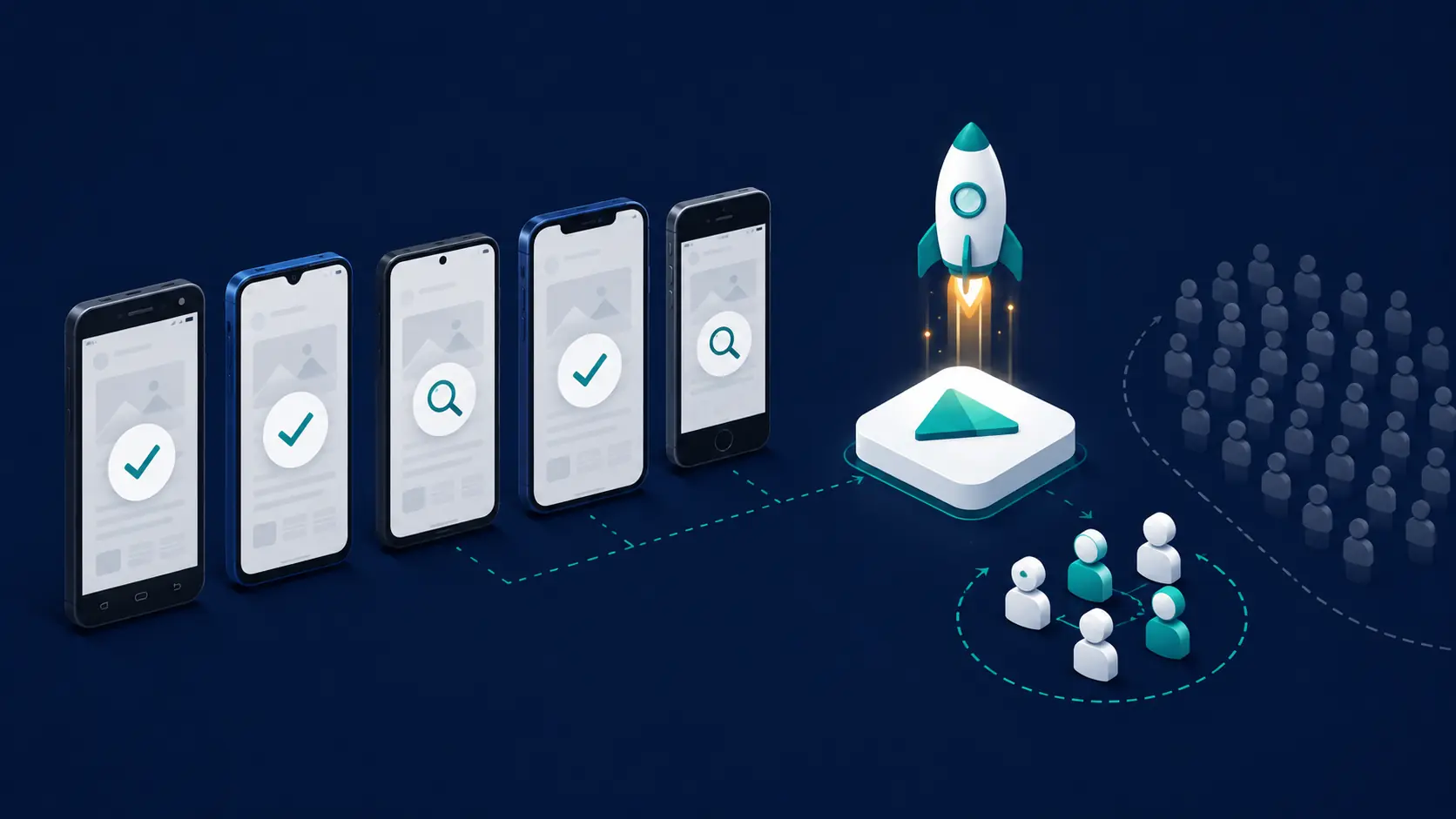
The last week goes to testing, fixing serious bugs, and getting ready to launch. Test on real devices, not only simulators. Try the app on the cheapest Android phone you can get, since many of your users will own something similar. Test on older iPhones that still run the previous iOS version. Test on slow internet connections too.
Keep your testing focused on the core user journey. If a user can get through the key path (signing up, doing the main action, and getting value), your MVP is ready to ship. Edge cases and minor bugs can be handled in the first update after launch.
App Store Preparation
Submitting to the App Store and Google Play means preparing screenshots, descriptions, privacy policies, and meeting review rules. Work on these alongside final testing instead of waiting until it ends. Apple’s review can take 24 to 72 hours, and sometimes more if they ask for changes, so submit early in the week to leave yourself some breathing room.
Write an App Store description that plainly explains what your app does and who it’s for. Include the keywords your target users are likely to search for. Use screenshots that show your best features in action. These details count, because your store listing is often the very first impression people get of your product.
Soft Launch Strategy
Think about releasing to a small, controlled group before you open the doors to everyone. A soft launch to 100 to 500 users helps you spot problems, collect early feedback, and gather your first testimonials without the stress of a full public launch. Invite people from your waitlist, your beta group, or the communities where your target users spend their time.
Common MVP Mistakes and How to Avoid Them
Mistake 1: Building Too Much
The most frequent MVP mistake is cramming in too many features. Every extra feature adds build time, testing time, and new bugs. You end up with an “MVP” that took six months, cost three times the planned budget, and still needs another month of fixes before anyone can use it. Strict control over scope is not optional.
Mistake 2: Ignoring Design
Some founders use the MVP label as a reason to launch an ugly product. That approach fails. People judge how credible your product is within seconds of opening it. A clean, professional design doesn’t take months of work. It takes deliberate decisions about layout, fonts, and consistency.
Mistake 3: Choosing the Wrong Tech Stack
Choosing a technology because it’s popular instead of because it suits your product leads to slow progress, trouble hiring, and technical debt. Pick boring, proven tools for your MVP. If the product takes off, you can always rework the architecture later.
Mistake 4: Not Planning for Post-Launch
Your MVP isn’t finished on launch day. It’s finished once you have enough data to make your next product decision. Plan for at least 90 days of support after launch before development even starts. You’ll be fixing bugs, responding to feedback, and shipping small improvements to keep early users interested.
Mistake 5: Building Without Talking to Users
If you haven’t spoken with at least 15 to 20 potential users before writing any code, you are guessing. Conversations with users uncover problems, wording, and priorities that internal brainstorming can’t match. Talk to users before you build, test your prototype with them before development, and launch to them before you scale.
What Happens After the MVP
A successful MVP hands you three things: proven demand (people actually use it), user feedback (they tell you what works and what doesn’t), and data (you can watch how they behave). With all three, you can decide what to build next with confidence. Some MVPs confirm the hypothesis and lead straight to a funding round and a full product build. Some show that the hypothesis was only partly right and the product needs a pivot. Others prove the idea doesn’t work, which stops you from spending $200,000 on something nobody wants. Every one of these outcomes has value. The only bad result is never launching.
M TECHUB LLC has helped hundreds of founders take an idea all the way to a launched MVP. Our 6-step process of Ideate, Design, Develop, Test, Launch, and Scale is designed to deliver working products quickly, and it comes with 3 months of free post-launch support.