
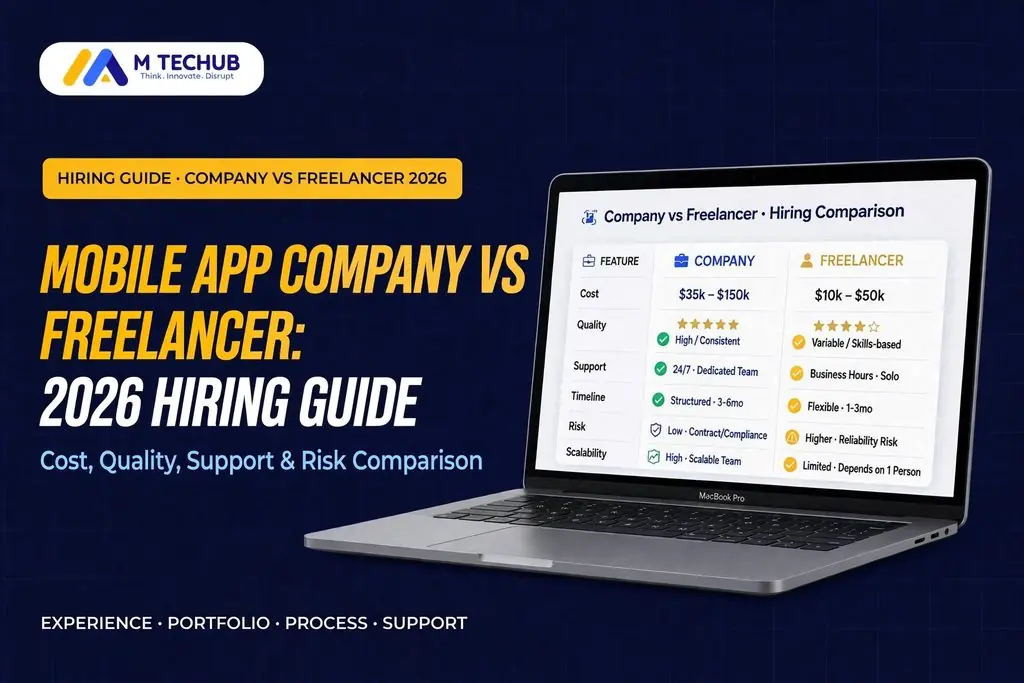
Mobile app development company vs freelancer is one of the most important hiring decisions for startups planning an app in 2026. A development company gives you a full team, project management, UI/UX design, engineering, QA testing, accountability, and post-launch support. A freelancer can work for smaller prototypes, limited budgets, or narrow technical tasks, but the risk increases when the project needs multiple skills, secure architecture, App Store submission, long-term maintenance, or fast delivery.
Table of Contents
- 1. Quick Comparison Table
- 2. What You Get With a Development Company
- 3. What You Get With a Freelancer
- 4. Cost Comparison (The Real Numbers)
- 5. Risk Comparison (What Can Go Wrong)
- 6. Quality Comparison
- 7. Timeline Comparison
- 8. Real Stories: When Freelancers Failed
- 9. When a Freelancer Actually Makes Sense
- 10. When a Company Is the Only Smart Choice
- 11. The Hybrid Approach
- 12. Decision Framework: 7 Questions
- 13. FAQs
1. Mobile App Development Company vs Freelancer: Quick Comparison
Here is every meaningful difference in one table:
Team and Structure
Company: Dedicated team: project manager, UI/UX designer, 2-4 engineers, QA specialist. Each person focuses on their expertise.
Freelancer: One person doing everything: design, frontend, backend, testing, deployment. Jack of all trades, master of fewer.
Cost
Company (M TECHUB LLC): 0-20/hr blended rate. Simple MVP: 5,000-5,000. Mid-range: 0,000-50,000.
Freelancer: 0-00/hr individual rate. Simple MVP: 0,000-5,000. Mid-range: 5,000-00,000.
Hidden cost difference: The freelancer hourly rate is lower, but projects take 30-50% longer because one person does everything sequentially. A company team works in parallel. A designer creates screens while engineers build the backend. A freelancer does one thing at a time.
Project Management
Company: Dedicated PM handles scope, timeline, communication, risk, and client updates. You talk to one person who manages the entire team.
Freelancer: You are the project manager. You define scope, track progress, review code, test features, and manage the freelancer. This takes 10-15 hours of your time per week.
Quality Assurance
Company: Dedicated QA team tests every feature across devices, screen sizes, OS versions, and edge cases before you see it.
Freelancer: The person who wrote the code also tests the code. This is like grading your own exam. Bugs that a fresh pair of eyes would catch in minutes survive for weeks.
Post-Launch Support
Company (M TECHUB LLC): 3-6 months free post-launch support including bug fixes, OS updates, and minor enhancements. Written into the contract.
Freelancer: Typically none. Once the project is delivered and final payment is made, most freelancers move to their next client. If bugs appear (and they will), you either pay for additional hours or find a new freelancer who has to learn the entire codebase from scratch.
Backup and Continuity
Company: If one developer gets sick, goes on vacation, or leaves the company, another team member picks up immediately. Your project never stops.
Freelancer: If your freelancer gets sick, takes another project, or disappears, your entire project stops. There is zero backup. This is the single biggest risk of hiring a freelancer for anything important.
Scalability
Company: Need to accelerate the timeline? Add 2 more engineers next sprint. Need to reduce cost? Scale down to maintenance mode. Flexible team sizing.
Freelancer: Cannot scale. One person is one person. To go faster, you need to find, hire, and onboard a second freelancer who has to learn the codebase. This takes weeks.
Legal Protection
Company: Formal contract with IP ownership clause, NDA, payment milestones tied to deliverables, and legal recourse if things go wrong.
Freelancer: Many freelancers work on informal agreements or basic platform contracts (Upwork, Fiverr) that offer limited legal protection. IP ownership is often unclear.
The mobile app development company vs freelancer decision is not only about hourly rate. It is about delivery risk, product quality, communication, testing, scalability, and what happens after launch.
M TECHUB LLC provides the full company experience: dedicated team, PM, QA, 3-6 months free support, IP ownership, NDA. Get a free comparison quote at project@mtechub.com
2. What You Get With a Development Company
When you hire a company like M TECHUB LLC, you are not just paying for code. You are paying for a system that delivers reliable results:
Dedicated Project Manager
Your PM is your single point of contact. They translate your business requirements into technical specifications, manage the development team, run sprint planning and demos, flag risks early, and keep the project on timeline and budget. You never have to manage individual developers. The PM does that.
Specialist Roles Working in Parallel
A UI/UX designer creates wireframes and visual designs while backend engineers set up the database and APIs. Frontend engineers build screens while QA engineers write test cases. Work happens in parallel, cutting timeline by 30-50% compared to a single freelancer doing everything sequentially.
Structured Development Process
M TECHUB LLC process: Discovery and requirements (week 1-2), wireframes and prototype with client approval (week 3-4), agile development in 2-week sprints with demos (week 5-20+), QA testing (ongoing + final 2 weeks), App Store and Google Play submission (week 1), and 3-6 months free post-launch support.
Code Quality Standards
Companies enforce code reviews, coding standards, automated testing, and CI/CD pipelines. Every piece of code is reviewed by a senior engineer before merging. This prevents the spaghetti code, security vulnerabilities, and technical debt that frequently plague freelancer projects.
Post-Launch Partnership
M TECHUB LLC does not disappear after launch. We provide 3-6 months free support, help you iterate based on real user data, fix bugs that surface with real users, handle OS updates, and plan v2 features. This post-launch period is where many freelancer relationships fall apart.
3. What You Get With a Freelancer
Freelancers have legitimate advantages for the right projects:
Lower Hourly Rate
Freelancer rates are 20-40% lower than company rates because they have zero overhead: no office, no PM, no QA team, no support staff. But lower hourly rate does not always mean lower total project cost because projects take longer without parallel work and professional project management.
Direct Communication
You communicate directly with the person writing the code. No intermediaries. For simple projects where the scope is crystal clear, this direct line can be efficient.
Faster Start
A freelancer can start tomorrow. A company needs 1-2 weeks for team assembly, contract signing, and project kickoff. If your project is genuinely urgent and simple, this speed matters.
Platform Protections (Upwork, Fiverr)
Freelance platforms offer escrow payments, milestone-based releases, and dispute resolution. These provide basic protection but are far less comprehensive than a formal company contract with IP ownership, NDA, and legal jurisdiction clauses.
The real cost of mobile app development company vs freelancer hiring depends on more than the initial quote. You also need to calculate project management time, rework, QA, bug fixes, code cleanup, and post-launch support.
4. Cost Comparison: The Real Numbers
The sticker price favours freelancers. The total cost of ownership often favours companies. Here is why:
Upfront Development Cost
Simple MVP (5-10 screens): Company: 5,000-5,000. Freelancer: 0,000-5,000. Difference: 40-60% less with freelancer.
Mid-Range App (15-30 screens): Company: 0,000-50,000. Freelancer: 5,000-00,000. Difference: 30-40% less with freelancer.
Complex App (30+ screens, AI): Company: 00,000-00,000. Freelancer: Not recommended. Single freelancers cannot reliably deliver complex apps.
Hidden Costs With Freelancers
- Your time managing the project: 10-15 hours per week at your hourly value
- Rework from bugs caught late (no QA team): 15-25% of project cost
- Finding a replacement if freelancer disappears: 2-4 weeks lost + onboarding cost
- Post-launch bug fixes at hourly rates: ,000-0,000 (company includes this free)
- Code cleanup before handing to future team: ,000-5,000
- Security audit to verify freelancer code quality: ,000-,000
Total Cost of Ownership Example
0,000 mid-range app with freelancer: 0,000 development + ,000 your management time (200 hours at 0/hr) + ,500 rework (15% bug fixes) + ,000 post-launch fixes + ,000 code cleanup = 5,500 total.
5,000 mid-range app with M TECHUB LLC: 5,000 development (includes PM, QA, post-launch support) + /bin/sh your management time + /bin/sh rework (QA catches bugs) + /bin/sh post-launch fixes (3-6 months free) + /bin/sh code cleanup (clean from start) = 5,000 total.
Result: Nearly identical total cost, but the company delivers higher quality, less risk, and zero management burden on you.
A mobile app development company vs freelancer comparison becomes clearer when you look at backup, accountability, documentation, security reviews, and long-term maintenance.
5. Risk Comparison: What Can Go Wrong
Freelancer Risks
âš Single point of failure: freelancer gets sick, takes another job, or disappears. Your project stops completely.
âš No code review: bugs and security vulnerabilities go undetected until users find them.
âš Scope creep: without a PM enforcing scope, features expand and budget inflates.
âš IP ownership unclear: many freelancers retain code rights unless explicitly transferred.
âš No post-launch support: freelancer moves to next client after delivery.
âš Communication gaps: freelancer working across time zones with no PM buffer.
âš Unscalable: cannot add team members to accelerate if behind schedule.
Company Risks
âš Higher upfront cost (20-40% more than freelancer quotes).
âš Slower kickoff (1-2 weeks for team assembly vs immediate freelancer start).
âš Potential for corporate bureaucracy if company is very large (500+ people).
Risk ratio: Freelancers carry 7 significant risks. Companies carry 3 minor risks. For any project that matters to your business, the risk calculus strongly favours a company.
6. Quality Comparison
Code Quality
Company: Code reviews by senior engineers, coding standards enforcement, automated testing, CI/CD pipelines, and technical documentation. Code is clean, maintainable, and ready for handoff to future teams.
Freelancer: Quality varies wildly. Some freelancers write excellent code. Many write functional but messy code that works today but becomes unmaintainable as the app grows. No external review means no quality check.
Design Quality
Company: Dedicated UI/UX designers who specialise in mobile interface design, follow Apple HIG and Material Design guidelines, and create design systems for consistency.
Freelancer: Most freelance developers are not designers. They use templates or create basic layouts that lack the polish and intuitiveness of professionally designed apps.
Testing Quality
Company (M TECHUB LLC): Dedicated QA team testing across 20+ device configurations, functional testing, performance testing, security testing, and regression testing before every release.
Freelancer: The developer tests their own work on 1-3 devices. Critical bugs on other devices, screen sizes, and OS versions go undetected until real users discover them and leave 1-star reviews.
7. Timeline Comparison
Simple MVP (5-10 screens)
Company: 2-3 months (parallel design + development + QA).
Freelancer: 3-5 months (sequential: design first, then development, then self-testing).
Mid-Range App (15-30 screens)
Company: 4-6 months.
Freelancer: 6-9 months.
Complex App (30+ screens)
Company: 7-12 months.
Freelancer: 12-18+ months (if they can complete it at all).
Why companies are faster: Parallel work. Designer creates Screen 5 while Engineer A builds the backend for Screen 1-4 and Engineer B builds the login flow. QA tests completed screens immediately. A freelancer does all of this sequentially: design all screens, then build all screens, then test all screens.
8. Real Stories: When Freelancers Failed
M TECHUB LLC has rebuilt over 30 projects that started with freelancers and failed. Here are common patterns we see:
The Disappearing Developer
A startup founder hired a freelancer on Upwork for 5,000 to build a fintech app. After 4 months and 8,000 paid, the freelancer stopped responding. The founder came to M TECHUB LLC with partially completed, undocumented code that was unusable. We rebuilt the entire app in 4 months for 5,000. Total wasted: 8,000 + 4 months of lost time. If they had hired M TECHUB LLC from the start, total cost would have been 5,000 with zero wasted time.
The Security Nightmare
A healthcare startup hired a freelancer to build a patient management app. The freelancer delivered a working app, but a security audit revealed: passwords stored in plain text (not hashed), no encryption on patient data, API endpoints with no authentication, and SQL injection vulnerabilities. The app was not HIPAA compliant. M TECHUB LLC rebuilt the entire backend with proper security for 5,000. The freelancer version was a liability, not an asset.
The Feature Creep Spiral
A founder hired a freelancer for a 0,000 e-commerce MVP. Without a PM to manage scope, every weekly call added just one more feature. After 8 months, the project was at 5,000 with no launch in sight. M TECHUB LLC took over, applied P0/P1/P2/P3 prioritisation, cut 60% of the feature list, and launched a focused MVP in 10 weeks for 0,000.
The Handoff Disaster
A startup built version 1 with a freelancer for 0,000. The app worked, but when they tried to hire a second developer to add features, the new developer could not understand the codebase. No documentation. No comments. No architecture patterns. Spaghetti code throughout. The new developer estimated it would take 0,000 just to refactor the code before adding any features. Effectively, the original 0,000 was wasted because the code was unmaintainable.
Common thread: In every case, hiring a company from the start would have cost less than the freelancer + rebuild combined. The cheapest option is rarely the cheapest outcome.
9. When a Freelancer Actually Makes Sense
Freelancers are the right choice in specific situations:
✅ Project budget is under 5,000
✅ You are a technical founder who can review code quality yourself
✅ The project is a simple prototype or proof-of-concept, not a production app
✅ You need a specialist for a very narrow task (e.g., 2 weeks of animation work)
✅ You are augmenting an existing team with an extra developer
✅ The project has no post-launch support requirements
✅ You have an existing codebase and need minor feature additions
10. When a Company Is the Only Smart Choice
Hire a company when:
✅ Project budget exceeds 0,000
✅ You are a non-technical founder who cannot review code quality
✅ The app handles sensitive data (financial, health, personal information)
✅ You need post-launch support and ongoing maintenance
✅ You plan to raise funding (investors prefer professionally built products)
✅ App Store and Google Play submission needs to be handled for you
✅ The app requires multiple skill sets (design + frontend + backend + QA)
✅ You need the app built in under 4 months (parallel team work required)
✅ You want clean, documented code that future teams can maintain
✅ The project involves AI, real-time features, or complex integrations
M TECHUB LLC: 700+ products delivered. Clutch and DesignRush top-rated. 3-6 months free post-launch support. IP ownership transferred. NDA standard. Offices in Sterling VA, London, Dubai, Islamabad.
11. The Hybrid Approach: Best of Both Worlds
Some founders use a smart hybrid approach:
Option A: Company for v1, Freelancer for Minor Updates
Hire M TECHUB LLC to build version 1 with clean, documented code. After the free support period, hire a freelancer for minor updates and feature additions. The freelancer can work on the clean codebase the company created. This gives you professional quality for the foundation and lower cost for ongoing small changes.
Option B: Company for Core, Freelancer for Peripheral
Hire a company for the core app (main user flows, backend, security) and a freelancer for peripheral tasks (marketing website, landing pages, content creation). The high-risk work is protected by company process. The low-risk work is done at freelancer rates.
Option C: Discovery with Company, Build with Freelancer (Risky)
Pay a company ,000-5,000 for the discovery phase (wireframes, prototype, scope document, architecture plan). Then hand the detailed specification to a freelancer to build. This reduces freelancer risk because the scope and architecture are professionally defined. However, you still carry all the execution risks of working with a freelancer.
12. Decision Framework: 7 Questions to Choose
Question 1: Is your budget over 0,000?
Yes: Company.
No: Freelancer may work.
Question 2: Are you a technical founder?
Yes (can review code): Either option works.
No: Company. You need a PM and QA team.
Question 3: Does the app handle sensitive data?
Yes (financial, health, personal): Company. Security cannot be compromised.
No: Either option works.
Question 4: Do you need post-launch support?
Yes: Company. M TECHUB LLC includes 3-6 months free.
No: Either option works.
Question 5: Is timeline critical (under 4 months)?
Yes: Company. Parallel team work is 30-50% faster.
No: Either option works.
Question 6: Will you raise funding with this product?
Yes: Company. Investors expect professional code quality and architecture.
No: Either option works.
Question 7: Is this a production app or a prototype?
Production app: Company.
Throwaway prototype: Freelancer is fine.
Scoring: If you answered Company to 3 or more questions, hire a company. If you answered Either to 5 or more, a freelancer may be sufficient.
The best way to decide between mobile app development company vs freelancer is to match the hiring model with your budget, product complexity, technical ability, timeline, and support needs.
Not sure? M TECHUB LLC offers free 30-minute consultations to evaluate your project and recommend the right approach. project@mtechub.com | https://mtechub.com/contact

13. Frequently Asked Questions
Is it cheaper to hire a freelancer or a development company?
Freelancers have lower hourly rates (20-40% less), but total project cost is often similar or higher when you account for your management time, rework from lack of QA, post-launch fixes at hourly rates, and potential code cleanup. A 0,000 freelancer project with hidden costs often totals 0,000-0,000. A 5,000 company project includes PM, QA, and post-launch support with zero hidden costs. M TECHUB LLC provides transparent, itemised pricing at https://mtechub.com/contact.
What if my budget is very limited?
If your budget is under $5,000, a freelancer is your only option. If it is $5,000-$5,000, consider M TECHUB LLC discovery phase (,000-5,000) for wireframes, prototype, and scope document, then decide whether to build with a freelancer using that professional specification or save for a company-built MVP.
How do I find a good freelancer?
Check their Upwork or Fiverr profile for: 90%+ job success rate, 50+ completed projects, portfolio of live apps you can download, and reviews mentioning communication and reliability. Even with all these checks, you still carry the risks outlined in this guide. For projects over 0,000, a company is safer.
Can I switch from a freelancer to a company mid-project?
Yes, but it is expensive. The company needs to audit the existing codebase, understand the architecture, and often refactor before adding features. This audit and onboarding typically costs ,000-5,000 and takes 2-4 weeks. M TECHUB LLC has done this for 30+ clients. It is always more expensive than starting with a company.
Does M TECHUB LLC work on small projects?
Yes. M TECHUB LLC takes projects from 5,000 (discovery phase and RAG chatbots) to 00,000+ (enterprise platforms). Our most common startup engagement is a $5,000-$5,000 MVP built in 2-4 months. We also offer standalone discovery phases (,000-$5,000) for founders who want professional planning before committing to full development.
What post-launch support does M TECHUB LLC include?
Every M TECHUB LLC project includes 3-6 months of free post-launch support covering bug fixes, OS compatibility updates, performance optimisation, and minor feature enhancements. This is written into the contract, not a verbal promise. Extended maintenance plans are available beyond the free period.
Can a freelancer build an AI-powered app?
Very few freelancers have genuine AI engineering expertise. AI apps require LLM integration, RAG pipeline setup, prompt engineering, vector databases, tool calling, guardrails, and ongoing model optimisation. M TECHUB LLC has built AI-powered products including Savage Mushroom Fitness (Gemini AI), Fate (agentic AI), OnSkin (computer vision), and AI Health Assistant (multi-specialty agents). See our AI Solutions for details.
What if the freelancer relationship starts well but deteriorates?
This is extremely common. The first 2-4 weeks feel great: fast communication, quick progress, enthusiasm. Then reality sets in: bugs accumulate, timelines slip, communication slows, the freelancer takes on other clients. By month 3-4, you are stuck with partial code, no documentation, and a freelancer who responds once per day. With a company, the PM maintains consistent communication and accountability throughout the entire project lifecycle.
Related Resources from M TECHUB LLC
- How to Choose a Mobile App Development Company
- Mobile App Development Company in USA
- Best Software Development Company for USA Startups
- Mobile App Development Cost 2026
- MVP Features Checklist
- AI Agent Development
- Mobile App Development Services
- Case Studies
- Contact
- External: Upwork Hiring Guide
- External: Clutch.co
Ready to Decide? Talk to M TECHUB LLC.
We will honestly tell you whether your project needs a company or whether a freelancer would work fine. No sales pressure. Just objective advice from a team that has seen 700+ projects succeed and rebuilt 30+ that failed with freelancers. Free 30-minute consultation.
Schedule Your Free Consultation: project@mtechub.com | https://mtechub.com/contact


