
How to build an MVP in 8 weeks starts with one rule: an MVP is not a half-built app. It is the smallest focused version of your product that validates your core business hypothesis with real users. By following a disciplined 8-week process (strategy in week 1, design in weeks 2–3, development in weeks 4–7, and testing plus launch in week 8), you can go from idea to a live, store-ready product without burning through your entire budget. This playbook walks you through each phase with practical guidance on what to build, what to skip, and how to avoid the mistakes that stall most startup launches.
What an MVP Actually Is (And What It Is Not)
The term MVP gets misused constantly. Some founders treat it as permission to ship something broken. Others use it as a label for a fully featured product they simply chose to launch early.
Neither interpretation is correct. An MVP Minimum Viable Product is a product with just enough features to solve one core problem for a specific group of users, deliver a usable experience, and generate real data about
whether your business model works. It is minimum in scope, but it must be viable. That means it works reliably, looks professional enough that users take it seriously, and delivers genuine value.
The purpose of an MVP is not to impress investors with a feature list. It is to answer one critical question as quickly and cheaply as possible: do people actually want this? Everything about your MVP every screen, every feature, every design decision should serve that question.
Week 1: Strategy and Scope Definition
The first week is the most important. This is where you define what your MVP will do, who it is for, and what success looks like. Founders who skip this phase or rush through it almost always end up rebuilding later.
Define Your Core Hypothesis
Write a single sentence that captures the assumption your MVP is testing. For example: “Parents of children aged 5–12 will pay $9.99/month for an AI-powered tutoring app that adapts to their child’s learning pace.” Every feature decision should connect back to this statement. If a feature does not help you test this hypothesis, it does not belong in your MVP.
Identify Your Core User
Your MVP does not need to serve every potential user. Pick the single most important user type the one whose problem you understand best and who is most likely to pay for a solution. Build for them first. You can expand to other user types later.
Map the Core User Journey
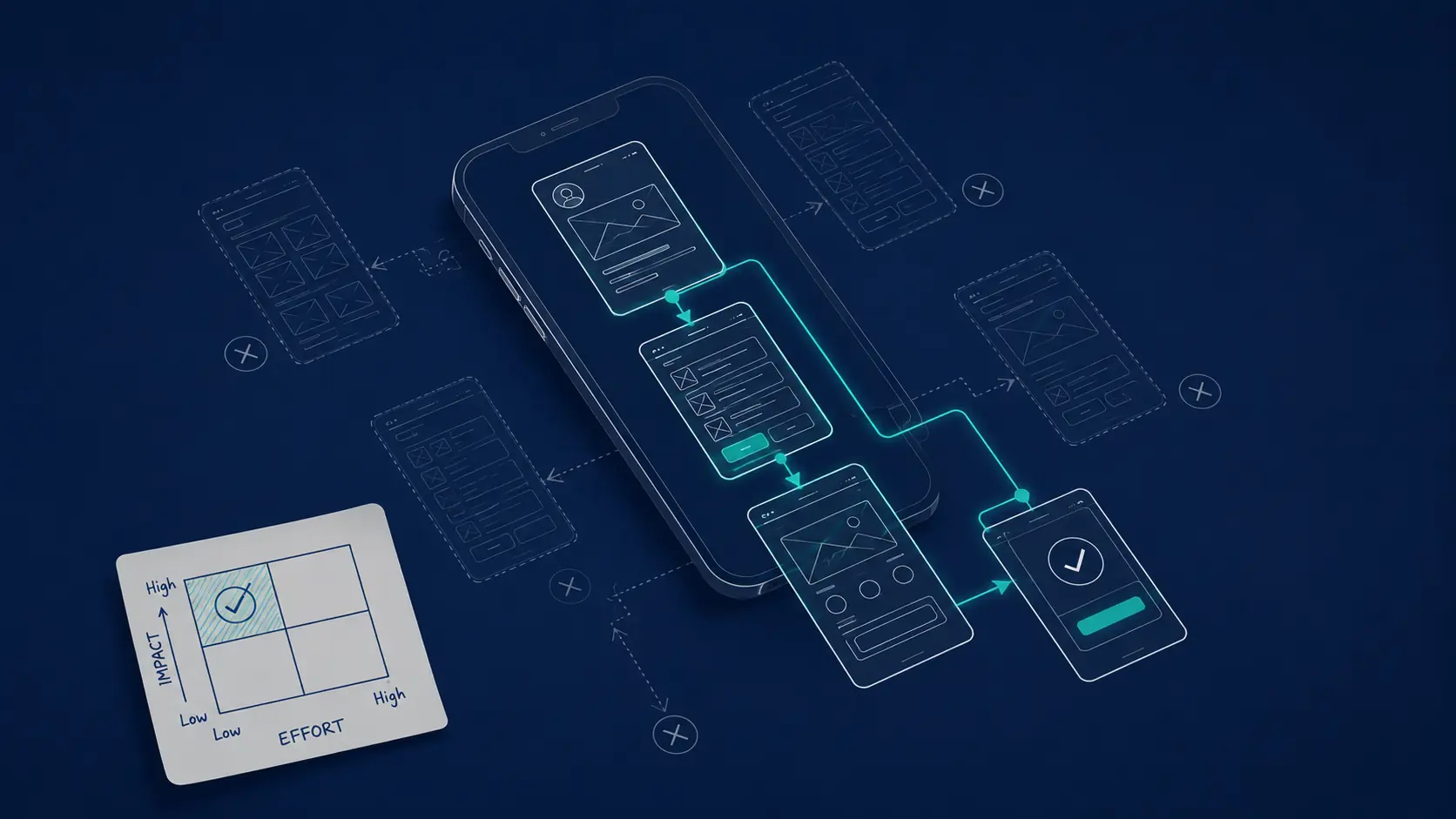
Sketch the critical path your core user takes from opening the app to getting value. For a food delivery app, that journey might be: browse restaurants, select items, checkout, track order, receive delivery. That is your MVP scope. Everything outside that journey loyalty programs, restaurant analytics dashboards, advanced search filters gets moved to version two.
Create a Feature Priority Matrix
List every feature you have imagined for your product. Score each one on two axes: impact on your core hypothesis and effort to build. High-impact, low-effort features go into the MVP. High-impact, high-effort features get simplified versions. Everything else gets cut. This exercise is often painful, but it is the single most effective way to prevent scope creep.
Weeks 2–3: Design
User Experience Before Visual Design
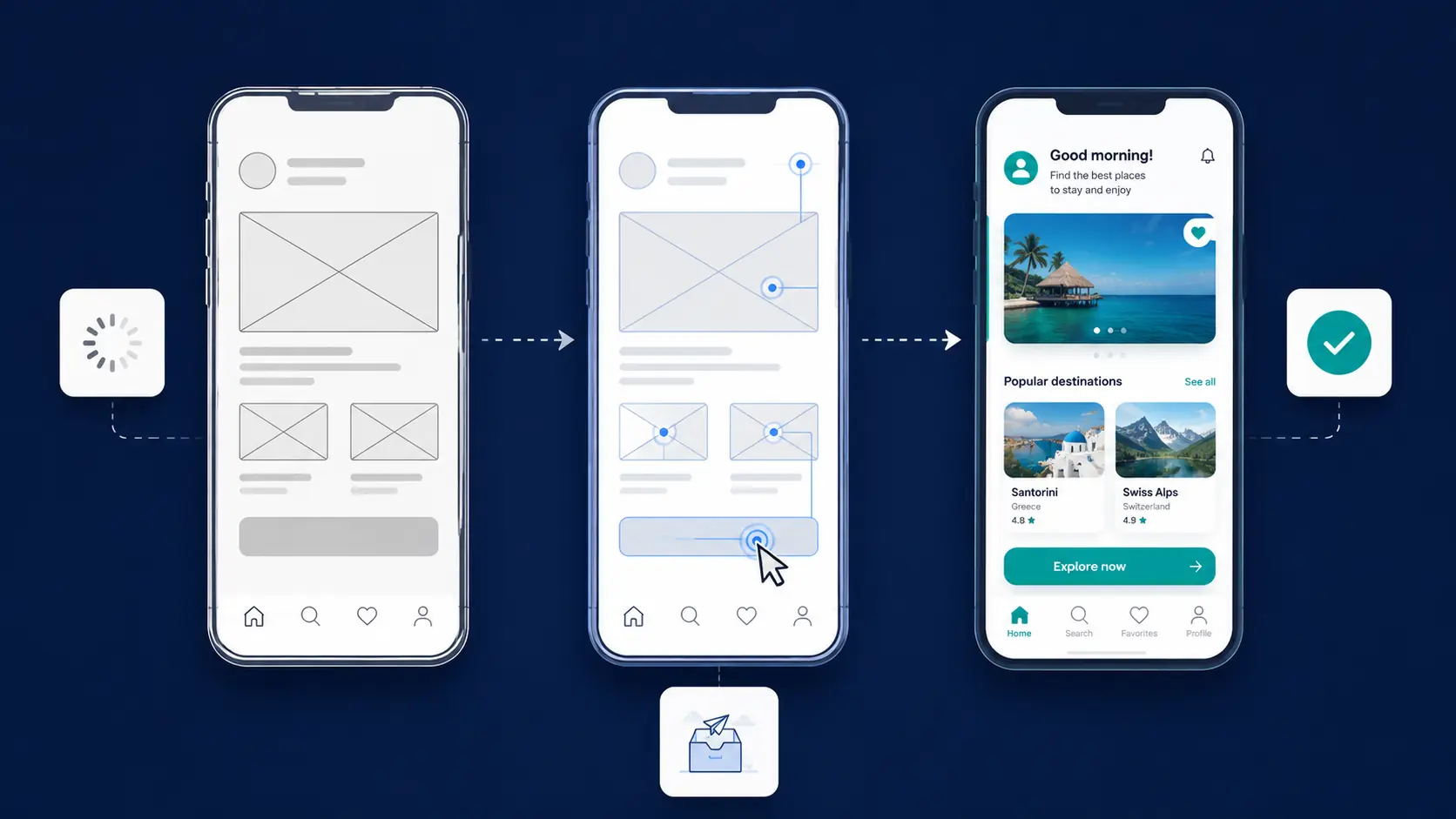
Start with wireframes, not pixel-perfect mockups. Wireframes are fast to create, easy to iterate on, and help you validate the user flow before anyone writes code. Use tools like Figma to create clickable prototypes that simulate the real app experience. Test these prototypes with five to ten potential users. You will learn more from 30 minutes of user testing than from three months of internal debate.
Visual Design That Ships Fast
Once the wireframes are validated, apply visual design. For an MVP, you do not need a completely custom design system. Use a clean, modern design with consistent typography, a clear color palette, and standard UI patterns. Users care about clarity and usability far more than visual novelty at this stage.
Design should produce a complete set of screens for every state in the core user journey loading states, empty states, error states, and success states. These are the screens developers will build from, so completeness here prevents ambiguity during development.
Weeks 4 – 7: Development
Choose the Right Tech Stack
For most MVPs in 2026, the optimal stack is a cross-platform mobile framework (React Native or Flutter) paired with a Node.js or Python backend and a managed database (PostgreSQL or MongoDB). This combination offers fast development speed, a large talent pool, and enough flexibility to scale when the time comes.
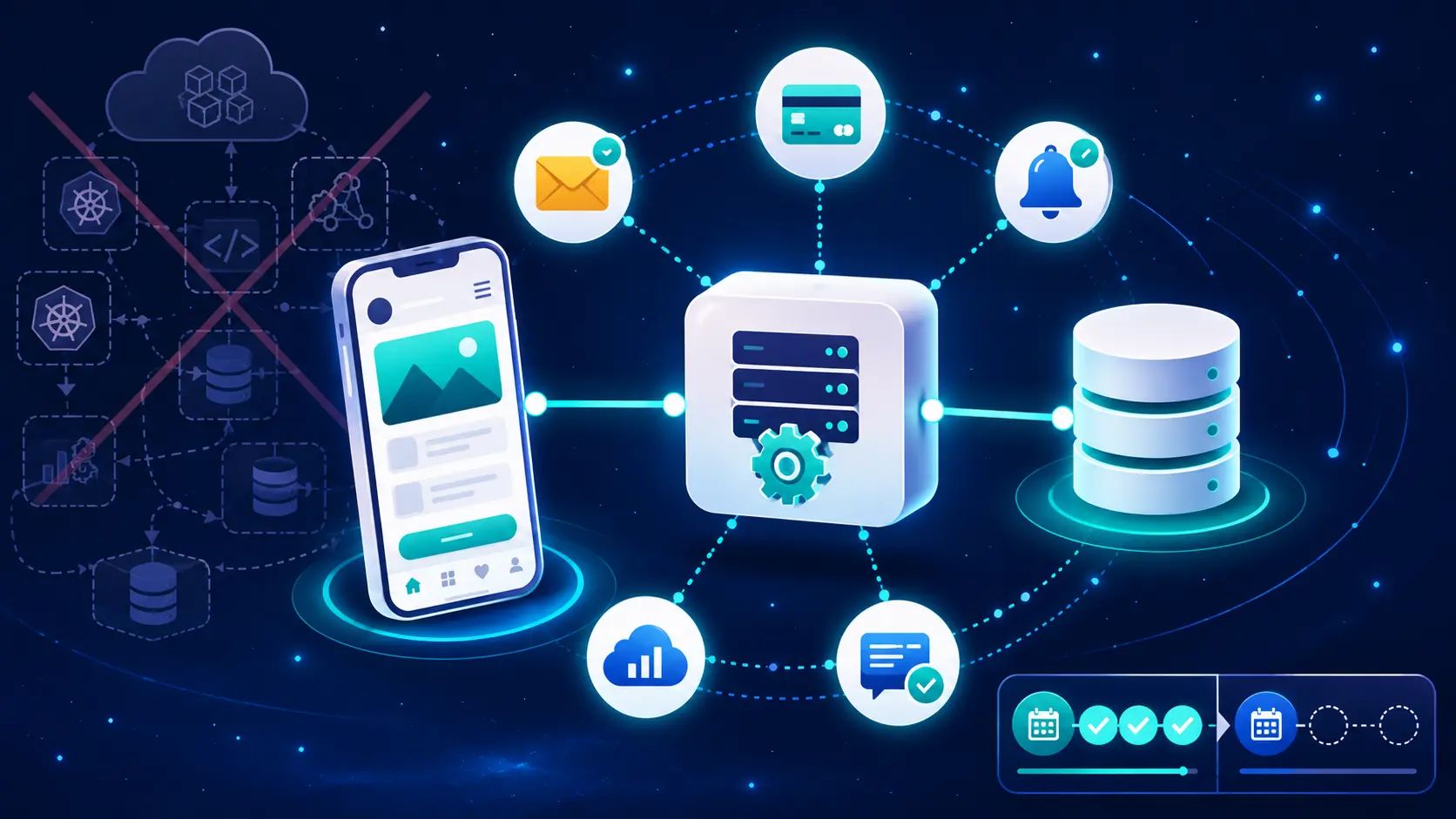
Do not over-engineer your tech stack for an MVP. You do not need microservices, Kubernetes, or a custom event-driven architecture. A well-structured monolithic backend with a managed database and a single cross-platform mobile app is the fastest path to launch.
Sprint-Based Development
Break the 4-week development window into two-week sprints. Sprint one covers the foundation: authentication, database schema, core API endpoints, and the primary user flow screens. Sprint two covers remaining features, third-party integrations (payments, notifications, etc.), and polish. Each sprint should end with a working build that the team can test on real devices. This cadence creates natural checkpoints and prevents the dangerous pattern of “heads-down coding for a month” followed by a scramble to integrate everything.
What to Build vs What to Buy
Do not build what you can buy or integrate. Payment processing? Use Stripe. Email notifications? Use SendGrid or Brevo. Push notifications? Use Firebase Cloud Messaging. Authentication? Use a managed auth provider. Analytics? Use Mixpanel or Firebase Analytics. Every hour your developers spend building commodity infrastructure is an hour they are not spending on the features that make your product unique. Reserve your engineering time for the things that only your team can build the features that deliver your unique value proposition.
The Features You Should Almost Always Skip in V1
Admin dashboards can be replaced with direct database queries or simple tools like Retool for the first few months. Advanced search and filtering can start with basic keyword search. Social features like commenting, sharing, and following should only be in V1 if they are core to your hypothesis. Multi-language support, dark mode, and accessibility refinements are important but can be added in V2 after you have validated the product. Detailed analytics dashboards for users can be replaced with simple summary screens.
Week 8: Testing and Launch
Quality Assurance
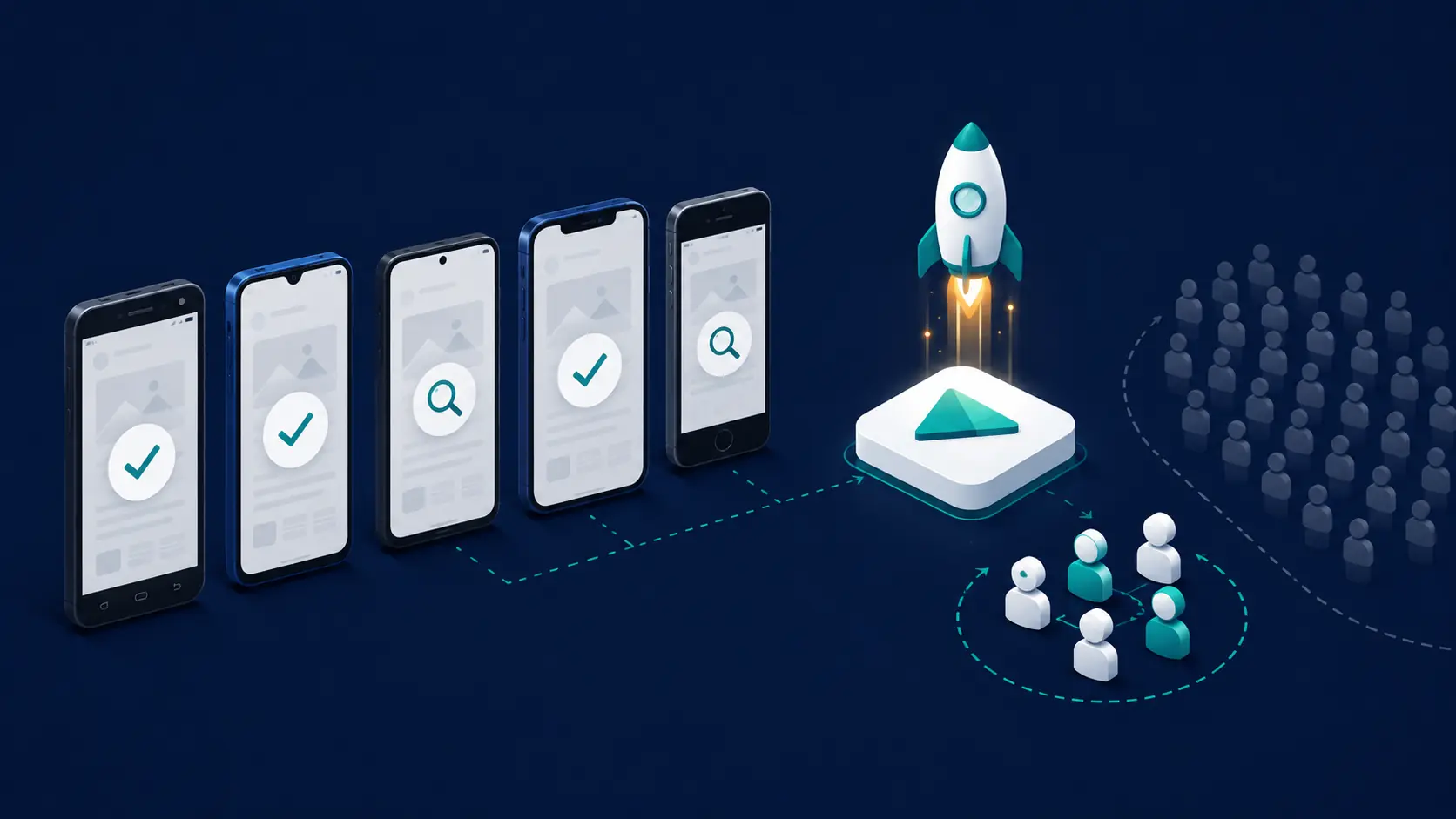
The final week is dedicated to testing, fixing critical bugs, and preparing for launch. Test on real devices not just simulators. Test on the cheapest Android phone you can find, because that is what a significant portion of your users will have. Test on older iPhones still running the previous iOS version. Test with slow internet connections.
Focus your testing on the core user journey. If a user can successfully complete the critical path (sign up, perform the core action, and get value), your MVP is ready to ship. Edge cases and non-critical bugs can be fixed in the first post-launch update.
App Store Preparation
App Store and Google Play submissions require screenshots, descriptions, privacy policies, and review compliance. Prepare these in parallel with final testing, not after it. Apple’s review process can take 24–72 hours (sometimes longer if they request changes), so submit early in the week to give yourself buffer time.
Write an App Store description that clearly communicates what your app does and who it is for. Use keywords your target users would search for. Take screenshots that show the app’s best features in action. These details matter your App Store listing is often the first impression potential users have of your product.
Soft Launch Strategy
Consider launching to a small, controlled group before opening to everyone. A soft launch to 100–500 users lets you identify issues, gather initial feedback, and build early testimonials without the pressure of a full public launch. Invite users from your waitlist, your beta testing group, or specific communities where your target users congregate.
Common MVP Mistakes and How to Avoid Them
Mistake 1: Building Too Much
The most common MVP mistake is including too many features. Every additional feature adds development time, testing time, and potential bugs. The result is a “MVP” that took six months to build, cost three times the budget, and still needs another month of bug fixes before it is usable. Ruthless scope discipline is non-negotiable.
Mistake 2: Ignoring Design
Some founders treat MVP as an excuse to ship an ugly product. This does not work. Users form opinions about your product’s credibility within seconds of opening it. A clean, professional design does not require months of work it requires intentional choices about layout, typography, and consistency.
Mistake 3: Choosing the Wrong Tech Stack
Picking a technology because it is trendy rather than because it fits your product’s needs leads to slow development, hiring difficulties, and technical debt. Choose boring, proven technology for your MVP. You can always re-architect later if your product takes off.
Mistake 4: Not Planning for Post-Launch
Your MVP is not done when it launches it is done when you have gathered enough data to make your next product decision. Plan for at least 90 days of post-launch support before development begins. You will need to fix bugs, respond to user feedback, and ship small improvements to keep early adopters engaged.
Mistake 5: Building Without Talking to Users
If you have not talked to at least 15–20 potential users before writing a line of code, you are guessing. User conversations reveal problems, language, and priorities that no amount of internal brainstorming can replicate. Talk to users before you build, test your prototype with users before you develop, and launch to users before you scale.
What Happens After the MVP
A successful MVP gives you three things: validated demand (people actually use it), user feedback (they tell you what works and what does not), and data (you can see how they behave). With these inputs, you can make an informed decision about what to build next. Some MVPs prove the hypothesis and lead directly to a fundraising round and a full product build. Some reveal that the hypothesis was partially right and the product needs to pivot. Some prove that the idea does not work, which saves you from spending $200,000 on a product nobody wants. All three outcomes are valuable. The only bad outcome is never launching at all.
M TECHUB LLC has helped hundreds of founders go from idea to launched MVP. Our 6-step process — Ideate, Design, Develop, Test, Launch, Scale — is built to deliver working products fast, with 3 months of free post-launch support included.
Can a real, professional-quality app actually be built in 8 weeks?
Yes, if scope is controlled ruthlessly from day one. The 8-week timeline works because the process front-loads all the hard decisions defining the core hypothesis, mapping only the critical user journey, and cutting everything that doesn’t directly validate the business model. What makes it fail is scope creep: founders who keep adding “just one more feature” mid-development. The guide is clear that an MVP is minimum in scope but must be viable in quality it needs to work reliably and look professional enough for users to take it seriously.
What should I build myself versus buy or integrate from third parties?
As a rule, don’t build anything that already exists as a mature service. Payments go through Stripe, email through SendGrid or Brevo, push notifications through Firebase Cloud Messaging, and authentication through a managed auth provider. Every hour your developers spend rebuilding commodity infrastructure is an hour not spent on the features that actually make your product unique. Reserve your engineering budget exclusively for the things only your team can build your core value proposition.
What if my MVP launches and proves my idea doesn’t work?
That’s still a win. The guide makes this point directly a failed hypothesis that costs you $30,000 and 8 weeks is infinitely better than spending $200,000 and 12 months building a full product nobody wants. An MVP that reveals a pivot, a narrower audience, or a fundamental flaw in your assumption gives you actionable data to make a smarter next decision. The only truly bad outcome, as the guide puts it, is never launching at all.