
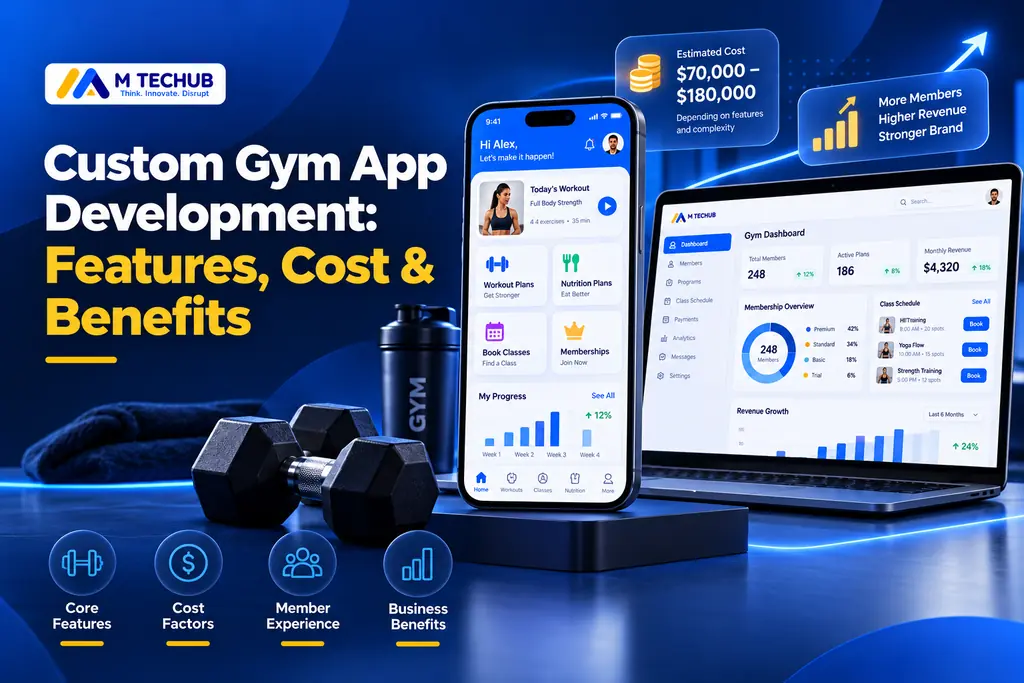
Custom gym app development typically requires an illustrative budget of $15,000–$30,000 for a tightly scoped MVP, $30,000–$70,000 for a mid-complexity application, and $70,000–$150,000 or more for an advanced gym management platform. These are planning scenarios, not verified industry averages. A focused MVP might take 3–4 months, while an integrated, mid-complexity application may require 6–9 months.
The actual investment depends on membership workflows, booking complexity, payment integrations, target platforms, and the development team’s location.
For gym owners in the United States and United Kingdom, the important question is not simply how much an app costs. It is whether custom development solves operational problems that existing gym management software cannot address effectively.
This guide explains the essential features, realistic budgeting methods, development timelines, technology choices, and business benefits to help fitness businesses make informed decisions.
Key Takeaways
Illustrative development budgets
$15K–$150K+
Across focused MVPs through advanced platforms
Illustrative MVP timeline
3–4 months
Assuming clearly defined requirements and limited integrations
Essential features
Memberships, bookings, payments, staff workflows, and account security
Build or buy?
Use existing software for standard workflows; consider custom development for important unmet needs
All cost and timeline scenarios require project-specific validation before budgeting or contracting.
What Is Custom Gym App Development?
Custom gym app development involves creating a mobile or web application specifically designed for a fitness business’s members, trainers, and administrators.
Unlike ready-made gym software, custom development allows a business to define its own user experience, membership rules, integrations, and operational workflows.
A custom solution generally falls into one of four categories:
- Member-facing gym app: Class reservations, account management, payments, and workout access.
- Gym management app: Membership administration, attendance, staff scheduling, and reporting.
- Personal training app: Workout programming, trainer appointments, and client progress.
- Integrated gym platform: Connected services for members, trainers, managers, and multiple locations.
For example, a Pilates studio with 12 reformers needs precise seat availability, instructor scheduling, and waitlist management. A fitness franchise operating 15 locations has different priorities, including centralized memberships and location-based access permissions.
The best product is designed around these practical differences.
Custom Gym App vs. Existing Gym Management Software
Businesses should compare custom development with established fitness management platforms before committing to a large investment.
Popular alternatives include Mindbody, ABC Glofox, and Mariana Tek.
Popular Gym Software Alternatives

Mindbody
A platform to evaluate for fitness and wellness businesses needing appointment scheduling, customer management, and business operations tools.
Website: Mindbody

ABC Glofox
An option for gyms and studios evaluating membership administration, booking workflows, and member engagement.
Website: Glofox

Mariana Tek
Particularly relevant for boutique studios seeking class scheduling, memberships, branded experiences, and multi-location tools.
Mariana Tek
+1
Website: Mariana Tek
These are software options to evaluate, not a ranking. Buyers should confirm current plans, integrations, geographic availability, and contract terms directly with each provider.
Custom Development vs. Ready-Made Software
| Factor | Custom gym app | Existing gym software |
|---|---|---|
| Initial investment | Higher upfront budget | Usually lower initial investment |
| Launch speed | Requires implementation and testing | Often faster to deploy |
| Branding | Broad design control | Provider-dependent |
| Membership rules | Tailored to requirements | Limited to supported configurations |
| Integrations | Developed against available APIs | Provider-dependent |
| Maintenance | Business or development partner | Primarily software provider |
| Long-term control | Greater architectural control | Ongoing vendor dependency |
For a small gym with standard memberships and uncomplicated class scheduling, established software may offer better value.
Custom development becomes more attractive when a business depends on unusual membership rules, proprietary training programs, specialized integrations, or operational processes that available platforms cannot support.
Build vs. Buy Decision Flow
A practical framework for deciding between existing software and custom development.
Essential Features of a Custom Gym Management App
The most useful features solve recurring operational problems. A gym should prioritize functions its members and staff need every day.
1. Member Registration and Profiles
Members need a simple way to register, update personal details, and review their membership information.
For example, a returning member should not need to complete another registration form to join a new fitness class.
2. Membership Plans and Automated Billing
A custom membership system can support monthly subscriptions, prepaid plans, renewals, upgrades, pauses, and cancellation rules.
Consider a gym offering a standard membership and a premium plan with additional trainer sessions. The application should apply the correct access permissions when a member changes plans.
For recurring billing, the backend should track successful payments, failed payments, grace periods, and membership status rather than relying only on what the user sees on the payment screen.
3. Class Booking and Waitlist Management
Members can browse schedules, reserve available places, and cancel bookings.
For example, when a Pilates class has 12 available spaces, the system must prevent a 13th confirmed booking and correctly manage cancellations.
A reliable booking system should use server-side capacity checks to avoid overbooking.
4. Trainer Scheduling and Client Management
Trainer dashboards can show upcoming sessions, assigned clients, and workout plans.
For a business offering private coaching, trainers may need to record session completion and share progress updates with clients.
5. Workout Planning and Progress Tracking
Workout features may include exercise instructions, sets, repetitions, completed sessions, and progress records.
A personal training business should prioritize these features early. A class-based yoga studio may not need them in its first release.
6. Notifications and Communication
Notifications can confirm bookings, remind members of appointments, and communicate schedule changes.
Messages should be timely and relevant rather than excessive.
7. Payments and Receipts
Payment functionality should support relevant membership transactions, receipts, and refund workflows.
The payment provider and billing method depend partly on the product being sold. Gym memberships for physical facilities are treated differently from certain digital-only fitness subscriptions under app store policies.
8. Administrative Reporting
Administrative dashboards can provide visibility into attendance, memberships, payments, and operational exceptions.
For example, if a gym consistently fills its 6 PM classes while its 2 PM sessions remain underbooked, managers can use attendance data to evaluate scheduling changes.
9. Account Security and Permissions
Role-based access ensures that members, trainers, and administrators can view only the information relevant to their responsibilities.
A trainer should not automatically have access to financial reports or unrelated members’ private information.
Advanced Features Worth Considering
Advanced features should support measurable business needs rather than simply making the product appear more sophisticated.
Wearable integrations: Connect compatible health and activity data, with appropriate user permissions, for workout tracking and training insights.
AI-assisted coaching: Help generate or adjust workout recommendations while maintaining suitable oversight and safety boundaries.
Multi-location management: Manage facility-specific schedules, shared memberships, staff permissions, and centralized reports.
Referral and loyalty programs: Track eligible referrals, rewards, and membership benefits.
Advanced analytics: Analyze attendance patterns, engagement, and membership changes using reliable, appropriately governed data.
Automation: Handle booking reminders, membership renewal notifications, and common staff workflows.
Feature Roadmap: MVP to Advanced Platform
PHASE 1
MVP
Member accounts
Class booking
Membership status
Basic admin tools
PHASE 2
Growth
Trainer dashboards
Advanced billing
Notifications
Reporting
PHASE 3
Advanced
Multi-location tools
Wearable integrations
AI-assisted features
Advanced analytics
Illustrative development sequence. Actual priorities depend on the gym’s business model.
A boutique studio should generally perfect its reservations and membership experience before investing in AI coaching. A personal training startup may choose a different sequence because workout programming is central to its business.
How Much Does It Cost to Develop a Gym App?
The budget for a custom gym app depends on the functionality, platforms, integrations, team composition, and level of testing required.
According to Clutch’s mobile app development pricing guide, updated September 21, 2026, most reviewed mobile app projects fall between $10,000 and $49,999, while the reported arithmetic average is approximately $90,780.
Clutch
These numbers are not contradictory. Many smaller projects can fall into a lower price range while a smaller number of expensive projects raise the arithmetic mean. However, Clutch’s published summary does not establish exactly how much the highest-cost projects contribute to that average.
Importantly, the Clutch figures cover mobile app development generally, not gym app development specifically.
Illustrative Gym App Development Budgets
| Project scope | Budget (USD) | Indicative timeline |
|---|---|---|
| Focused MVP | $15,000–$30,000 | 3–4 months |
| Mid-complexity app | $30,000–$70,000 | 6–9 months |
| Advanced platform | $70,000–$150,000+ | 9–15+ months |
These are illustrative planning scenarios, not verified market averages. The lower end assumes a tightly limited scope, economical blended delivery rates, and minimal integrations. A full-service agency in the US or UK may quote substantially more for the same functionality.
A focused MVP might contain accounts, basic class booking, membership status, and a limited administrative dashboard. More complex applications may add recurring billing, trainer management, custom workflows, and multiple integrations.
Development Cost Calculation
To avoid confusing a basic MVP with a mid-complexity project, consider a 1,200-hour example for a mid-complexity application.
| Activity | Estimated hours |
|---|---|
| Requirements and planning | 100 |
| UX/UI design | 140 |
| Mobile app development | 400 |
| Backend and admin tools | 320 |
| Testing | 160 |
| Deployment and coordination | 80 |
| Total | 1,200 |
At an illustrative blended rate of $40–$60 per hour, the calculation is:
1,200 hours × $40
$48,000
1,200 hours × $60
$72,000
This estimate broadly corresponds to a mid-complexity project, although the $72,000 result slightly exceeds the illustrative $70,000 band. The bands are not fixed price ceilings.
For a smaller MVP, a separately scoped project with 500 development hours at $40–$60 per hour would cost $20,000–$30,000 before excluded expenses.
Development Rates by Region
Clutch’s September 2026 mobile app pricing guide provides the following location-specific figures. The reported rates reflect listed providers and should not be treated as guaranteed prices for all agencies in a country.
Clutch
| Location | Reported hourly range |
|---|---|
| United States | $25–$49 |
| United Kingdom | Not reported |
| Poland | $50–$99 |
| Ukraine | $25–$49 |
| India | Below $25 |
These reported ranges should not be confused with rates for a senior, full-service delivery team. For example, Clutch’s separate custom software development guide reports $50–$99 per hour for US providers and $25–$49 for India.
Clutch
For US and UK gym owners, the practical approach is to request comparable proposals from domestic and offshore teams, using the same scope and acceptance criteria.
Compare total delivery cost, management, communication, testing, revisions, security, and post-launch support instead of selecting a partner solely by hourly rate.
How Much Does Annual Gym App Maintenance Cost?
For initial budgeting, an annual maintenance allowance of 10%–20% of the original development cost is a useful illustrative starting assumption, not a verified industry standard.
For example:
| Initial development cost | Illustrative annual maintenance allowance |
|---|---|
| $25,000 | $2,500–$5,000 |
| $50,000 | $5,000–$10,000 |
| $100,000 | $10,000–$20,000 |
The allowance may cover software updates, bug fixes, technical monitoring, and limited maintenance work. It should not be assumed to include major new features, all hosting charges, payment transaction fees, or expensive third-party licenses.
For a small gym, a modest maintenance contract plus infrastructure and software charges may be manageable. An advanced, multi-location platform with continuous development could require substantially more.
Gym App Requirements and Budgets by Business Type
Business size alone does not determine development cost. A small personal training startup with sophisticated coaching features could require more development than a large gym chain using established software.
The following scenarios illustrate how different requirements affect the budget.
| Business type | Main requirements | Illustrative budget (USD) |
|---|---|---|
| Small independent gym | Accounts, bookings, membership status | $15,000–$30,000 |
| Boutique fitness studio | Class scheduling, waitlists, payment integration | $25,000–$50,000 |
| Personal training startup | Client programs, trainer workflows, progress tracking | $30,000–$70,000 |
| Multi-location gym chain | Shared memberships, multiple facilities, integrations | $70,000–$150,000+ |
These figures assume different scopes and are not quotations or published sector averages.
A small gym should first consider existing software. A boutique studio may justify custom development when its booking and membership rules are not adequately supported. A larger chain should budget carefully for data migration, access control, and integrations with current systems.
How Long Does It Take to Develop a Custom Gym App?
A focused gym app MVP might take approximately 3–4 months from agreed requirements to release. A mid-complexity gym management application may take 6–9 months, while a large integrated platform may take 9–15 months or longer.
These timelines are illustrative planning ranges, not verified industry averages. Clutch reports approximately 11 months as a typical timeline across its broader mobile app project data.
Clutch
Example MVP Development Timeline
Illustrative 4-month delivery plan
Month 1
Discovery and UX
Month 2
Core development
Month 3
Integrations and testing
Month 4
Final QA and launch
Illustrative cumulative project progression, not a guarantee that individual stages are completed sequentially.
Schedules change when projects require complex payment migration, access hardware, multiple mobile platforms, or extensive approval and testing.
To keep delivery predictable, businesses should finalize MVP priorities early, appoint a decision-maker, and document the acceptance criteria for each essential workflow.
Technology Choices: Native vs. Flutter vs. React Native
The technology stack affects the development process, maintenance requirements, and supported device features.
| Approach | Relevant strengths | Trade-offs |
|---|---|---|
| Native iOS and Android | Direct platform integration and platform-specific control | Separate implementations increase work |
| Flutter | Shared mobile codebase and consistent UI | Some native integrations still require platform-specific work |
| React Native | Shared codebase with a JavaScript/TypeScript ecosystem | Native modules and platform-specific testing remain necessary |
For a membership and booking application targeting both iOS and Android, Flutter or React Native may provide an efficient starting point.
For projects relying heavily on specialized wearable devices, hardware access, or unusual platform capabilities, teams should evaluate native development or a hybrid architecture.
Technology recommendation: Select the framework after identifying integrations, user experience requirements, developer expertise, and expected maintenance needs. No framework is universally the best option.
Benefits of Custom Gym Apps for Gym Owners
Custom gym applications deliver the greatest value when they improve measurable business workflows.
1. Reduce Manual Administrative Work
Consider a studio running eight classes a day, seven days a week. That creates 56 recurring weekly class sessions.
A connected booking system removes the need for staff to manually update separate reservation sheets for every class. It also gives managers a consistent view of remaining capacity and cancellations.
2. Simplify Membership Management
A connected billing and membership system keeps account status, renewal dates, and relevant access permissions aligned.
When a member upgrades a subscription, the system can apply the appropriate services without requiring staff to modify several separate records.
3. Improve Booking Convenience
Members can view class availability and make reservations without depending on reception hours.
Accurate booking rules prevent double reservations, reduce scheduling confusion, and support reliable waitlists.
4. Improve Operational Decisions
Reporting tools can highlight attendance patterns, consistently full sessions, unused class capacity, and membership changes.
Managers can use this information to review schedules, staffing, and service offerings.
5. Create a More Consistent Member Experience
A branded application provides a shared place for memberships, bookings, communications, and training resources.
Convenience alone does not guarantee higher retention, but a well-designed app gives members fewer reasons to encounter unnecessary service friction.
Development Process: From Requirements to Launch
Building a gym app requires coordination between business stakeholders, designers, developers, and testers.
1. Business Requirements and Planning
Identify the problems the application needs to solve. Review current membership processes, booking rules, existing software, and staff responsibilities.
2. MVP Feature Prioritization
Choose the features required for the first usable release. Separate business-critical functionality from optional enhancements.
3. UX/UI Design
Design the member journey, registration screens, booking experience, trainer dashboards, and administrator workflows.
4. Technical Architecture and Integrations
Plan the application architecture, databases, payment systems, user permissions, and integrations with existing tools.
5. Development and Testing
Build the agreed functionality and test realistic scenarios, including payment failures, simultaneous bookings, membership cancellations, and account recovery.
6. Launch Preparation
Perform security, accessibility, performance, and platform reviews before release.
7. Maintenance and Improvement
Monitor application performance, resolve issues, review user feedback, and prioritize future enhancements.
Security, Privacy, and Compliance Considerations
Gym apps often process personal information, membership records, billing information, and potentially health-related data.
Security requirements should include strong authentication, appropriate access permissions, encrypted connections, limited data collection, and secure integrations.
US Privacy Requirements
The following laws are particularly relevant when evaluating a gym application’s data practices.
California Consumer Privacy Act (CCPA), as amended by the California Privacy Rights Act (CPRA): Applicable businesses must address requirements concerning personal information and consumer rights, including access, deletion, correction, and certain opt-outs.
Office of the Attorney General
Washington My Health My Data Act: This law addresses certain consumer health data outside HIPAA and may apply to fitness applications collecting, processing, or sharing relevant health information. Its applicability depends on the business and data practices involved.
Washington State
HIPAA: Not every consumer gym or fitness app is automatically subject to HIPAA. The application’s role, the organizations involved, and their relationships determine whether HIPAA obligations apply.
FTC Health Breach Notification Rule: Some health applications outside HIPAA may have separate breach notification obligations.
UK Privacy Requirements
UK businesses must consider the UK GDPR and Data Protection Act 2018.
Some workout and health-tracking information qualifies as special category personal data, depending on what it reveals about an individual.
Businesses processing such information need to identify the relevant legal requirements before collecting it.
Payment Rules and Stripe Integration
Apple’s App Review Guidelines, updated October 16, 2026, distinguish services consumed outside the app from digital features and content. Section 3.1.3(e) permits payment methods other than in-app purchase for qualifying physical goods or services, while digital purchases generally require an assessment under the applicable in-app purchase rules and regional exceptions.
Apple Developer
Google Play’s payments policy similarly identifies physical gym memberships as physical services for which Google Play Billing must not be used, while qualifying digital fitness subscriptions are generally subject to Play Billing requirements or applicable exceptions.
Play Console Help
For subscription billing, Stripe recommends handling webhooks for subscription changes, invoice events, and failed payments. A gym application should verify incoming webhook events and synchronize access permissions with the confirmed subscription state.
Stripe Docs
These are important technical and legal considerations, not a substitute for product-specific compliance review.
How to Choose a Custom Gym App Development Company
A capable development partner should understand both software engineering and the operational challenges of a fitness business.
Start by evaluating relevant project experience, familiarity with membership and booking workflows, technical capabilities, security processes, and ongoing support arrangements.
Before signing a development agreement, ask these questions:
- Has the company built similar membership, booking, or subscription applications?
- Which features are included in the initial quotation?
- How will the app connect with current gym management tools?
- Who owns the source code, intellectual property, and infrastructure accounts?
- How will bugs, change requests, and delayed integrations be handled?
- What are the post-launch maintenance and support costs?
Compare proposals against a consistent scope. A lower quotation may exclude testing, integrations, migration, or support that another supplier includes.
Is Custom Gym App Development Right for Your Business?
Custom development is most appropriate when an application must support business-specific processes that cannot be addressed adequately with existing tools.
A gym owner should compare three options: subscribing to an established platform, configuring or integrating existing software, and building a custom application.
An independent gym offering standard memberships may find that existing software provides the necessary functionality at a lower total cost.
A boutique fitness business with specialized class packages, complex waitlists, or distinctive member services may have stronger reasons to consider a tailored solution.
For a larger gym chain, custom development may provide greater control over centralized membership rules, internal reporting, and connections with existing operational systems.
The decision should account for expected usage, implementation risk, ongoing maintenance, and the total cost of ownership over several years.
Conclusion
Custom gym app development provides fitness businesses with opportunities to simplify daily operations, manage memberships, improve booking experiences, and connect services through a tailored platform.
The right investment depends on the gym’s business model, essential features, technology requirements, and long-term operating costs.
For smaller businesses, existing software or a focused MVP may be the sensible starting point. Growing studios, personal training businesses, and multi-location chains may benefit from greater customization when standard platforms cannot support their requirements.
References
Clutch — Mobile App Development Pricing Guide 2026
Clutch — Custom Software Development Pricing Guide