
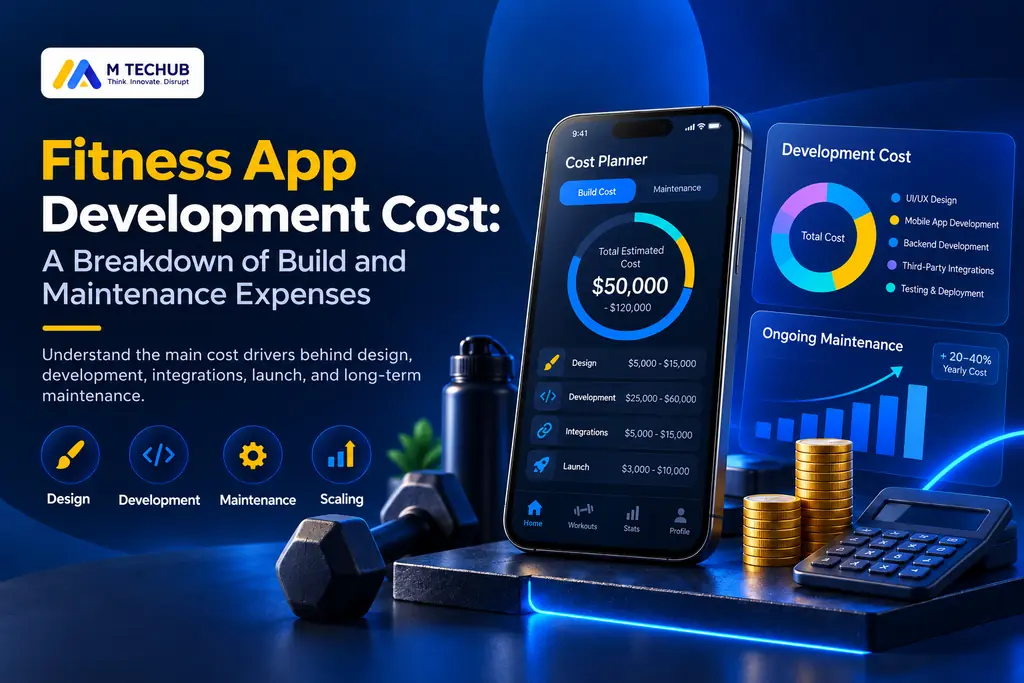
Fitness app development cost depends on the features, delivery team, platforms, and integrations involved. Published estimates provide a starting point: ScienceSoft places basic custom fitness apps at $50,000–$100,000, while Clutch lists £30,000–£80,000 for feature-light mobile apps and MVPs in the UK. The UK bracket covers mobile apps generally, rather than fitness apps specifically.
These figures help establish an initial funding bracket. Your project estimate should then explain what the team will deliver, how much work it requires, and which expenses continue after launch.
A workout library with manual logging needs a different budget from a platform offering wearable synchronization, individual coaching, and AI-generated plans. The business also needs funding for maintenance, infrastructure, content, and customer support.
How Much Does It Cost to Build a Fitness App?
The clearest way to compare development costs is by product scope.
| Product scope | Published estimate | Features described by the source |
|---|---|---|
| Basic fitness application | $50,000–$100,000 | Manual activity tracking, GPS, calorie calculations, training resources, and reminders |
| Standard fitness application | $200,000–$300,000 | Personalized workout and nutrition plans, goals, progress tracking, and gamification |
| Advanced fitness platform | Up to $600,000 | Capabilities such as live coaching, streaming, AI coaching, and immersive features |
These are ScienceSoft’s published estimates, not an industry-wide average or M TECHUB fitness app development quotation.
The gap between categories reflects different products. Adding coaching, real-time communication, or advanced personalization introduces new workflows, administration tools, data handling, and testing.
When reviewing a quote, check whether it includes:
- Discovery and requirements.
- UX and interface design.
- Mobile applications and backend development.
- Content administration.
- Integrations and subscription access.
- Testing, release preparation, and handover.
Two proposals with similar totals can cover substantially different responsibilities.
Fitness App Development Cost in the USA vs. the UK
Local hourly rates affect the budget, but the team’s location and seniority matter more than the customer’s billing address.
Published US and UK Hourly Rates
Clutch’s country guidance provides the following reference points:
| Market or experience level | Published hourly range | Basis |
|---|---|---|
| USA: mid-level developers | $70–$120 | Clutch’s US app development guidance |
| USA: senior developers | $120–$200 | Clutch’s US app development guidance |
| UK: mobile app development | £60–£120 | Clutch’s UK app development guidance |
The US figures distinguish developer seniority; the UK range combines factors such as seniority, region, and technology. They therefore provide purchasing context rather than a perfectly matched national comparison.
Ask each supplier whether its rate applies to an individual developer or a team that includes design, testing, and delivery management. Also confirm where the people performing the work are based.
What Those Rates Mean for a Project
For 1,000 billable hours, applying the published rate bands produces:
| Rate basis | Calculated development amount |
|---|---|
| US mid-level developer range | $70,000–$120,000 |
| US senior developer range | $120,000–$200,000 |
| UK mobile development range | £60,000–£120,000 |
These are arithmetic scenarios, not complete project quotations. A real team may use several role-specific rates, and the required hours must come from the agreed scope.
Compare proposals using the same feature brief, acceptance criteria, and delivery responsibilities. A lower hourly rate does not guarantee a lower total if the estimated effort is higher.
Fitness MVP Development Cost for Startups
A fitness MVP development should support one complete user journey.
For a guided-workout product, that might mean a user can select a goal, find a suitable session, complete it, record the result, and review progress. If premium content is central to the business, purchasing and restoring access also belong in the first release.
A focused scope could include:
- Account creation and onboarding.
- A supplied workout library.
- Workout completion logging.
- Basic progress history.
- One subscription offering.
- Reminders and product analytics.
- A small administration interface.
Wearable connections, community feeds, live classes, and advanced AI can follow unless they are essential to the initial proposition.
Illustrative MVP Workstream Breakdown
The following example allocates 1,000 team hours. It uses selected blended rates of $100 per hour and £80 per hour to demonstrate the calculation.
| Workstream | Deliverable | Hours | USD example | GBP example |
|---|---|---|---|---|
| Discovery and specification | Workflows and acceptance criteria | 80 | $8,000 | £6,400 |
| UX and interface design | User journeys and screen designs | 120 | $12,000 | £9,600 |
| Mobile app development | Accounts, workouts, logging, and progress | 300 | $30,000 | £24,000 |
| Backend and administration | Application data and content management | 180 | $18,000 | £14,400 |
| Third-party integrations | Subscriptions, reminders, and analytics | 100 | $10,000 | £8,000 |
| Testing and release preparation | Device testing, fixes, and submission preparation | 140 | $14,000 | £11,200 |
| Coordination and handover | Delivery management and documentation | 80 | $8,000 | £6,400 |
| Total | Defined working MVP | 1,000 | $100,000 | £80,000 |
The allocation and blended rates are illustrative. Content production, wearable integrations, custom machine learning, legal services, and marketing are excluded.
Total team hours also do not establish the calendar schedule. Staffing, dependencies, feedback cycles, and release preparation affect delivery time.
Which Features Increase Fitness App Development Expenses?
Feature labels often hide the work that determines cost.
Workout Content and Coaching
A supplied video library needs browsing, playback, administration, and access controls.
Producing that content introduces separate expenses for instruction, filming, editing, licensing, and updates. Individual coaching adds trainer permissions, client assignments, history, scheduling, and potentially messaging.
Decide who supplies the content and how staff will manage it before requesting a fixed quote.
Wearable Integration
Wearable integration requires permission handling, synchronization, source selection, and testing.
Health Connect, for example, defines permissions for individual data types and additional permissions for background or historical access. Google also requires relevant data-use declarations for publication.
The development scope should explain what happens when permissions are revoked, records arrive late, or two sources report the same activity.
Price the required data flows rather than requesting broad “wearable support.”
AI Fitness Features
A rules-based workout selector and a generative coaching assistant need different budgets.
A selector can match approved workouts to stated preferences. A generative assistant also needs evaluation, monitoring, usage limits, safeguards, and fallback behavior.
For the cost of building an AI fitness app MVP, separate initial implementation from ongoing model usage and review. Define what the system may recommend and how unsuitable outputs will be handled.
iOS and Android Development
A shared codebase can consolidate development work. Platform-specific purchases, permissions, integrations, and device testing still need coverage.
Ask suppliers to identify shared and platform-specific tasks. Choose the framework around the product requirements rather than an assumed savings percentage.
UK VAT and US Privacy Requirements
Regional obligations can change both development scope and cash flow.
UK VAT and Health Data
The UK standard VAT rate is 20%. Where standard-rate VAT applies, an £80,000 net development invoice becomes £96,000 including VAT.
Confirm whether quotes include VAT, how the supplier’s location affects treatment, and whether your business can recover it. Do not automatically add 20% to every overseas invoice.
For special category health data, the ICO explains that organizations need an Article 6 lawful basis and a separate Article 9 condition. Identify the resulting data controls and assessment work during discovery.
California Privacy Requirements
California’s CCPA, as amended by the CPRA, applies to businesses meeting its coverage criteria. It provides rights including access, deletion, correction, and opting out of sale or sharing. Health information and precise geolocation can constitute sensitive personal information.
For a covered fitness business, the budget may need to include request handling, identity verification, vendor coordination, and applicable privacy controls.
Review analytics and advertising SDKs alongside the app’s own database. Data sharing can occur through third-party tools as well as application features.
Washington and HIPAA
Washington’s My Health My Data Act can affect businesses providing products or services in Washington and handling consumer health data. Its requirements include health-data disclosures and deletion rights.
HIPAA applicability depends on the app’s role and business relationships. A consumer fitness app does not become HIPAA-covered simply because it processes health-related information.
Assess the applicable jurisdictions before finalizing consent, retention, deletion, and vendor workflows.
App Store and Google Play Fees
Registration charges and transaction fees serve different purposes.
| Charge | Published amount or standard arrangement |
|---|---|
| Apple Developer Program | $99 per membership year; local currency available in some regions |
| Google Play developer registration | $25 one-time fee |
| Apple Small Business Program | 15% commission on eligible paid apps and in-app purchases |
| Apple standard auto-renewable subscriptions | 30% commission during a subscriber’s first paid year, reducing to 15% afterward |
| Google Play automatically renewing subscriptions | Published service fee of 15% |
Eligibility, market, program, and billing arrangements can affect the applicable terms. Confirm them before finalizing subscription margins.
Registration fees belong in the launch budget. Transaction fees belong in the revenue model. Purchase implementation and testing remain development tasks.
Fitness App Maintenance Cost After Launch
Maintenance keeps the existing product operating. It includes defect investigation, compatibility updates, dependency patches, security reviews, and release support.
New features need a separate development allowance.
Using the selected blended rates from the MVP example:
| Monthly support capacity | At $100/hour | At £80/hour |
|---|---|---|
| 10 hours | $1,000 | £800 |
| 20 hours | $2,000 | £1,600 |
| 40 hours | $4,000 | £3,200 |
These are capacity calculations, not maintenance market averages. Confirm response times, coverage hours, unused-hour rules, and additional charges before signing a support agreement.
Hosting and Third-Party Services
Infrastructure bills are separate from engineering support.
Budget for hosting, databases, storage, video delivery, monitoring, email, and paid APIs. Estimate costs using activity such as streamed minutes, uploaded files, or AI requests.
Ask for expected-usage and higher-usage scenarios, with spending alerts and review points.
Fitness App Build and Maintenance Cost Breakdown
The example below combines development with 12 months of operation.
| Expense | USD scenario | GBP scenario |
|---|---|---|
| MVP development | $100,000 | £80,000 |
| Selected contingency: 15% | $15,000 | £12,000 |
| Engineering support: 20 hours monthly | $24,000 | £19,200 |
| Assumed infrastructure and tools allowance | $3,000 | £2,400 |
| Build plus 12 months of operation | $142,000 | £113,600 |
The contingency and infrastructure figures are planning assumptions. Validate them against project risks and usage forecasts.
Add applicable taxes, store charges, transaction fees, content, legal advice, customer support, marketing, and planned feature expansion separately.
How to Reduce Development Costs Without Sacrificing Quality
Reduce product breadth while keeping the core journey complete.
Start with one audience and one primary outcome. Supply approved content early, settle major workflows before implementation, and investigate uncertain integrations through focused prototypes.
Existing services can reduce custom work, but compare recurring charges, customization limits, data export, and ownership.
Keep testing, privacy controls, and handover inside the agreed scope. Otherwise, the business inherits essential work that the headline quote does not cover.
References