01
Staff re-enter data from invoices and forms
Extract required fields, validate them against business rules, and send incomplete or conflicting records to a reviewer.

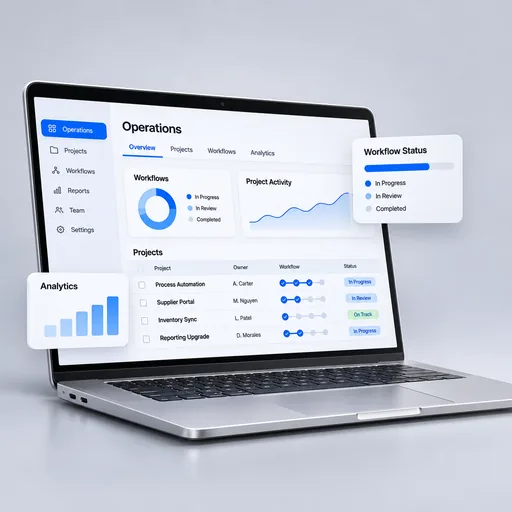
M TECHUB LLC builds custom AI solutions for business workflows that depend on your data, rules, and existing systems. We automate tasks such as extracting document data, routing support requests, and preparing CRM updates for approval. Each workflow defines what the AI can read, what it can do, and when it must hand work back to your team.






Start with a task that follows a repeatable process. Identify the information it receives, the rules it must follow, and the person who handles exceptions.
Tell us which task takes too much manual effort, which systems it touches, and where exceptions go today. We will discuss what a focused pilot could automate and how your team can measure the result.
Pick the capabilities your product needs — we wire them in when the business case is clear.
Extract structured fields from forms, summarize records for review, or answer employee questions using approved documents. When answers need to reference internal material, the workflow can retrieve relevant sources and show them to the user. We define how it handles questions when the available sources are incomplete.
Connect an AI agent to the tools it needs for a defined task. For example, an agent can read an incoming request, check it against a system record, and prepare an update for approval. Permissions, output checks, and escalation rules govern each step. See our AI Agents and Automation services for deeper agent delivery.
Build a chatbot around your support policies and help desk. It can answer routine questions, collect the details needed to open a ticket, and pass the conversation to your team when the issue needs human attention.
Add review, classification, or drafting capabilities to the software your team already uses. For example, an analyst can review a generated summary and its source material inside an existing dashboard before approving the next step. Related work also sits under our AI Integration services.
Define which sources the workflow can read, which fields can reach a model, and how access is authorized, validated, and logged.
Decide which outputs need validation and what happens when required information is missing before anything reaches a business system.
Choose which actions can run automatically and who approves changes to business records such as CRM updates.
Estimate how often the workflow will run and what model calls, hosting, and human review will cost as usage grows.
See how thoughtful design, modern engineering, and applied AI solve real business challenges.
Languages, platforms, and cloud tools we use to design, evaluate, and ship AI products.
 Python
 TypeScript
 JavaScript
 Node.js
 React
 Next.js
 Docker
 Kubernetes
 AWS
 Azure
 Google Cloud
 Firebase
 MongoDB
 PostgreSQL
 GraphQL
 RESTful APIs
 CI/CD
 GitHub Actions
We work from your actual inputs, decision rules, and exception paths. Your team can review the proposed workflow and integration scope before development starts.
We define what the pilot must demonstrate and how we will measure it. Depending on the workflow, that may include extraction accuracy, routing errors, or the time staff spend correcting outputs.
We agree who approves proposed actions, handles failed integrations, monitors the workflow, and maintains its rules after launch.
Limit permissions for users, service accounts, and AI tools to the records and actions they need.
Review what enters model requests and logs, and define retention and deletion requirements.
Validate proposed actions before execution and route high-impact changes to an authorized reviewer. Record relevant workflow events and test access boundaries and failure scenarios before release.
We match LLM capabilities and cloud infrastructure to the use case; our stack reduces risk, supports growth, and builds lasting systems.
 ChatGPT
 Llama
 Gemini
 ClaudeDALL·E
 github
 ruby on railsnode.jsreact
 next.js
 ios
 redis
 android
 figma
 sentryaws
 linearkubernetes
 aws s3
 notion
 digitalocean
 wordpressdocker
Custom AI development services design, build, and integrate AI for a defined business task. The work can include connecting approved data sources, applying business rules, validating outputs, and setting up human review before actions are taken.
Yes, where your systems provide suitable APIs, connectors, or permitted data access. During discovery, we identify what the workflow needs to read or update and how those interactions will be authorized, validated, and logged.
Cost depends on the number and condition of the integrations, data preparation, exception handling, approval requirements, and expected usage. A scoped estimate can separate pilot development from recurring costs such as model calls, hosting, and maintenance.
Share the steps your team follows today, representative inputs, the systems involved, and examples of exceptions. Identify who reviews uncertain results and which measure will show whether the pilot is worth expanding.
Yes. The workflow can prepare a proposed action, such as a CRM update, for an authorized reviewer. Validation and access rules control what the workflow can do before and after approval.
That depends on the selected model, licensing, and infrastructure. During discovery, we evaluate compute needs, maintenance responsibilities, and what data would leave your environment if the workflow uses an external model API.

Share the use case, the systems involved, and any constraints. Our team will review it and suggest a next step.