
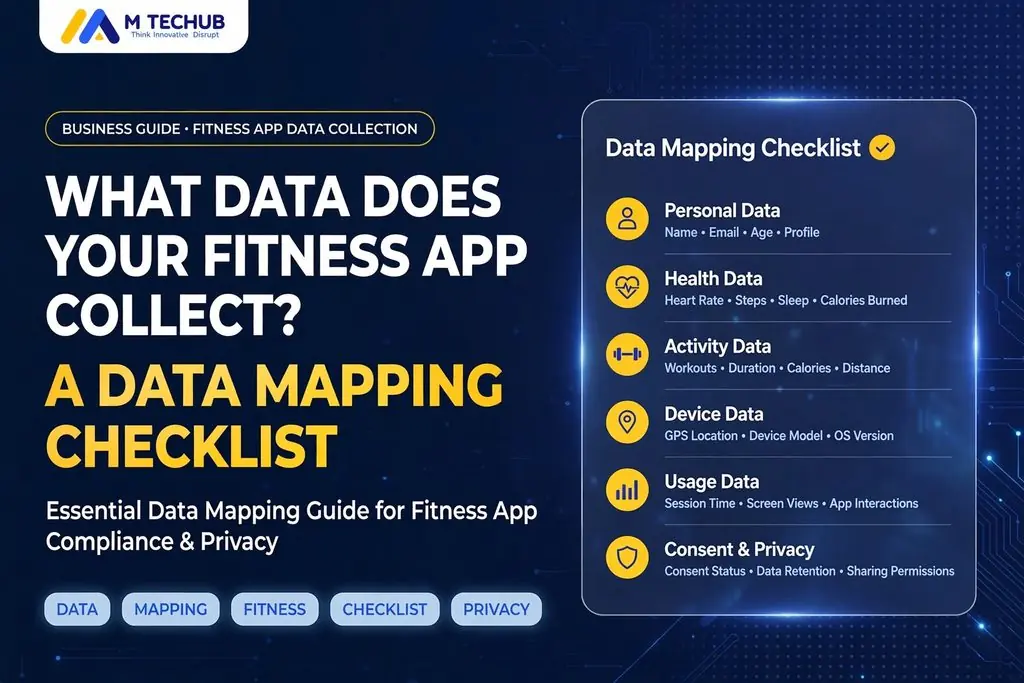
A fitness app can collect much more than steps and completed workouts. Depending on its features and integrations, it may handle account details, body measurements, heart rate, GPS routes, payment references, coaching messages, and technical information generated by analytics tools.
Some information comes directly from users. Other data arrives through connected devices, health platforms, background processes, or third-party software. Your team may also create new information by calculating scores or making recommendations from existing records.
This fitness app data collection checklist helps you identify those records and follow them through the product: where they originate, why they are needed, where they are stored, who receives them, and how they are deleted.
The goal is a map that reflects actual app behavior. A privacy policy, permission screen, or database diagram provides part of the picture. A useful audit connects those documents with observed data flows.
Key Takeaways
- Map user entries, device measurements, SDK data, and calculated outputs separately.
- Follow each flow through device storage, backend systems, vendors, logs, and backups.
- Treat platform permissions, legal grounds, and store disclosures as separate checks.
- Assign owners and verify retention, export, and deletion behavior.
What Data Do Fitness Apps Collect From Users?
There is no single list that applies to every fitness product. A basic workout logger has different data needs from a running app, nutrition service, or remote coaching platform.
Use the categories below as audit prompts, rather than a recommendation to collect everything.
| Data category | Examples to look for | Audit question |
| Account and profile | Name, email, account ID, age range, profile photo | Which fields are required, and why? |
| Workout activity | Exercise names, sets, repetitions, weights, duration, distance, steps | Are individual events stored, or only summaries? |
| Health and body information | Heart rate, weight, height, sleep records, injury notes | What does the information reveal about the user’s health? |
| Nutrition and hydration | Meal logs, calorie estimates, dietary preferences, water intake | Do free-text notes reveal additional sensitive details? |
| Location | GPS routes, timestamps, start and end points | Is precise location necessary for the feature? |
| Device and technical information | IP address, operating system, app version, device identifiers, crash reports | Which fields reach monitoring or analytics vendors? |
| Transactions | Subscription status, purchase receipts, billing references | Does the app receive payment details or only provider references? |
| Coaching and social content | Messages, progress photos, comments, shared workouts | Who can view the content by default? |
| Derived information | Training trends, readiness estimates, recommendation profiles | Are calculated outputs recorded and shared separately? |
Health Platform Data Sources: Health Connect and Apple HealthKit
Connected health platforms expose distinct record types. Android Health Connect provides separate read and write permissions for health and fitness data types. Your audit should identify the specific records your app accesses, rather than describing the integration only as “health data.”
For every Health Connect integration, document:
- The record types requested.
- Whether access involves reading, writing, or both.
- The feature that needs each record type.
- Whether information stays on the device or reaches your backend.
- What happens when access is denied or revoked.
On iOS, Apple HealthKit requires authorization for specific data types your app reads or writes. Record each requested type, its direction, the feature it supports, and whether your app copies the information to another system.
HealthKit authorization does not describe what happens to a backend copy. Your map must follow information beyond the platform integration.
Apple also limits what an app can learn about denied HealthKit read access. An empty query result should not be treated as proof that the user has no records. Test unavailable data and permission changes without making unsupported assumptions about the user’s health history.
Distinguish measured values from user entries and algorithmic estimates. A user-entered weight, a wearable measurement, and an estimated calorie value have different origins and limitations, even when they appear together on a dashboard.
What Is Fitness App Data Mapping?
Fitness app data mapping documents how information moves through your product and its supporting systems.
For each processing activity, connect the data source to its purpose, storage locations, recipients, access controls, retention rules, and deletion process. Include original records and outputs created from them.
Consider a running feature. GPS coordinates may enter through the phone’s location service, remain briefly in an offline queue, reach a backend, and appear in a saved route. A separate analytics event may record that a run was completed. A support export may create another copy.
Those are different flows, even though they relate to one workout. Mapping only the main database leaves the other copies unexplained.
The Information Commissioner’s Office (ICO) describes processing records that cover purposes, data categories, recipients, transfers, retention where possible, and security measures where possible. An engineering data map can help inform these records, but it does not automatically satisfy every legal documentation requirement.
Fitness App Data Collection Checklist: What to Record
Create one inventory entry per meaningful data flow. Split entries when the same field serves different purposes or reaches different recipients.
| Inventory field | What to document |
| Feature and owner | The feature using the data and the person responsible for it |
| Data fields | Actual fields, units, timestamps, and identifiers |
| Source | User entry, phone sensor, wearable, health platform, vendor, or calculation |
| Purpose | The specific function supported by collection or use |
| Collection trigger | Signup, workout start, background sync, purchase, or another event |
| Necessity | Required, optional, replaceable with less detailed data, or unnecessary |
| Sensitivity | Personal data, possible health data, precise location, credentials, or other sensitive content |
| Permissions and legal basis | Platform permissions and, separately, applicable legal grounds or consent requirements |
| Storage | Device files, backend databases, queues, logs, exports, backups, and vendor systems |
| Recipients and access | Internal roles, external vendors, coaches, other users, and public visibility |
| Geography | Storage and processing locations, remote access, and relevant transfer arrangements |
| Retention | Duration or decision criteria, deletion trigger, and applicable exceptions |
| Deletion and export | How records are located, removed, or included in a user export |
| Evidence | Schema references, inspected payloads, vendor documentation, and test results |
| Review status | Last review date, unresolved gaps, owner, and next action |
Avoid entries such as “stored securely” or “kept as needed.” They do not tell an engineer which system to check or which deletion rule to implement.
A useful entry should allow another team member to locate the information, explain its purpose, and verify its handling.
How to Perform Data Mapping for a Fitness App
Step 1: Define the Audit Scope
Identify the app versions, environments, platforms, and user journeys under review. Include the mobile app, backend, website onboarding, admin portal, coaching dashboard, and connected services where relevant.
Bring together product, engineering, security, support, and privacy owners. Engineers can identify payloads and storage, while product owners explain why a field exists. Support teams may know about exports or screenshots that do not appear in architecture documents.
Use controlled test accounts and fictional records during inspection. Record which build and configuration produced each observed flow.
Step 2: Inventory Collection Points
Walk through signup, profile editing, workout logging, wearable connections, purchases, messaging, and account deletion.
Check automatic collection as well as visible forms. Review software development kit (SDK) configuration, background jobs, push token registration, crash reporting, and attribution tools.
For each feature, establish whether collection occurs before the user enables it. An optional integration should have a clearly understood activation path, including what happens when access is denied or later revoked.
Record free-text fields separately. An injury note or coaching message can contain information that the app’s predefined categories do not anticipate.
Step 3: Trace Data Through Every System
Follow representative fields from the device to the backend and onward to external services. Review authorized network captures, application programming interface (API) payloads, database schemas, event definitions, and vendor settings together.
Include temporary locations:
- Offline queues and caches.
- Retry jobs and message queues.
- Application and diagnostic logs.
- Support attachments.
- Exported reports.
- Vendor systems and backups.
Treat “we do not collect that” as something to verify. A profile form may omit location while an analytics payload contains location-related information. An app may also exclude message text from its main database but include it in diagnostic logs.
Step 4: Map Identifiers and Derived Data
List the identifiers that connect records: account IDs, device IDs, installation IDs, purchase references, and vendor-specific user IDs.
Replacing an email address with a stable account ID does not by itself establish that a dataset is anonymous. Assess whether the organization or another recipient can reconnect records to an individual.
Track calculated outputs too. If an app derives a readiness estimate from sleep and activity records, document the inputs, output, purpose, recipients, and retention of the resulting estimate.
A derived score can remain associated with a user after its source records are removed. Include that possibility in deletion testing, and avoid presenting inferred scores as established medical facts.
Step 5: Review Vendors and Downstream Sharing
For every SDK and service, identify what it receives, why it receives it, and what contractual or configuration controls apply.
Do not assume a vendor receives only the fields visible in your own dashboard. Inspect event payloads and settings for automatic metadata, custom properties, user identifiers, session recordings, and diagnostic attachments.
Record whether the vendor processes data solely on your instructions or uses it for additional purposes. Verify subprocessors, processing locations, deletion support, and relevant contracts.
For iOS fitness integrations, assess whether a vendor’s behavior meets Apple’s definition of tracking. When required, obtain permission through App Tracking Transparency (ATT) before tracking or accessing the advertising identifier.
ATT permission does not replace other applicable consent requirements. Not every analytics activity is tracking under Apple’s definition.
Step 6: Set Retention and Test Deletion
Define retention by purpose. Workout history, troubleshooting logs, subscription records, and abandoned account information need separate decisions.
Do not invent one universal retention period. Document the reason for each duration or criterion, together with legal obligations and exceptions where applicable.
Test what account deletion actually triggers. Does it remove routes, messages, images, vendor profiles, search indexes, and cached records? Does it stop future synchronization?
For backups, document expiry and restore handling. Explain how the team prevents previously deleted records from returning to active use after restoration.
Distinguish removal from active systems from later expiry of restricted backup copies. Your user-facing explanation should reflect the process the team can actually deliver.
Step 7: Reconcile the Map With User-Facing Disclosures
Compare observed behavior with onboarding explanations, permission prompts, privacy notices, and app store disclosures.
Check Apple App Store privacy labels and Google Play’s Data safety section against your inventory, including relevant third-party SDK behavior.
Apple asks about data collection, purposes, links to users, and tracking. Google Play asks about collection, sharing, purposes, and other handling practices. Apply each platform’s definitions and exceptions rather than copying identical answers between stores.
For example, Google distinguishes information processed solely on the device from information transmitted off the device. Keep on-device processing in your internal map even where a store does not classify it as disclosed collection.
If a screen says location supports route tracking, check whether another recipient receives it. If analytics uses workout attributes, the inventory should describe that separate use.
Turn unresolved gaps into assigned actions. Each action needs an owner, a concrete fix, and evidence that the fix worked.
A Worked Example: Mapping a Running Feature
The following is a hypothetical design example, not a claim about a specific app.
| Flow | Proposed design | Evidence to verify |
| Route collection | Capture coordinates during an active tracked run | Observe start, pause, stop, and background behavior |
| Local storage | Queue unsynced route points on the device | Inspect queue expiry and logout behavior |
| Backend storage | Associate saved routes with the user’s account | Confirm storage locations and access controls |
| Analytics | Send a completion event without precise route points | Inspect the actual event payload and automatic metadata |
| Sharing | Let the user choose whether to share a route | Test defaults, public links, and visibility changes |
| Account deletion | Remove active route records and address related copies | Test backend, vendor, cache, and backup workflows |
A route can reveal where someone starts or ends a regular run. Consider whether the feature needs exact points, whether route sharing should obscure sensitive endpoints, and whether users understand the sharing controls.
This example illustrates a practical data minimization question: can the product provide the intended benefit while collecting or exposing less detail?
Health App Data Privacy: Which Compliance Questions Matter?
A data map supports health data compliance by making processing visible. It cannot decide every legal obligation without the app’s markets, business relationships, and actual data uses.
UK and EU GDPR: Identify Health Data and Its Processing Grounds
Where the relevant General Data Protection Regulation (GDPR) regime applies, data concerning health receives special protection.
Classification depends on what information reveals and how it is used. A generic category such as “fitness metrics” is not a complete legal assessment.
The ICO explains that UK GDPR processing of special category data requires both an Article 6 lawful basis and an Article 9 condition, with additional UK requirements in some circumstances.
Document that assessment separately from platform permissions. A user allowing sensor access does not, by itself, resolve the legal grounds for every downstream use.
Consider whether high-risk processing requires a data protection impact assessment under the applicable rules. Evaluate EU and UK requirements separately, including relevant local requirements.
This checklist provides a starting point for the inventory rather than an exhaustive GDPR compliance assessment.
US HIPAA: Assess the App’s Role
Collecting health-related information does not automatically make every fitness app subject to the Health Insurance Portability and Accountability Act (HIPAA).
The organization’s role and relationships matter, including whether it acts as a business associate of a covered entity.
U.S. Department of Health and Human Services (HHS) resources for mobile health app developers provide scenarios and an interactive tool to help assess applicable obligations.
Map who the app serves, on whose behalf it processes information, and what agreements govern those activities.
FTC Rules: Look Beyond HIPAA
An app outside HIPAA may still have US privacy obligations.
The Federal Trade Commission (FTC) Health Breach Notification Rule guidance explains coverage for relevant personal health record vendors, related entities, and service providers.
The FTC also explains that a breach can involve unauthorized disclosure, rather than only a hacking incident. Vendor sharing and analytics flows therefore deserve attention in the assessment.
Document which information reaches each recipient, whether that disclosure is authorized, and how the organization would identify and respond to a breach.
US State Consumer Health Privacy Laws
Washington’s My Health My Data Act can regulate consumer health data outside HIPAA. Assess the law’s scope and exemptions before deciding it applies to your product.
For covered processing, map collection, sharing, consent or applicable requested-service exceptions, and the consumer health data privacy policy. The law also provides consumer rights, including deletion, and imposes separate requirements for selling consumer health data.
In California, assess whether the business and data fall within the California Consumer Privacy Act (CCPA), as amended by the California Privacy Rights Act (CPRA).
Health information and precise geolocation can be sensitive personal information. Relevant obligations may include notices at collection, access and deletion rights, correction, opt-outs from sale or sharing, and limits on certain uses of sensitive information.
Do not assume every fitness app is covered by every state law. Record applicable markets, coverage decisions, exceptions, and the vendor flows needed to honor user rights.
Apps Used by Under-18s
In the United States, the Children’s Online Privacy Protection Act (COPPA) applies to covered services directed to children under 13 and services with actual knowledge that they collect personal information from children under 13.
Where required, verifiable parental consent must precede collection, subject to limited exceptions. Review current rule requirements for third-party disclosure, security, and retention.
The UK Children’s Code concerns relevant online services likely to be accessed by people under 18, including services that are not specifically aimed at children.
Assess your likely audience and document age-appropriate privacy design, including high-privacy defaults and controls for location and profiling where applicable.
Add age-related flows to the inventory:
- Age assurance information.
- Parental consent records.
- Family accounts.
- Coach or guardian access.
- Public sharing settings.
Collect only the age information needed for the chosen approach. COPPA’s under-13 threshold should not be used as a universal definition of a child.
Common Gaps in a Mobile App Data Audit
Several omissions make an inventory look complete while leaving important questions unanswered:
- Ignoring logs: Diagnostic records may contain request bodies, identifiers, or user content.
- Grouping everything as health data: Teams lose the detail needed to assess purpose, permissions, and access.
- Missing derived outputs: Scores and profiles are created after collection and can have their own downstream uses.
- Equating access revocation with deletion: Stopping new access does not establish that existing copies were removed.
- Excluding staff tools: Admin screens, support exports, and coaching dashboards create additional access paths.
- Treating a vendor contract as runtime evidence: Agreements explain permitted behavior. Payload inspection helps establish actual behavior.
Prioritize gaps involving sensitive information, unexplained recipients, excessive permissions, and deletion paths that do not work as described.
Copyable User Data Collection Checklist
- List audited builds, platforms, environments, and user journeys.
- Identify visible forms and automatic collection points.
- Record Health Connect, HealthKit, and wearable data types separately.
- Assign a purpose and owner to each meaningful data flow.
- Separate raw records, user entries, estimates, and derived profiles.
- Review whether less data could support the same feature.
- Document device, backend, log, export, backup, and vendor copies.
- Inspect identifiers and third-party payloads.
- Verify internal roles and external recipients.
- Record relevant permissions and separate legal assessments.
- Assess ATT requirements where relevant.
- Document state-law and age-related applicability decisions.
- Define retention criteria and deletion exceptions.
- Test denial, revocation, logout, export, and deletion behavior.
- Reconcile the map with privacy notices and store disclosures.
- Assign unresolved gaps and attach verification evidence.
- Review affected flows whenever features or integrations change.
Use the accompanying CSV inventory template to record one meaningful data flow per row. Import it into Excel or Google Sheets, duplicate blank rows as needed, and attach evidence for each completed entry.